



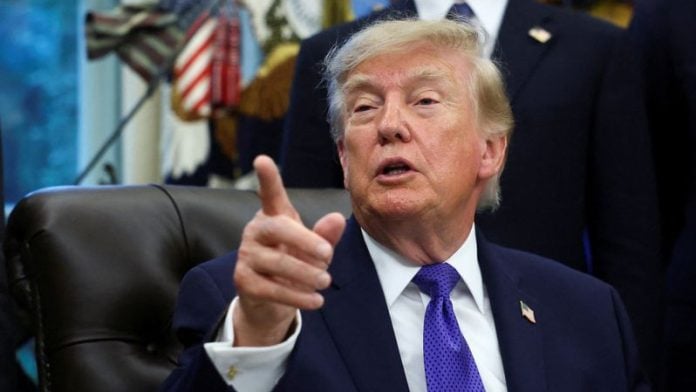
New Delhi: United States President Donald Trump met some of the world’s leading technology executives at the White House on 29 September for a high-profile meeting and luncheon. The summit discussed advances in AI, which he has rebranded as “super intelligence”, or SI.
The gathering, attended by about 40 leaders from companies including Amazon, Microsoft, AMD, and Palantir, along with House Speaker Mike Johnson and senior administration officials, produced a voluntary “White House Accord on Super Intelligence: Joint Commitment on Frontier Responsibilities.”
Trump called the document “almost like a constitution in a way” and “a form of protection”, which is “morally binding.”
He added that the US would lead the technology’s development through industry self-regulation rather than heavy government guardrails.
“We have people that love our country and love the world,” Trump told reporters, joined by industry leaders including Jensen Huang (Nvidia CEO), Elon Musk (xAI and SpaceX CEO), Mark Zuckerberg (Meta CEO), Sundar Pichai (Google CEO), Dario Amodei (Anthropic CEO), and President Greg Brockman (OpenAI).
“We had a great meeting today,” he said. “The biggest people in the world signed that (the accord), and I signed it as President, and it really is a form of protection.”
The accord commits to four layers of controls and audits including robust internal monitoring of model capabilities and alignment (including cybersecurity, biosecurity, and chemical threats), internal teams to ensure those controls function and problems are fixed, independent external auditors or evaluators, and independent board committees to review auditor reports and ensure issues are remediated.
Zuckerberg summarised it as giving the public and customers confidence that the technology “works in the way that we intend.”
“Every company is building something that’s a little bit different,” Zuckerberg said.
He added that while all the companies have different plans going ahead, they have arrived on a common ground with the accord.
“The idea isn’t that this is the only thing that we will ever do; it is that this is a start and an accord that the whole industry could come to,” the Meta CEO said.
Calling it a “historic discussion,” he added that “it is a meaningful step forward.”
Nvidia’s Huang pushed back against any perceived trade-off between progress and safety.
“There’s no conflict between innovation, technology, and safety,” Huang said. “We are going to have to create new technologies to advance the capabilities of AI, but we’re also creating new technologies that advance the safety of AI.”
Huang established that the leaders will collaborate on the advancements.
“We’re going to advance this technology that is so consequential to humanity, that is so consequential to the future prosperity of our nation, and we’re going to do it responsibly and safely,” he said. “If we do this right, and work with the President and everyone here, we can win.”
Also read: From Bible study to prayer, Americans are asking AI questions about faith and spirituality
A terminological shift
Musk, too, weighed in, highlighting the “positive benefits of AI”, before correcting himself: “SI, pardon me. Superintelligence.”
“I think my far most likely outcome is an age of abundance, where we don’t have just a universal basic income, we have universal high income,” he said.
He added that robots and AI could deliver better medical care “than anyone here, including me. And wouldn’t that be wonderful?”
On concerns about jobs, particularly “laptop jobs”, Musk said that jobs have undergone change historically.
“Jobs are going to change. Jobs have always changed,” he said. He added that calculations were done manually by people seated in buildings before calculators came along.
“I think we’ll see an evolution of roles, the most likely outcome,” he said. “Which is incredibly beneficial, and it’s a future that you would want.”
Trump then introduced Google’s Pichai, calling him “a monster”, playfully.
“This guy is a monster, and nobody knows. What a great life, to be a monster and not have to go through this,” he joked.
Pichai laughed in response, saying, “Hopefully a better tagline than ‘I’m a monster’.”
Trump used the occasion to formalise a terminological shift.
“We’ve changed the name officially today. We’ve changed the name officially to SI (superintelligence), instead of AI,” he said. “I guess that’s really quite an announcement because the name has been officially changed by the biggest, the smartest, the greatest people anywhere in the world.”
Later, Trump signed an executive order directing federal agencies to use “Super Intelligence” and “SI” in official correspondence, websites, reports, and other non-statutory communications.
(Edited by Aamaan Alam Khan)