



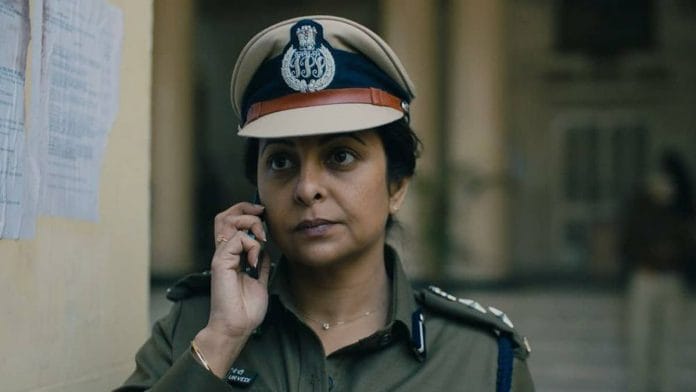
New Delhi: Actor Shefali Shah was once convinced that the Hindi film industry had finished with her. The roles had narrowed, the offers had begun to look alike, and she could see herself being reduced to the kind of supporting character whose presence mattered less than the star she was playing mother to. Today, after Delhi Crime, which earned her an Emmy nomination, and a career that has repeatedly defied easy categorisation, she has a memoir out, without claiming to have made sense of it all.
For Shah, “it is too early to write a memoir after all, there is so much left to do.”
“Writing was something I wanted to do for a long time. I started posting pieces of my life on Instagram, where people responded to honesty and relatability. So when publishers approached me with the idea of a book, I agreed almost immediately. The publishers, however, wanted me to write a memoir,” Shah told ThePrint.
The actress was willing to give it a shot, but with one condition: it would not be a conventional, chronological account of her life. It would be sporadic, messy, and, in her words, “unpolished.” Shah wanted the book, The Audacity of Being: A Sort of Memoir, to sound like a person speaking about her life, rather than an actor carefully curating a public image.
For her, the common thread between her writing and acting is honesty.
“I think there is honesty in it. It’s as raw and authentic as it can get. There is no pretence. There is no make-believe,” she said. According to the actor, honesty makes people more receptive, whether they encounter it in a piece of art or in another person.
An accidental actor
It is also why Shah has never been particularly interested in the trappings of stardom. She describes herself as an “accidental actor.” There was no grand plan, no carefully mapped-out ambition to enter the film industry. She began with Gujarati theatre before moving to television, making her debut in the 90s and gaining widespread household recognition with hit shows like Hasratein and Banegi Apni Baat.
She made a brief appearance in mainstream cinema with a small role in Ram Gopal Varma’s Rangeela (1995). But, later she realised her role wasn’t what she was expecting and walked out of the film.
Her early filmography includes two very different but significant films: Ram Gopal Varma’s 1998 film Satya and Mira Nair’s Monsoon Wedding (2001). The former came after she walked out of Rangeela, a decision that could have easily complicated their professional relationship. Instead, when Varma approached her for Satya, Shah understood that he was willing to move past her earlier decision.
“There was no bad blood between us. If he had been angry, he would have never offered me Satya,” she said.
She apologised for the way she had left Rangeela, and they went on to work together.
For Shah, both Nair and Varma offered similar freedom on the sets.
“Both the sets were similar in terms of the freedom their directors — Nair and Varma — gave the actors. Actors could explore their characters rather than simply follow instructions,” she said.
“With Nair, the approach was particularly collaborative. After all, in Satya I had a 7-minute role. Actors were encouraged to find their own way into a scene, Nair would step in when she had a specific vision for how a moment should unfold.”
Shah’s experience on Nair’s set was also different from working with Rituparno Ghosh on the 2007 film The Last Lear.
“Monsoon Wedding was boisterous, energetic and filled with the exuberance of a large group of people coming together, Ghosh’s set was quieter and more fluid. It was so calm that it felt almost as if everyone were whispering,” the actor recalled.
There is no single dream role that would make Shah feel she has accomplished everything. Nor does she say that an actor necessarily reaches a point beyond which there is nothing left to do.
“I’m an extremely greedy actor,” she said, describing her appetite for roles. She is drawn to the strength of a character, but also to its fragility and detail. She wants to explore various parts, including characters that nobody has played before.
In her career, though, there have been just two regrets. Shah was offered Mira Nair’s The Namesake but could not take it because of another professional commitment. She also had to turn down Meghna Gulzar’s Talvar because she was scheduled to be out of the country for Dil Dhadakne Do (2015). Both are films she wishes she could have been part of.
‘Industry hanged me and my boots’
There was a time for Shah when her hunger to play diverse roles had nowhere to go.
She has been candid about accepting roles that did not necessarily serve her career. Playing Akshay Kumar’s mother in Waqt: The Race Against Time (2005) is one decision she describes as “professional suicide.” Looking back, she says she would not make the same choice again. Because, soon after the film, Shah was bombarded with similar mother roles.
Shah, in her memoir, reveals that her husband and director Vipul Amrutlal Shah advised her against playing the mother to Akshay Kumar in Waqt. And, he was considering casting Jaya Bachchan or Hema Malini opposite Amitabh Bachchan.
However, it was Big B who suggested Vipul to cast Shefali Shah for the role and this time he couldn’t say no.
Shefali was barely into her 30s when she played Akshay’s mother. And, Vipul’s fear came true. She was soon flooded with all mother roles.
“I felt like I was going to be the next Nirupa Roy,” she writes in her memoir.
In an earlier interview, Shah had revealed that Dil Dhadkane Do had gotten her out of retirement. The actor has now clarified that she had not decided to retire. She said the industry was no longer offering her the kind of work she wanted.
“I thought the industry had hanged me and the boots together,” she said.
For women in Hindi cinema, this was hardly an unfamiliar predicament. Shah recalled a time when the possibilities available to female actors narrowed with age. A woman might be cast as someone’s mother or friend, with her presence serving as nothing but an accessory to the main story. Whether she or any other actor occupied the role often seemed immaterial.
Then came Dil Dhadakne Do, followed by Delhi Crime in 2019, which turned out to be a “game changer” for her career.
“Had someone told her a few years earlier that a woman in her 40s would headline a series, and that the woman would be me, I would have laughed. I never expected to be considered for a role like that,” she said.
The expansion of streaming platforms, she acknowledged, helped change that. “I happened to be in the right place at the right time.”
On ‘Three of Us’
For all the strength associated with Shah’s performances, one of her most interesting roles is built around vulnerability. In Three of Us, she plays Shailaja, a woman confronting the fading of her memories. The character is fragile, uncertain, and, in many ways, lost.
Shah did not prepare for the role by watching similar films or looking for an existing performance to use as a reference. She rarely does that unless a director specifically asks her to. She prefers to find the character on its own terms.
“Three of Us was exciting for me because it offered something different from the strong, decisive women I was often asked to play,” Shah said.
Shailaja did not need to have all the answers. Her vulnerability was not a flaw that needed correcting; it was the very thing that made the character compelling.
“The beauty of her was that she was lost,” she added.
Shah’s desire to keep moving between such contrasting parts is also why she resists the idea of a definitive dream role. She wants variety, surprise, and the opportunity to do things she has not done before.
Audacity of being herself
The title of Shah’s memoir, The Audacity of Being, suggests a life shaped by defiance. But she is reluctant to frame her choices as acts of rebellion. She has never set out to go against the world simply for the sake of it. Whether in her personal life or her professional decisions, she said, she has tried to do what feels right or comfortable to her.
“Yes, I have had the audacity to live my life the way I wanted to,” she said.
There is a difference between making a choice to prove a point and making one because it is what you genuinely want. Shah sees herself as having done the latter, even when the decisions have not necessarily been the best ones.
There is, however, one thing she is determined to prove through her work: that she can play a part so well that it cannot be ignored. Beyond that, she is content to live without constantly explaining herself.
“Art is very subjective. So my intention with every role is to give my best so that the audience cannot ignore it so that the audience doesn’t feel that some other actor would have done justice,” she said.
For Shah, growing and transitioning from one phase of life to another is inevitable. The choice is whether to remain stuck in a moment or move on.
Also read: Gondhal actor Anuj Prabhu’s Oscar journey began with college theatre. And discussing Nolan in hostel
No lessons, just a life
For all the personal revelations in her memoir, Shah is not interested in presenting herself as a source of wisdom.
“I am still learning how to live my own life. I am in no position to prescribe how anyone else should live theirs. A book, like a film or a painting, is subjective,” Shah said.
Different readers will bring their own experiences to it and take away whatever resonates with them. She does not want to dictate what they should or should not understand from her story.
She wanted it to be unpolished because life itself is rarely neat.
“I have presented whatever I did in complete honesty. And I spoke about it like a normal person. It’s just that I happen to have a camera in front of me but that doesn’t change the person I am,” she said.
For Shefali Shah, her story is not a neatly completed arc, with every setback leading to a triumph and every decision serving a larger purpose. It is a work in progress, messy and uncertain, with room for regret, reinvention, and the occasional kaftan.
“I would rather keep moving than pretend I have figured it all out,” she said.
(Edited by Aamaan Alam Khan)