


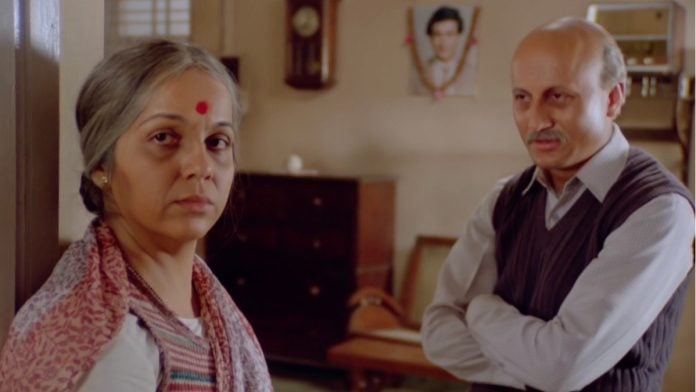
Anupam Kher was just 28 when he played a 65-year-old man mourning the loss of his son in Mahesh Bhatt’s directorial debut, Saaransh. His co-star Rohini Hattangadi, who played his wife in her sixties, was the same age — 28 — when the film released on 25 May 1984.
Kher almost didn’t get to play the role at all. A fortnight before shooting was due to start, Rajshri Productions pushed Bhatt to replace him with an established star, Sanjeev Kumar. Bhatt agreed, and Kher — who had spent nearly six months preparing — packed his bags to leave Mumbai. Before he left, he confronted Bhatt about the decision. Bhatt relented, kept him in the role, and convinced the producers to accept it.
Saaransh was Kher’s first film. In many ways, the role also took him away from becoming the conventional Bollywood hero, dancing around trees in romantic songs alongside actresses in chiffon sarees. That was a path he never took. Instead, his portrayal of B.V. Pradhan, a retired schoolteacher in Mumbai, laid the foundation for an acting career that would span nearly five decades and more than 500 films — and won him his first Filmfare Award, for Best Actor.
The film opens with Pradhan writing a letter to his son, Ajay, who lives in New York. As he continues writing and expressing his love for him, he is pulled back to reality: his son has been killed in a mugging. Three months have passed since the family received the news.
Pradhan’s best friend, Vishwanath, and his wife, Parvati (Hattangadi), are both worried that Pradhan still hasn’t come to terms with the loss. Pradhan confesses to Vishwanath that he no longer has any will left to live.
With their son gone, the family has lost its only source of income, so Pradhan and Parvati rent out Ajay’s room to Sujata Suman (Soni Razdan), a struggling actress. Sujata is secretly involved with Vilas Chitre (Madan Jain), the son of an influential local politician, Gajanan Chitre. Vilas wants to marry her but keeps postponing it, too afraid to tell his father.
Soon after, Pradhan receives word that Ajay’s ashes have arrived from the US, along with his belongings — a TV, a VCR, a refrigerator. At the customs office, he is stonewalled and disrespected by an official uninterested in helping him. Pradhan forces his way into the department head’s office and breaks down, saying he has come only for his son’s ashes and wants nothing else. The officer relents. The scene — one of the film’s most remembered — was shot in Mumbai’s Film City in a single take, with no rehearsal and no glycerine; Kher has said he had no real memory of loss to draw on and built the breakdown entirely out of his own years of struggling as an actor in the city.
Pradhan, an atheist, gives the ashes to Parvati, who takes them to a priest. The priest tells the couple that Ajay will soon be reincarnated as a child born near them. Disillusioned, Pradhan scatters some of the ashes near a bench in a nearby children’s park.
Convinced his life no longer has a reason, Pradhan first tries to kill himself by stepping in front of a speeding car. He then attempts suicide by inhaling gas from the stove. To convey the depth of his despair, the film leans on two songs, Bhupinder Singh’s ‘Andhiyara Gehraya Suna Pan Phir Aaya’ and Amit Kumar’s ‘Har Ghadi Dhal Rahi Sham Hai Zindagi’, both capturing the loneliness that has settled over the couple.
Soon after, he and Parvati together decide to end their lives by consuming poison. Just as Parvati is about to consume it, Sujata enters the scene confronting Vilas who wants her to abort their child. When he hesitates to claim the child, she throws him out. Parvati sees the intervention as the priest’s prediction coming true. Both of them offer to take Sujata to meet Gajanan, hoping he’ll allow the marriage. Gajanan refuses the marriage and threatens Pradhan and Sujata, demanding Sujata abort the pregnancy and leave the city. Pradhan, on principle, refuses to turn Sujata out and gives her shelter instead.
Gajanan doesn’t stop at threats. His men try to bribe Pradhan, cut off his electricity, beat up Vishwanath to stop him supplying the household’s milk, and throw lit firecrackers into the house. Gajanan arranges for a doctor to illegally abort Sujata’s pregnancy during a routine check-up. When none of it works, he has Vilas — without Vilas fully understanding his father’s intentions — frame Pradhan in a fake prostitution racket.
Pradhan tries to reach the police commissioner for help and is blocked by bureaucratic delay at every turn. With no one willing to help him, he storms into the Chief Minister’s office. There, he discovers the Chief Minister, Shashikant, is a former student of his. Shashikant immediately calls the police commissioner and the remand home where Sujata is held, and ensures Gajanan is made to answer for it.
Pradhan realises that Parvati’s conviction that Ajay will be reborn through Sujata’s child will only end in more heartbreak for everyone. He asks Sujata and Vilas to leave the city quietly, at night, and gifts them Ajay’s belongings, finally released by customs. Sujata asks to see Parvati one last time; when Parvati refuses to let them go, Pradhan holds her back and lets the couple leave. Parvati is shattered, but Pradhan helps her accept that Ajay is gone and will not return. When she suggests they go through with the poison after all, he refuses: he tells her that the gist of his life — the saaransh — has turned out to be her, and that whatever else, they did one good thing in helping Sujata’s child survive.
The film closes with Pradhan taking Parvati for an early morning walk to the same park. Flowers have bloomed where he once scattered Ajay’s ashes. He tells her that the real beauty of life is that everyone dies — and life goes on anyway.
Much of the story draws from Mahesh Bhatt’s own life. He has said the film was inspired partly by the death of his spiritual guru UG Krishnamurti’s son, and separately by the real experience of a Maharashtrian couple in Mumbai whose only son was murdered in New York.
“It was the finality of death and how human beings cope with loss that interested me. The result was Saaransh,” Bhatt said.
Saaransh came a year after Bhatt’s Arth (1982) and extended what critics have called his run of “confessional cinema.” It won Kher the Filmfare Award for Best Actor, Bhatt the award for Best Story, Madhukar Shinde the Best Art Direction, and was nominated for Best Film, Best Director and two acting categories besides. It was screened in the Panorama section of the 1984 International Film Festival of India, and Bhatt received a special prize at the Moscow International Film Festival.
India submitted it as its official entry for the 1985 Academy Award for Best Foreign Language Film, though it wasn’t nominated. Made by Rajshri Productions, a studio better known for family entertainers, Saaransh is remembered today as one of the few standouts of a decade largely seen, in retrospect, as a low point for content in mainstream Hindi cinema; in 2016, NDTV included it on a list of 70 great Indian films marking 70 years of Independence.
(Edited by Prashant Dixit)