


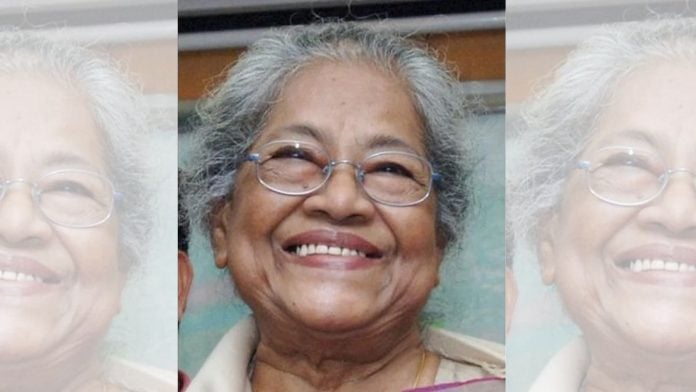
New Delhi: Renowned Indian contemporary artist Arpita Singh died on Monday morning at Fortis Hospital in Delhi. The 89-year-old was a pioneering figurative modernist who was awarded the Padma Bhushan for her contribution to art. Her densely layered canvases explored women’s inner lives against the backdrop of social and political upheaval.
“She had heart- and lung-related issues for some years now. However, she was actively working. Her health dipped in the last three days, and she was admitted to the hospital,” her husband, fellow artist Paramjit Singh, told PTI.
Their only daughter, artist Anjum Singh, died of cancer in 2020.
Arpita Singh was born on 22 June 1937 in Baranagar, then part of Calcutta in the Bengal Presidency (now West Bengal). Born Arpita Dutta, she moved with her family to Delhi in 1946, shortly before Independence and Partition.
She studied at Delhi Polytechnic, graduating with a diploma in fine arts in 1959. She later worked as a textile designer at the Weavers’ Service Centre under the Ministry of Textiles.
The experience shaped her visual language, particularly her use of patterns, craft traditions and dense surface details. She married Paramjit Singh in 1962.
Also read: Sudhir Patwardhan’s archive of ordinary lives — a tired mother, a pair of eyes, a cup of tea
A distinctive voice in Indian art
Singh emerged as one of the most distinctive voices in post-Independence Indian art. Her work combined narrative storytelling with what has been described as a “carnival of images arranged in a curiously subversive manner”.
From the 1980s onwards, her canvases centred on the female figure, often portrayed as strong yet vulnerable. These figures appeared alongside maps, numbers, animals, flowers, weapons and fragments of text.
Spanning six decades, her work drew on Indian miniature painting, folk traditions, Kantha embroidery and modernist influences. She transformed everyday experiences and catastrophic events into dreamlike, densely populated scenes that reflected social turmoil, violence and humanitarian crises without becoming didactic.
Some of her early works included surrealist landscapes, followed by a period of pure abstraction focused on dots and lines, before she returned decisively to figurative painting.
Exhibitions and honours
Singh widely exhibited her work in India and internationally, with major appearances at institutions including the Centre Pompidou, Guggenheim Bilbao and Barbican Centre. In 2025, she held her first solo institutional exhibition outside India, Remembering, at London’s Serpentine Galleries.
She received the Padma Bhushan in 2011 and the Fellowship of the Lalit Kala Akademi in 2014. Her other honours included the Kalidas Samman and Parishad Samman.
Art curator Uma Nair described her as the “high priestess of contemporary Indian art”.
“Her ability to balance the human figures with predominantly abstract compositions on canvas and paper, show her precision and harmonic balance created principally with a reliance on contours so as to lay the formal foundations of her oeuvre to create an aesthetic bridge to her evolution,” Nair wrote in an Instagram post.
She also called Singh the “female M F Husain of the female arc”.
(Edited by Maryam Hassan)