



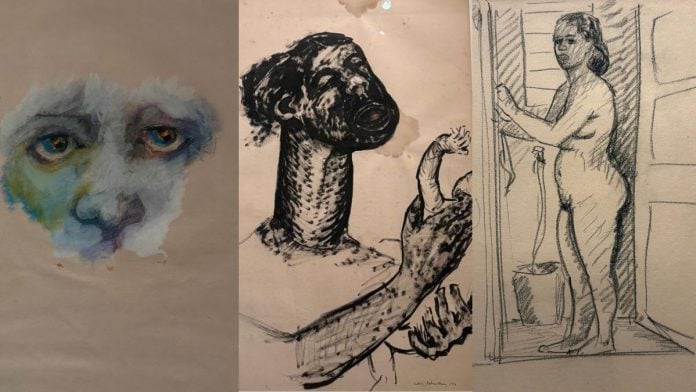
New Delhi: A woman holds her child, her neck stretched upwards and her face marked by heavy, dark strokes. Her posture shows fatigue and a deeper agony born of exhaustion. The strain is visible even in her hands, yet she continues to hold the child close.
In the sketch, artist Sudhir Patwardhan captures the everyday labour of motherhood without turning it into a dramatic moment.
The act of looking is central to In Another Mode: Sudhir Patwardhan’s Drawings 1970–2000, which shows 200 drawings by the artist to Vadehra Art Gallery in Delhi from 25 September to 23 October. Curated by art historian R. Siva Kumar, the exhibition brings together works made across three decades, from small observations to larger drawings that stand on their own.
At its opening, hundreds of art enthusiasts, students and friends gallery-hopping through Defence Colony came to see the exhibition, with Patwardhan at its centre, fielding questions.
“Firstly, my interest has always been in people. I have always been drawn to observing people, at railway stations, bus stops or wherever I happen to see them, and making drawings and sketches of them. That interest has remained with me. Over time, I also became interested in the situations in which people live, the circumstances around them and how these shape their everyday lives,” Patwardhan told ThePrint.
The uniqueness of the incomplete
For Patwardhan, a sketch is not merely a step towards a finished painting. Its incompleteness can preserve something that a more considered work might lose. Some of the sketches in the exhibition remain unfinished, yet feel complete in ways that a painting sometimes cannot.
“Sketching is much more spontaneous, and you just get done. So many times you don’t even intend to say what is getting said in a sketch. And that cannot be recreated in a painting,” he said.
The result is an archive of encounters, some lasting only as long as a glance. One of the sketches centres on a pair of eyes, rendered with hues of blue. It is the gaze that stays — the eyes looking directly out from the paper, as though the fleeting encounter that inspired them has not quite ended.
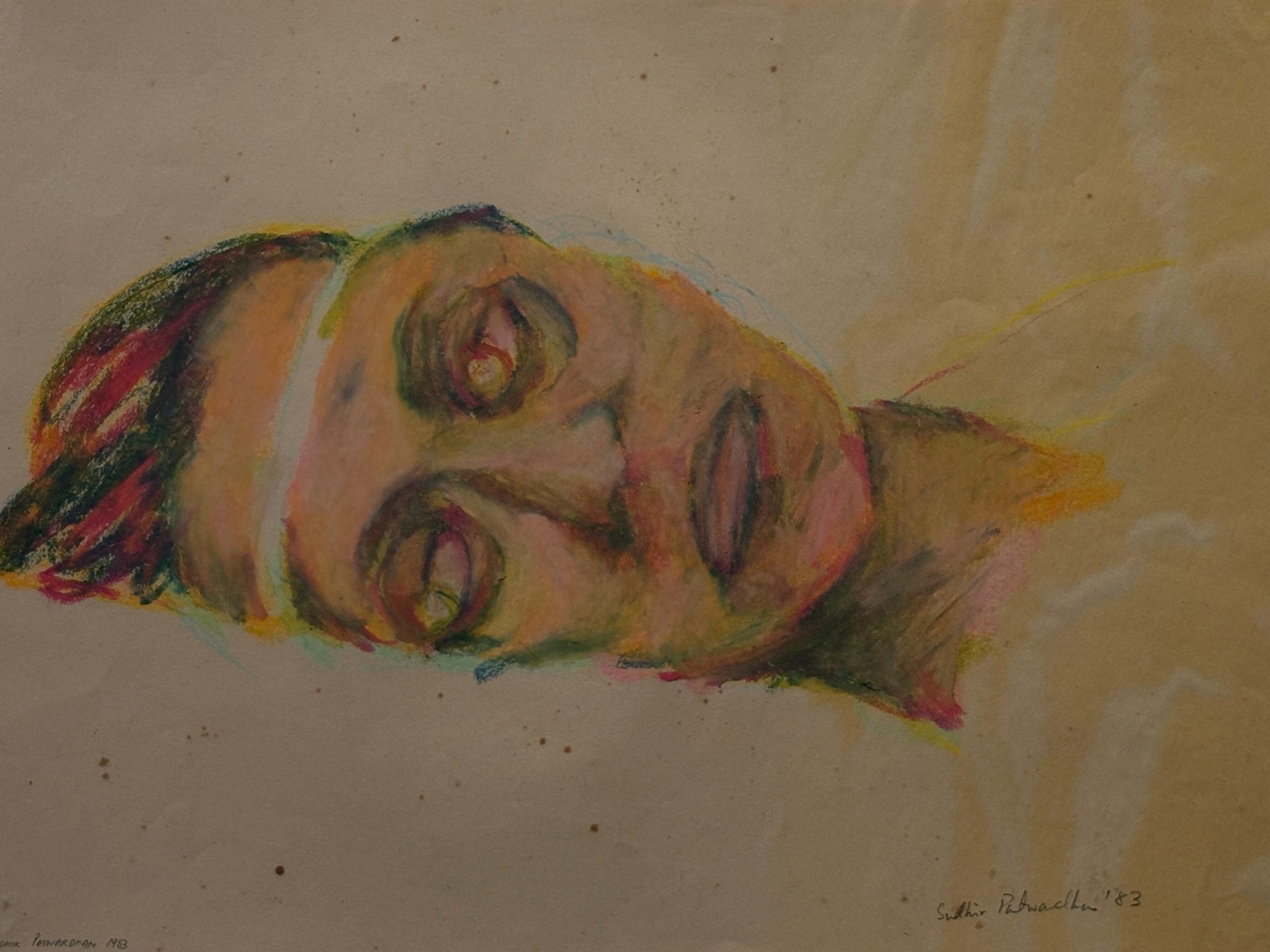
Patwardhan recalled that it may have begun with nothing more than an encounter — seeing someone somewhere, noticing an expression, and carrying it in his mind until he eventually drew it.
The memory is part of what makes the sketches intimate. They are recognisable without being specific. The people could belong to another city or another time, yet their tiredness, curiosity, solitude or concentration is familiar.
Patwardhan also uses drawing to hold on to places he has known. During his medical service, he spent part of his rural posting in Sirur, about 100 kilometres from Pune. The area was in the grip of a severe drought.
“So I used to go there and sit at the cafe, have a cup of tea and do sketches. So both of those come from Sirur. Therefore they are called Sirur Cafe,” he said.
Also read: A shrunken lake, a restored madrasa — only ruins of medieval Hauz Khas remain
A radiologist turned artist
Patwardhan was born in Pune in 1949 and graduated from the Armed Forces Medical College in 1972. He worked as a radiologist in Thane from 1975 to 2005, while developing his practice as an artist. His work has since remained closely tied to Mumbai, Thane and the people who inhabit their changing urban landscapes.
His paintings and sketches have often focused on working people and ordinary streets. The Barbican, which showed his work in its 2024 exhibition The Imaginary Institution of India, describes his large paintings as exploring the effects of urbanisation on the individual city dweller and the city itself.
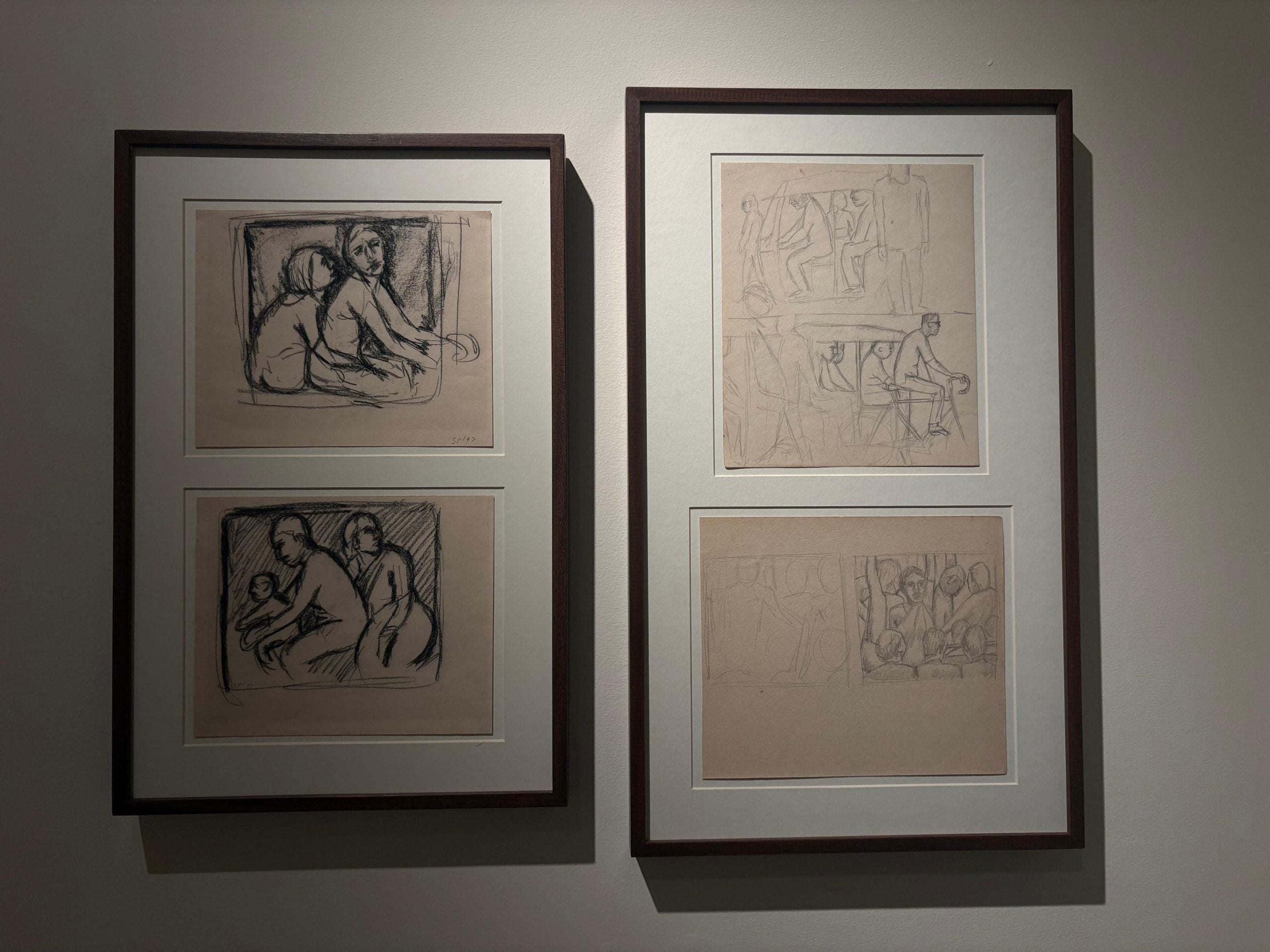
The drawings offer a quieter route into the same world. Vadehra’s curator’s note describes the smaller works as “notations made from life”, while the larger drawings become independent works, with their marks remaining more open than those in a painting.
“In painting, you make choices — compositional choices. You decide where to place this, where to place that, whether to use one colour or another. You’re making so many decisions, drawing on your knowledge and everything you’ve learnt,” said Patwardhan.
The simplicity of Patwardhan’s drawings is what gives them their immediacy. He does not impose drama and allows them to remain as they are.
His sketches move between fragments of the human body — feet, a head, bodies caught in moments of private intimacy — and scenes of everyday life — people reading newspapers at railway stations, sleeping, waiting or just passing time.
The sketches are a record of the ordinary, capturing the repetition, stillness and monotony of daily life without trying to make it appear more meaningful than it is.
Looking at his work today also adds another layer to their complexity: time. Mumbai, like the people who inhabit it, has changed.
“Most things have changed so much over the last 20 or 30 years. Bombay has changed so much that one hardly recognises the places anymore,” he said.