



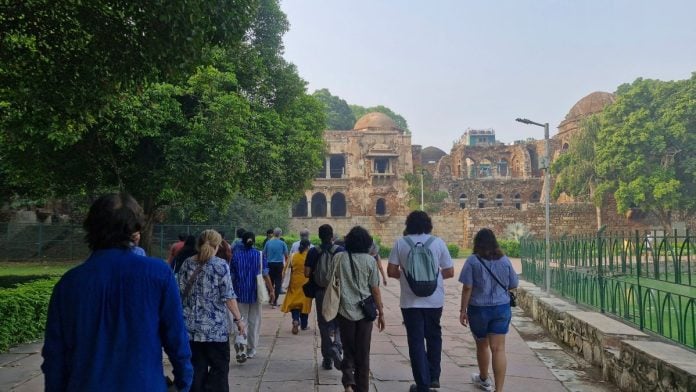
New Delhi: Today, Hauz Khas is famous for its cafes and boutiques. But few who come here have entered the fourteenth-century madrasa that Firoz Shah Tughlaq built on the edge of what was once a royal reservoir.
One morning, a small gathering of about 30 people set out to trace what that madrasa complex once was, and ask what official stories leave out.
“Mapping a Madrasa”, a field visit organised as part of DAG’s City as a Museum programme, brought historians Sudeshna Guha and Amar Farooqui to the Hauz Khas Madrasa to examine how an educational institution was embedded in Delhi’s landscape, its water, gardens, settlements and political histories.
As the group of history enthusiasts, young and old alike, walked past the remains of the madrasa, the lake, and Firoz Shah Tughlaq’s tomb, they were urged to think about what survives and what disappears when a historic site undergoes restorations and interventions.
Near the monument, they gathered around Guha and Farooqui. Some fanned themselves against the September heat as the historians began reconstructing a landscape that looked very different from the one where they now stood.
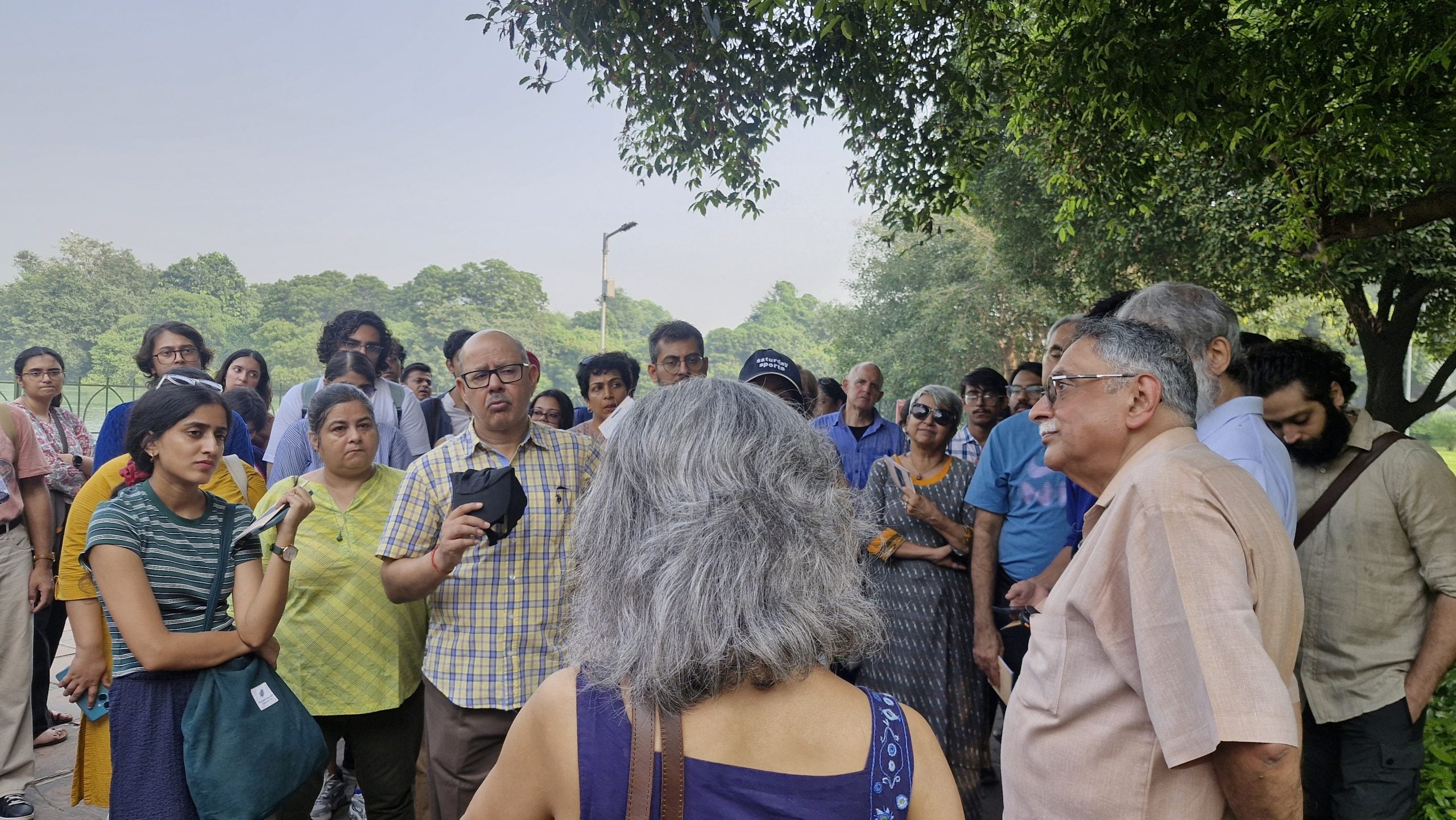
Guha recalled visiting the site in the 1970s with her grandmother.
“There were no ASI cordons. This place actually looked a bit like the ruins, and it also looked like what this complex was supposed to mean; a complex fronted by a royal reservoir, where the Sultan would come from his other hunting lodges in a boat, with a royal entourage,” she says.
Dug under Alauddin Khilji in the early fourteenth century to supply water to growing settlements and the royal household, the reservoir predates the Madrasa. After it was silted up, Firoz Shah Tughlaq had it re-excavated. Today the water survives as a much smaller lake.
The madrasa was built beside the reservoir around 1354, soon after Firoz Shah took the throne in 1351.
But much of the original complex is no longer visible. Guha said large portions of the madrasa’s south and east sides have disappeared, and criticised how the ASI has conserved it, saying the northern side is all that remains visible.
Pointing to the chajjas, brackets and eaves that drew on older temple traditions, she said, “This was absolutely novel in the Sultanate period.” Her eager listeners squinted against the morning rays to observe the architectural details she was talking about.
Farooqui then placed the madrasa within the changing urban landscape of 14th-century Delhi. Recalling accounts from the Moroccan traveller Ibn Battuta, Farooqui said that the area, before the madrasa was built, was so full of pavilions, musicians and singing girls that Battuta called it Tarababad, which some translations render as “city of music”.
Then, Farooqui described the madrasa itself. He called it an institution of higher learning, rather than simply a place of religious instruction.
“Students and scholars travelled to such institutions in search of specialised knowledge, and teachers taught different schools of Islamic jurisprudence,” he explained. The madrasa, he added, provided students with stipends, food and accommodation.
Listening and observing
The group then moved inside the complex, where the second part of the visit shifted from listening to close observation. Instead of a conventional guided walk, participants were handed a workbook designed by Ritoshi, a final-year history student at Shiv Nadar University.
Ritoshi’s workbook had a series of prompts that required participants to read historical records, observe the architecture, and question the information on the site’s existing boards.
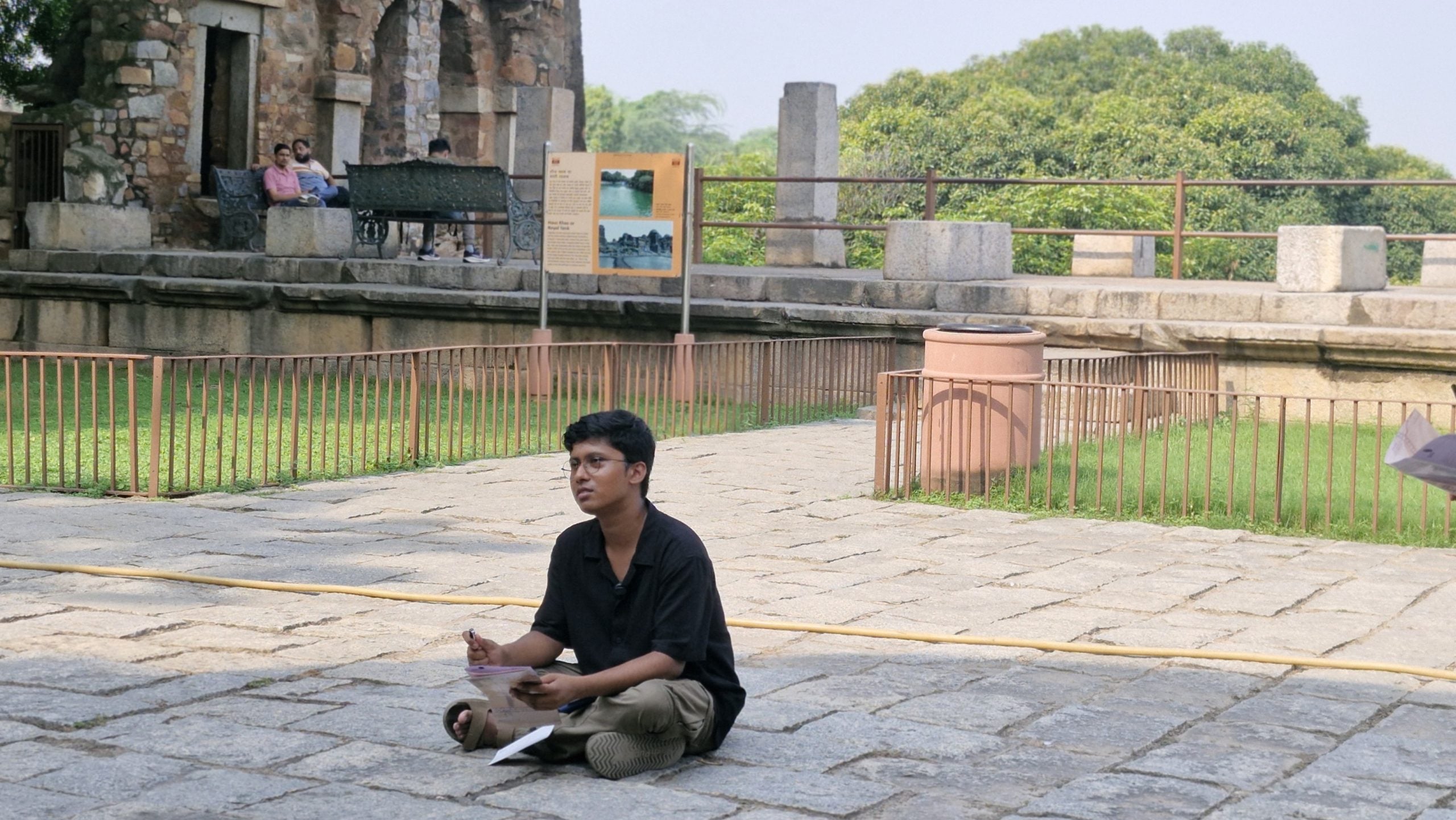
Sitting inside one of the pavilions, the participants first read aloud from Firoz Shah’s own writings in the workbook — one about reviving the tank that had “been filled up and become dry”, another about his wish to build “mosques and colleges and monasteries”.
They were then asked to choose two of four themes that they thought the passages reflected: religious community, madrasas, memorialisation of his rule, or hydraulic architecture. The discussion became less about choosing the “right” answers and more about how the categories overlapped.
One participant argued that memorialisation and commitment to the religious community could not easily be separated: “It’s part of the same act,” she said.
Guha jokingly objected to the question itself: “This is a dumb question because all four will work.”
The next prompt asked participants to respond to fourteenth-century poet Mutahar’s description of the madrasa’s gardens, fragrances, flowers and birds.
“You have to be Mutahar and look around. The ambience, the environment and the landscape, what four or five elements would you choose to write about?” Ritoshi asked.
“It’s a very multi-sensorial experience,” one participant observed, recalling the discussion of musicians, orchards and birds around the reservoir.
Another pointed to the “cool feeling of the stone” beneath them.
“The quiet,” another said, “You feel a sense of calm and peace.” Others in the gathering nodded in agreement.
Also read: J&K’s first kho kho world champion still awaits Rs 40K. ‘Is it because I’m a Muslim woman?’
Missing social history
The participants were then directed to the information boards installed at the site. Here, the discussion became more pointed — what does an official description tell visitors, and what does it leave out?
“Social history is missing,” one participant said after reading a board describing the Madrasa. The historical accounts shared by Guha and Farroqui included students, teachers, travellers and people settling around the institution. “Those stories are absent here,” she said, pointing to the board.
The group then entered Firoz Shah’s tomb, which sits at the junction of the madrasa’s two wings. Inside, participants looked up at the decorated dome and examined the cenotaphs, some taking photographs.
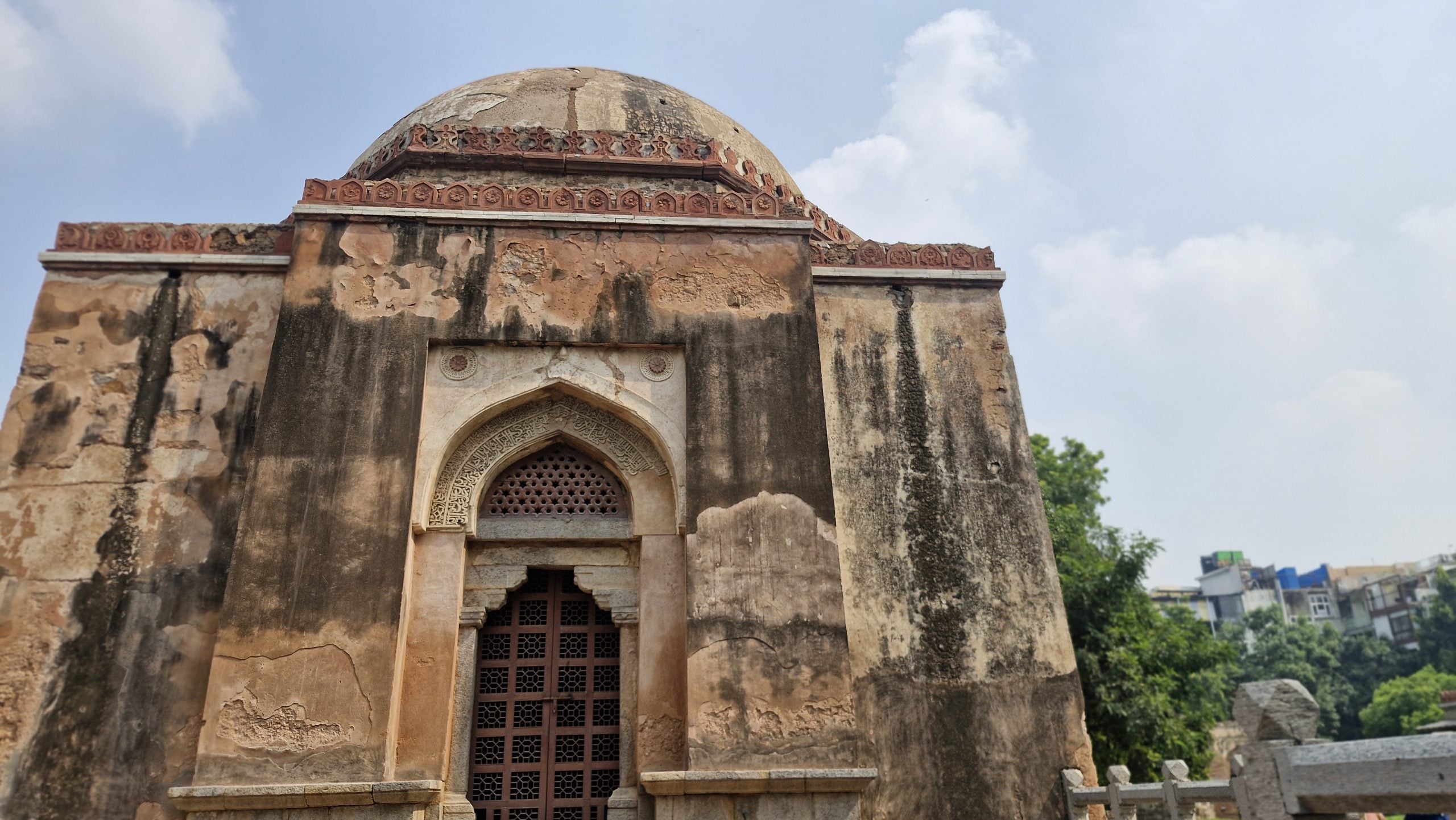
Asked how she would rewrite the tomb’s signboard, Guha said she was tired of boards that list measurements. She wanted one that explained the tomb as a gateway between the madrasa and the garden, Firoz Shah’s “palatial paradise”.
She objected to the railing around it and to the ASI’s habit of conserving tombs in isolation.
“Why isolate something where it was not a part to be isolated?” she said, adding that the tomb could not be understood separately from the madrasa, garden, and reservoir around it.
In the final leg of the field visit, participants were shown photographs of the complex in the earlier stages of its conservation and they were asked how the landscape had been altered.
“So many intrusions have come around,” one participant said, pointing to the changes in accessing the complex.
Another noted how the old photographs made the relationship between the lake and the buildings easier to understand: “We really get a sense that the lake extended all the way.”
The session ended well past its scheduled hour. Some people headed for the exit while others lingered by the railing, looking out at the lake, now a fraction of what Khilji had built. A few stayed seated in the pavilion as the late-morning heat settled.
Outside the complex, Hauz Khas returned to what it usually is: cafes and boutiques opening their shutters, joggers on their morning loop, all within sight of a shrunken reservoir, the tomb of Firoz Shah Tughlaq, and a madrasa whose surviving structures bear the marks of repeated restoration.