



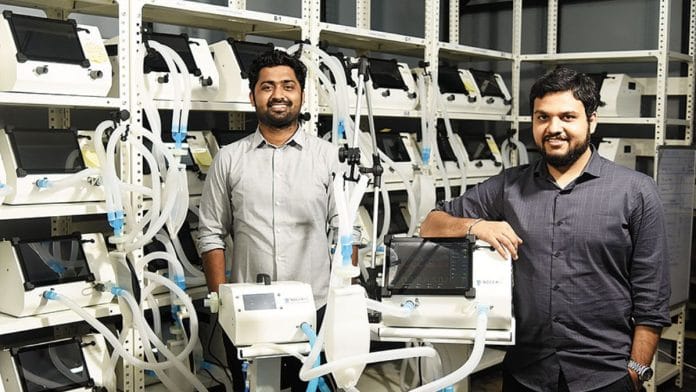
New Delhi: A small start-up founded by three IIT Kanpur alumni became one of India’s biggest pandemic success stories. Today, Noccarc Robotics has proved that it is more than just “the ventilator company” that made headlines in 2021.
The Pune-based start-up began by building an ICU ventilator in 90 days and has now evolved into a med-tech company. It makes patient monitors, a new model of an advanced ventilator, and is also venturing into AI-powered solutions for critical care. Noccarc’s products can be found in over 700 hospitals in India, including AIIMS, JIMPER, Apollo Hospitals, and even Army hospitals.
In May 2026, Noccarc was one of the five deep tech start-ups that received funding of Rs 1 lakh crore as part of the government’s Research, Development and Innovation (RDI) scheme.
While the company was fueled by the passion of its founders in its initial days, a post-pandemic med-tech environment is very different. One of the founders, Nikhil Kurele, said that India is still heavily dependent on med-tech imports.
“Despite being a profitable company, our market share is 3.5 per cent. The way our product was bought during Covid-19 was very different. In a normalised market, people look for brands and capability. During Covid, people were ready with money. Patients were paying Rs 1 lakh a day to be on a ventilator, so hospitals had the money to invest,” Kurele told ThePrint.
And yet, even after competing with imported medical devices, Noccarc has grown by nearly 300 per cent in the past two years. Seventy per cent of its business comes from government hospitals and its latest high-end ventilator, introduced in 2023, has been installed in over 450 hospitals across the country.
The company is soon to begin commercial-scale production for its newly launched patient monitor in a few months. The founders are also planning to expand and create AI-enabled products that can potentially analyse clinical data and help doctors with diagnosis and treatments.
Also read: AI data centres do not need environment clearance, Centre tells Parliament
From solar panels to ventilators
Noccarc’s journey into med-tech was a fortuitous accident. The idea for building ventilators came to them as they were sharing a slice of pizza, ready to pack up the company pre-covid avatar and head to their hometowns for the lockdown.
Founded in 2015, Noccarc initially wanted to help build robotics for India’s defence forces. The founders, Kurele, Harshit Rathore, and Tushar Agarwal, were all mechanical engineers who loved machines. Kurele and Rathore had even built full-scale racing cars during their grad school.
“We had that image in our college as well as our incubation days. People would say that ‘these guys can make products’ because we love products,” Kurele laughed.
When they launched the company, they began by looking up the Japanese translation of car parts. In the car, the knuckle holds the wheel assembly together. The entire weight of the car’s body passes on to the wheels through the knuckle, and in Japanese it is pronounced ‘nokka’.
The founders recall that Nokia sent them a legal notice, which claimed that the two names were phonetically similar. Eventually they settled on the name Noccarc and pivoted to making a waterless robotic system for cleaning solar panels. At the time, the company was a success; they had the money, they had the manpower. They decided to walk away from all of it when the lockdown struck. They were asked to shut down their factory.
But over those last few slices of pizza together, the founders began discussing ventilator shortages across the world.
“We saw what MIT and Stanford were developing and felt these were basic systems that we could build,” Kurele recalled. “At the time, the idea wasn’t to become a medical device company. We simply wanted to contribute when the country needed help.”
The team was supported by mentors from IIT Kanpur, Amitabh Bandopadhyay and Shrikanth Shastri, who later went on to document the entire process in a book titled The Ventilator Project.
Along with their mentors and help from clinicians and investors, the team developed its first working prototype within 24 hours of receiving permission to reopen its facility. Over the following three months, they worked 16 to 18 hours every day to develop an advanced ICU ventilator that met government specifications for treating critically ill patients.
Kurele joked that with so many Padma awardees on the consortium calling and helping them daily, failing was not an option.
Money was the last thing on their minds, the founders said. The company made Rs 80 crore of revenue during their initial phase. Nearly 3,000 ventilators were deployed at the time, and many continue to remain functional, long after the company even stopped manufacturing that model and introduced a new, more advanced one.
Kurele recalled that time as one of the most emotional ones in his life. At the peak of Covid-19, nearly every person in the Noccarc team was dealing with personal tragedies. Some members of the team, Mayur Chate and Samar Ahmed, even fought with their families to come and join the team in their small office in Pune.
“We were living in one flat. Every person was in and out of the ICU. Every day we were meeting Covid-19 patients. I think I could proudly say that it was like being part of a cricket match representing India or being part of the front-line war. These are golden opportunities in life, we rarely get them, and we would do it all over again if we get the chance,” said Kurele.
Today, the company has a larger mission. Even though India still imports simple hardware devices like welding machines, Kurele said that they don’t just want to copy existing healthcare products and make them in India.
“India’s challenges are different,” he said. Small towns have a shortage of specialists and it is difficult to move patients from one hospital to another. “We need to make technology that solves our problems,” Kurele added.
(Edited by Ratan Priya)