



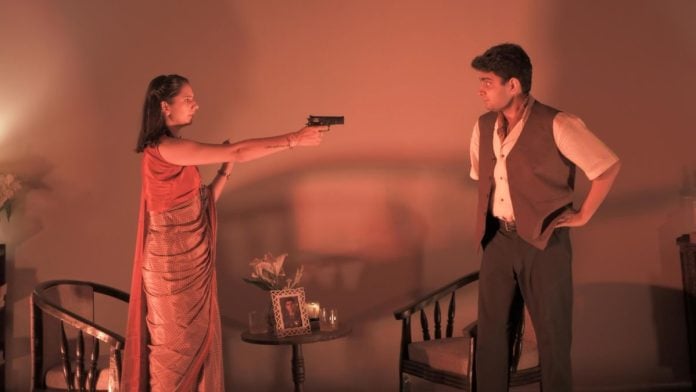
Lucknow: For a city that has spent centuries telling stories through tehzeeb, adab, Urdu poetry, and dastangoi, Lucknow has never really been short of a stage. Its theatre has carried the city’s literary and cultural traditions forward, from Hindi classics and Urdu adaptations to the work of generations of theatre practitioners. But somewhere in this long tradition, English theatre has struggled to find a regular place.
Aman Shah, 26, and Shubhra Pandey, 28, now want to make room for it. Through The Matinee Theatre, the two actors are taking English plays outside Lucknow’s established theatre halls and into museums, amphitheatres, and other unconventional spaces, hoping to build an audience for a form that has largely remained on the margins of the city’s theatre scene.
For Pandey, the idea is not about changing theatre for the sake of it, but about making space for it to evolve.
“Change is the only constant, that is how it works. Everything exists because of change, so why not art? And by changing it, we never mean that it loses its essence. We want to change it for the better,” Pandey said.
For decades, Lucknow’s theatre scene remained centred around the stages of Bhartendu Natya Academy (BNA) and Sangeet Natak Akademi (SNA). The city’s stages were known for Hindi classics such as Mohan Rakesh’s Ashadh Ka Ek Din and Dharamvir Bharati’s Andha Yug, along with Urdu and Awadhi adaptations of Munshi Premchand and Saadat Hasan Manto. Western drama also came to Lucknow through the work of Padma Shri Raj Bisaria, known as the ‘Father of Modern Theatre’ in Northern India and the founder of BNA. He introduced lucknow to plays such as Jean-Paul Sartre’s In Camera and Harold Pinter’s The Caretaker.
Shah trained under Bisaria for three years following the Guru-Shishya tradition, studying classical texts, poetry, and acting techniques. Pandey grew up around Lucknow’s theatre scene. She spent her childhood in green rooms with her mother, veteran theatre artist Neetu Pandey, and attended summer workshops at BNA and SNA.
Taking theatre outside the auditorium
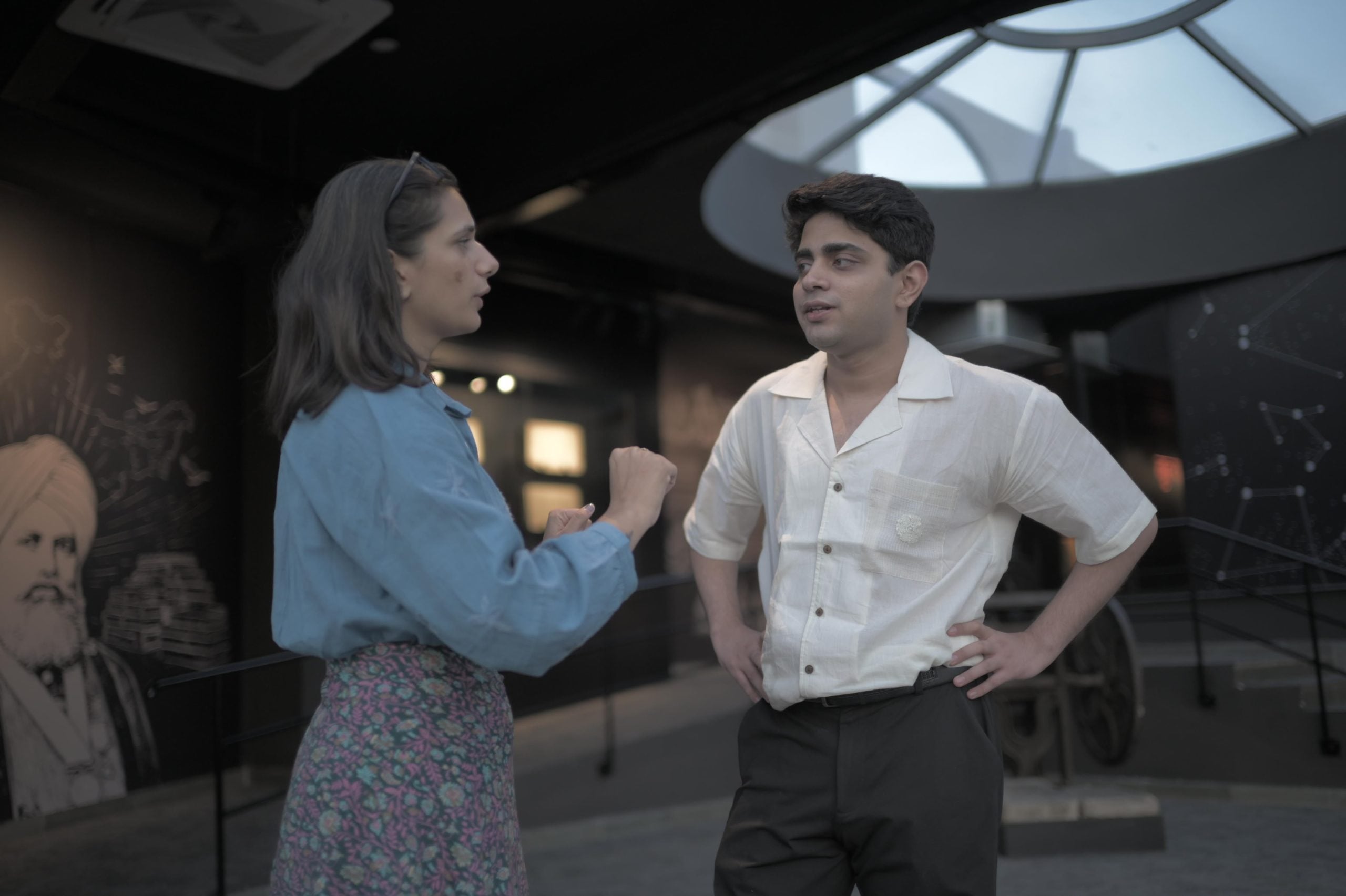
But despite both coming from Lucknow’s established theatre background, they are trying to do things differently at The Matinee Theatre. Instead of waiting for shows at traditional auditoriums, the duo is taking theatre to smaller and unusual spaces, while also trying to bring a younger audience to theatre.
“To make it unconventional, you really have to step outside the auditorium and perform wherever you can. When everyone else is experimenting, why keep it confined to a traditional hall?” Pandey said.
Shah explained that they aim to cater to audiences in places where people don’t expect theatre.
“We want to trigger a cultural revolution in Lucknow,” he said.
Barely an hour before the show begins, there is no quiet green room or slow warm-up. Shubhra is almost always running late because of her personal pre-show ritual — going early in the morning to Kisan Bazaar’s Phool Mandi to pick flowers to keep on stage.
“She is very particular about fresh flowers… tuberoses, lilies, and a specific mist spray so the set smells good—it should be a whole sensory experience,” Shah said.
Meanwhile, back at the venue, Shah is playing janitor and host all at once. The team is small, so almost everything rests on the actors’ shoulders.
“I was placing toilet paper rolls in the restrooms, stocking hand wash, and taping down peeling cloth from the chairs,” Shah said.
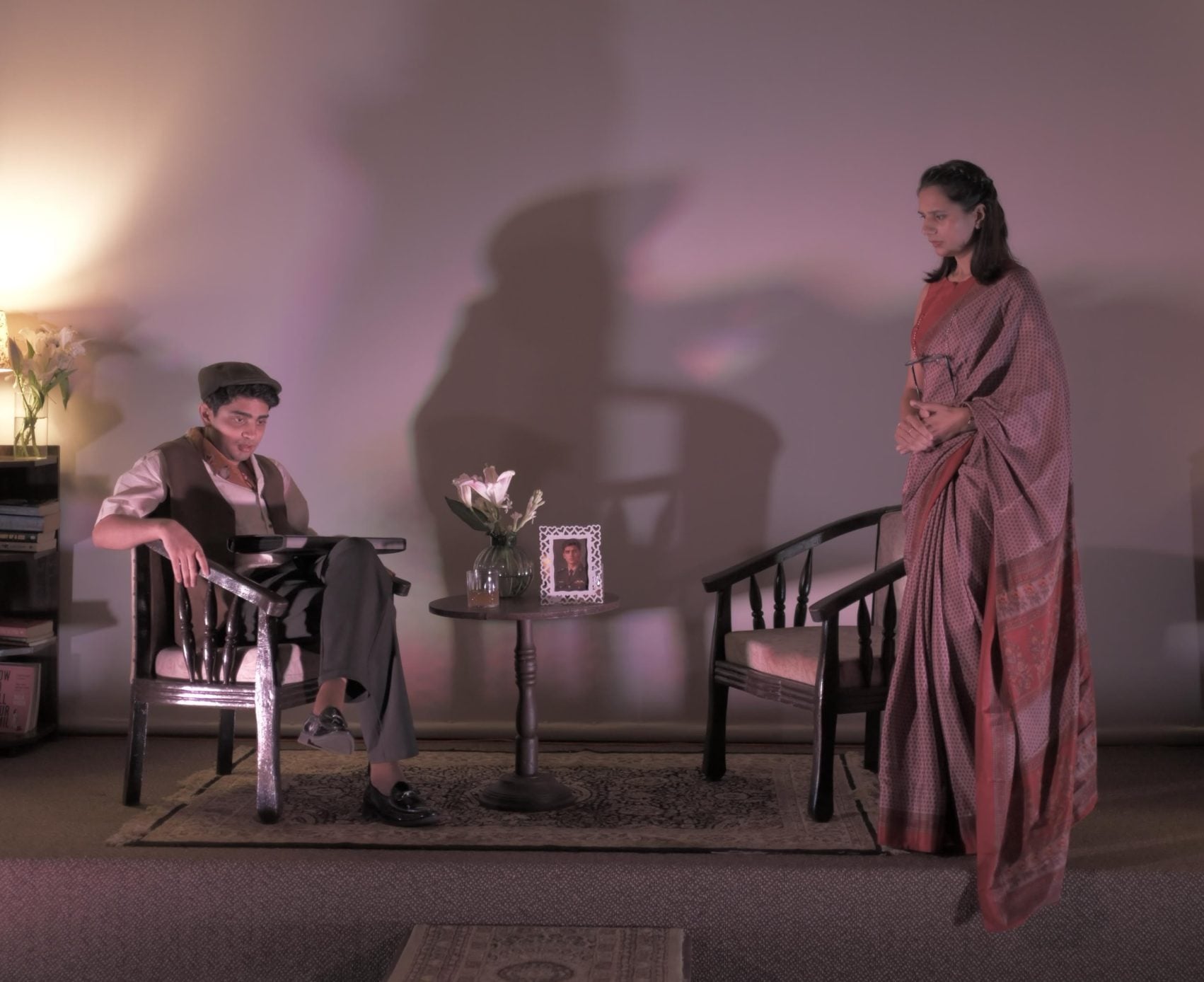
And it is not just the theatre team that gets involved. Their whole households become part of the production. At the time of the show, Shah’s living room sat completely empty for two days because lamps, carpets and vases were hauled over to dress the stage, alongside sofas from Pandey’s house.
“We bring things from our own homes to set up our stage. So first of all, the sofa came from my house, the rug from someone else’s house. So that’s how our theatre gets made,” Pandey said.
Ad shoot to plays
It all started in July 2026, during a commercial shoot for a jewellery brand, when Shah casually asked Pandey if she would be interested in doing theatre.
Shah had worked as a stand-in on the sets of Mira Nair’s A Suitable Boy, web series Dehati Ladke and Aanand L Rai’s Nakhrewaalii. But despite his screen work, he felt increasingly restless with the way young actors in Mumbai were expected to fit into a certain mould while waiting for casting directors to give them an opportunity. As he put it, Andheri West is filled with “same-looking people with slight curly hair, clean-shaven, good build, totally neat and tidy”, all trying to become actors.
“Until an artist creates their own style, develops their own vision, and tells their own story according to who they are, they are essentially just waiting around hoping someone likes them and casts them in a film,” Shah said.
He wanted to create his own work and tell stories rooted in his home city, but the cost of making a film remained beyond his reach.
“I started Matinee Theatre because I can’t make a film right now. I don’t have enough funds to make a Rs 10-15 crore film. But I can certainly produce a theatre play,” Shah said.
He approached Pandey between takes on the ad shoot. He had already admired her work and asked if she would be interested in theatre. She agreed, and Shah promised to send her a script that night.
Pandey, an RJ-turned-actor who hosted shows on Radio Mirchi and Red FM, grew up around Lucknow’s green rooms, watching her actor-mother Neetu Pandey. She also had been trying to put together an independent theatre group of her own rather than relying on the city’s established institutions. Shah’s proposal therefore came at the right time.
She was, however, familiar with the tendency in Lucknow to discuss theatre projects at length without actually staging them. This time, she decided to trust Shah’s determination to execute the idea.
“In Lucknow, a lot of people talk about doing plays, but they don’t actually do them. So many people just keep planning and plotting,” Pandey said.
She recalled that Shah had claimed he already had a script ready.
“He said he had a script ready, which he definitely didn’t. But even so, he sent it over that same night,” Pandey said.
That night, Aman adapted Anton Chekhov’s two-actor play The Bear and sent it to Pandey. Rehearsals began the next day.
Without a permanent hall or enough funds to rent a rehearsal space, they found an unconventional practice room, the Sidewalk Cafe in Gomti Nagar. Every evening from 6 to 8 pm, after Pandey and Shah wrapped up their shoots, they would sit with coffee and script.
Once they had memorised their lines and needed a proper space to work on their movements, they pooled in Rs 500 to Rs 600 to rent studios on hourly basis. With no outside director, the two actors directed each other, working through the play line by line.
“Because we are willing to learn. If I tell Aman something, Aman will not be very rigid or orthodox about it and would probably give it a shot and try what I’m trying to tell,” Pandey said, adding that this made them pull off the play without any director.
Building a stage of their own
Within a month of sharing the script over WhatsApp, The Matinee Theatre staged its debut performance on 7 August this year and quickly got sold out. Their opening show did not take place in a grand auditorium or a well-maintained hall, but at the Buddha International Centre, a neglected and rundown space.
The performances themselves also carried the spontaneity that came from the two actors directing each other. During one of the performances, Shah unexpectedly sat down on the floor while delivering a dialogue, even though the movement had never been rehearsed. Pandey initially wondered what he was doing, but instead of breaking the scene, she adapted her own movement to his position.
“My first instinct was, ‘Wait, what is he doing?’ But that’s the beauty of working together—I didn’t panic or freeze. I adapted my movement right there to match his level, and it made the scene feel even more intimate and real,” Pandey said.
Instead of waiting for slots at traditional state auditoriums in Bhartendu Natya Academy or Sangeet Natak Akademi, the duo continued looking for alternative spaces for their performances. That search led them to LMHA, or the Lucknow Museum of Art and Heritage, which they got access to through an unexpected challenge rather than any formal connection.
“We had zero inside connections to get LMHA,” Shah recalled. “I was at an event when someone told Juwairia Qamruddin, the curator, that we do drama. She challenged me, ‘Show us by performing here.’ I said, ‘Give us a date.’ She gave me a date, I promised to do it, and we pulled it off!”.
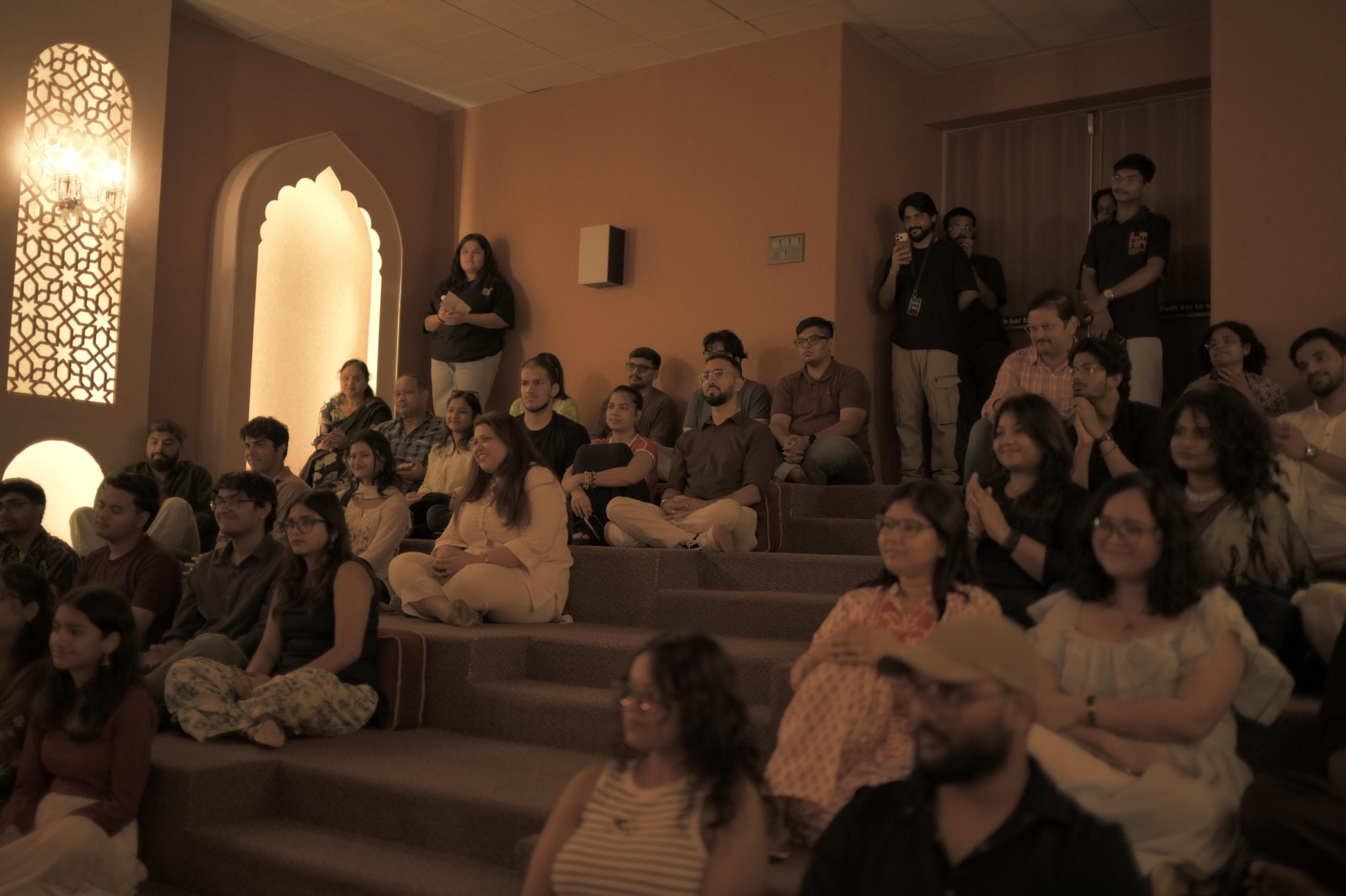
The museum space was never designed for theatre. Its open-air courtyard and small amphitheatre were meant for panel discussions, book readings, and documentary screenings. But the duo turned the space into a stage for The Bear.
“The stage is not that big like a usual stage, but we found a way out,” Pandey said. For her, moving away from traditional theatre halls is part of their attempt to experiment with the form.
They staged three shows in a single afternoon, at 3 pm, 5 pm and 7 pm, and sold out every slot.
Putting together the production on an independent budget also meant building a small team from within Lucknow’s theatre community. Shah brought in Manish Dada, a technician who has a day job but has worked on the lights for hundreds of local plays. Bunty created the original live music, while Ayaan handled the visuals.
When Shah went to print their promotional posters and banners, Amar Fax, one of Lucknow’s larger printing presses, charged him just Rs 1.
“He said, ‘Aman, brother, whenever you have work worth one or two lakhs, let me know. How could we take money from you for this?’” Shah recalled.
With tickets priced at Rs 100, the duo also wanted to make theatre accessible to a younger audience. Nearly 75 per cent of their audience was first-time theatregoers.
“Our motto is: For the young, by the young, an 18- or 19-year-old comes in with an open mind, free of bias,” Shah said.
They also chose to do away with ceremonial formalities and keep the focus on the performance itself.
“No ceremonial lamp lighting, no floral bouquets, no VIPs. When artists produce their own work, they honour the audience rather than bureaucratic dignitaries,” Pandey said.
While every backstage technician and crew member was paid their standard commercial rate, neither Shah nor Shubhra took a single rupee for acting. Across their LMHA shows, their production costs came around Rs 87,000 against Rs 85,000 in sponsorship, leaving them with a loss of Rs 2,000. They also donated the entire Rs 45,000 raised through ticket sales back to the museum.
“Everyone else working at The Matinee Theatre gets paid. It’s just the two of us who don’t. It was his brainchild and now my adopted child—and it takes a village to raise a child,” Pandey said.
Also read: Kashmiri cinema is seeing a sunrise after 23 dark yrs. It has the talent, not the machinery
Beyond The Bear
For Shah and Pandey, the sold-out shows of The Bear are only the beginning. Instead of treating The Matinee Theatre as a one-off project, they are building a collection of plays that can travel to different cities. The team is already working on a play around Amrita Pritam and Imroz’s works.
“We want The Matinee Theatre to have three or four stories ready—a bouquet of plays that we can perform anytime. We might do The Bear in Delhi, maybe Imroz in Bombay, and something else in Bangalore,” Pandey said.
Their search for new spaces also continues. The duo is now in talks to take theatre to the Ekana Cricket Stadium. But their larger plan goes beyond finding new venues. They want to build permanent, fully equipped theatre spaces in Lucknow, with proper sound and lighting facilities, so that independent artists do not have to struggle to find basic infrastructure or turn their homes into rehearsal and performance spaces like them.
“We want to break all those barriers that a play can’t happen without a director, or without institutional backing. Let’s make theatre great again,” Shah said.
(Edited by Aamaan Alam Khan)