



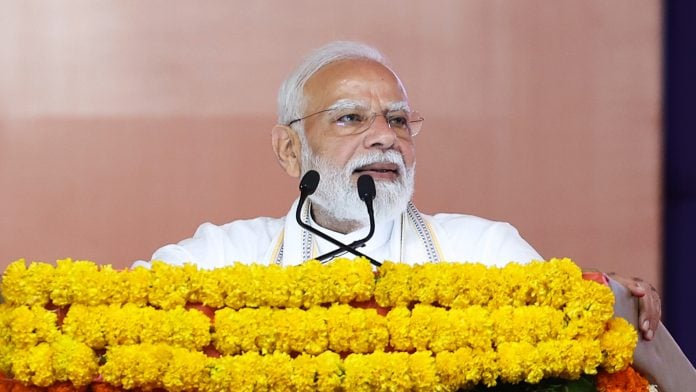
New Delhi: With advances in technology, the world is now at our fingertips. Artificial intelligence is reshaping governance; quick commerce platforms are spoiling citizens with faster deliveries. As the world moves faster and becomes more technologically-dependent, Prime Minister Narendra Modi called for changes in the civil services recruitment system, including greater “time certainty” in examinations at the UPSC’s centenary events.
“When AI can process thousands of documents in just a few moments, and when governments have real-time data available, citizens expect swift solutions. This changing mindset demands a new transformation from our civil services as well,” said PM Modi on 1 October.
“The India of 2047 will be very different from today’s India. Compared to today, India will be more urban, and the gap between villages and cities will shrink. The aspirations and expectations of our citizens, especially the youth, will be far greater,” he added.
Modi also questioned whether public services can keep pace with the speed of today’s instant-delivery world and function accordingly.
“The country is moving rapidly on the reform express. So, the institutions that conduct examinations must also work on reforms that are the need of the country. An examination should not be considered just an event. It is related to the future of our youth. A delay of even a few months can create difficulties for the youth. Therefore, the examination system should follow the principle of time certainty,” the PM said.
He further talked about how India needs to bring young people into public services.
“We need to bring young people into public service who are attracted to public service, not just the public office. Hence, it is essential that the recruitment exam does not merely assess how much a candidate knows, but also looks into why the youth wants to join the civil services,” said Modi.
In recent years, the trend of people getting into civil service has also changed. Modi added that today, it is not just the urban youth who are applying for civil services, but also young people from rural backgrounds.
“When UPSC was established, opportunities were mostly accessible to youth from big cities, affluent families, and top institutions. But today, youth from villages and small towns are also reaching public services. The participation of our daughters is also continuously increasing,” PM Modi said.
“In 1952, the percentage of women candidates in civil services was only 3 per cent. Today, it has risen to over 30 per cent,” he added.
(Edited by Insha Jalil Waziri)