



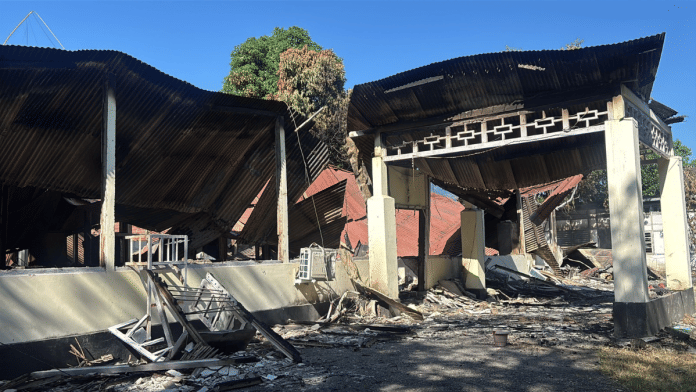
New Delhi: Five days after the violence in Arunachal Pradesh’s Pasighat, where protesters set fire to the NHPC office and torched several police vehicles during an anti-dam bandh, activist Konton Noyong said the violence was an unplanned reaction to police action.
“The violence was a result of the brewing anger. The police used stun guns against the protesters and that’s when they retaliated. Now it has reached a deadlock situation,” Noyong told ThePrint in an exclusive interview. “But the communities whose land and livelihoods will be affected by the dam project are not going to budge.”
Noyong is the first environmental engineer from the Adi tribal community, traditionally known for hunting, fishing, handloom weaving and cane craftsmanship.
Eighteen years after former Prime Minister Manmohan Singh called it a project of national importance, the proposed Siang dam, also known as the Siang Upper Multipurpose Project (SUMP), has become a site of contestation between indigenous tribes, the National Hydroelectric Power Corporation (NHPC) and the administration. New Delhi views the Siang dam as a strategic counter to China’s mega dam project, as well as a means of securing water availability for India. Opposition to the project is also not new; it dates back to the 1980s, when the Brahamputra Board began a survey for the Siang dam.
But Noyong, an environmental engineer opposing the dam, dismisses the project’s strategic positioning as spin.
From a flood-control measure to a project of national importance and now a national security issue, the changing pitch for SUMP has only deepened local concerns, Noyong said.
“The government needs to stop pushing us. If it doesn’t, China will take advantage of the situation. And that won’t be good for Arunachal Pradesh or our country,” said Noyong, a representative of the youth wing of the Siang Indigenous Farmers Forum (SIFF). “From the 1980s to 2025, there was no national security threat. Now the narrative is being changed to weaken our opposition.”
On Friday, a 12-hour anti-dam bandh in Pasighat escalated into violence as protesters set fire to the NHPC office and torched police vehicles. More than 25 people were later detained, restrictions were imposed and additional security forces were deployed. What began as local opposition to the SUMP has now hardened into a standoff between the government and communities in the Siang valley.
Noyong has been campaigning against the dam by visiting villages and informing residents about its potential impact. He says he learned about the proposed dam’s history from his ancestors, who opposed it in the 1980s and 1990s, and is continuing that resistance. He gained prominence in 2024-25 through speeches delivered as a representative of the SIFF youth wing. In one of his speeches, whose video on Facebook garnered nearly 1.5 lakh views and more than 5,000 likes, he alleged that the government had forced people to sign memorandums of understanding (MOUs).
One commenter, Takam Samyor, wrote: “One man army of the Adi community… why are the other social activists not standing beside this one man army.”
Also read: A dam, ancestral land & a standoff: Arunachal’s Siang villages battle a national project
Building a campaign against the dam
Noyong contests the government’s efforts to build a consensus among the Adi community in favour of the Siang dam. He has launched a counter-campaign to build opposition to the project.
In 2025, Noyong launched an awareness-cum-signature campaign against the project. He travelled to 56 villages that he said would be affected by the Siang dam. He visited community halls in each village and spoke to residents about the river, the proposed dam and its potential impact on their lives. The campaign made him one of the prominent voices opposing SUMP in Arunachal Pradesh.
At each meeting, he took photographs and collected signatures from residents to document their opposition to the project.
“I launched the campaign when a team from the government was simultaneously visiting villages and asking residents to sign MoUs,” Noyong said.
He now carries a file containing signatures, photographs and petitions wherever he goes. “This is my evidence of the opposition to the project,” he said.
Noyong says his social media accounts have been suspended and his ATM card is no longer working.
“I can’t even withdraw money for emergency situations. But I still stand with my people. I am an educator. My job was to pass on the knowledge. My work was to plant the seeds,” said Noyong, who studied at Swami Vivekananda School in Arunachal Pradesh and says he can recite shoklas from the Bhagavad Gita from memory.
Also read: Arunachal farmers’ body calls CM Khandu ‘two-faced’, says won’t meet until detainees released
‘Mother Siang’
Noyong, who studied environmental engineering at Lovely Professional University (LPU), says his ancestral history is intertwined with the Siang River, which the community calls “Mother Siang.”
“Our whole lives revolve around this river. And also, our cultural heritage. I can trace my forefathers’ names back 37 generations, and I know where each of them lived. Our migration through generations was dictated by the Siang river,” said Noyong.
Noyong says he is not opposed to development, and that neither are the community members, activists, and forums opposing the dam. In his interviews with local media, Noyong has reiterated that he wants to work as an engineer on dams for the government, just not on the Siang.
“We are not anti-development. Bring the dam, make the dam but not in the main stem because that will create the problem,” he said.
He says the community has reasons to oppose the project, including the prospect of displacement and migration.
“This dam is being built right at the centre of our Adi territory. So, if they build the dam there, half of our land is gone. And most of our agricultural land is within the 100-200-metre stretch along this river.”
(Edited by Prashant Dixit)