


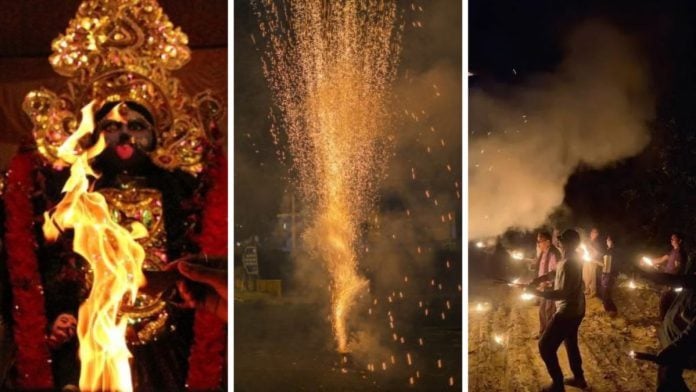
New Delhi: From dancing around fire in the hills to welcoming Goddess Kali in West Bengal, Diwali is celebrated across India in different forms. While the festival shares a common message of the triumph of good over evil, its rituals, beliefs and festivities take different forms across states and communities, reflecting India’s rich cultural diversity.
In parts of southern India, Diwali marks Lord Krishna’s victory over the demon Narakasura, with the lighting of oil lamps symbolising the triumph of good over evil. In northern India, the festival is associated with Lord Ram’s return to Ayodhya after 14 years of exile, following his victory over Ravana, accompanied by Sita and Lakshman.
With cultural differences, Diwali became one festival with many stories in India.
From symbol of strength to traditional fire dance
While several parts of northern India celebrate the nine days of Navratri, Bengal observes Durga Puja as the homecoming of Goddess Durga, who visits her parental home for a few days. And soon after one divine daughter leaves, another is welcomed. In Bengal, Diwali is celebrated as Kali Puja, honouring Goddess Kali as a symbol of strength, energy and power.
“Soon after one daughter leaves during Durga Puja, we wait for another, which is Kali,” Manisha, who hails from West Bengal, said, adding that the celebration is quite different from the way Diwali is observed in Delhi. “We don’t do Lakshmi Puja, and it is not just about sweets like it is in Delhi. We celebrate with different kinds of dishes around us.”
The celebrations begin weeks in advance, as homes are cleaned and decorated, sweets are prepared and shared with relatives and friends, and every corner is adorned with oil lamps, candles and decorative lights.
In several parts of Bihar, apart from Lakshmi Puja, families follow distinctive rituals involving fire. Elders of the household prepare bundles of dried grass for the male members of the family, which are later set alight as the men jump over them as part of the traditional celebration.
“Eggplant and potato pakodas are mandatory. They are prepared and distributed among people around us, along with sweets,” said Priyanka Kumari Singh, who hails from Bihar. She added that food choices and regional culinary differences play a significant role in shaping the celebrations.
The association of fire with Diwali is not limited to Bihar. In parts of Uttarakhand, particularly Garhwal, celebrations remain incomplete without Bhaila, a traditional fire dance and game. Bundles of wooden pieces of similar size are tied together and set alight. Men and women of the family then swing the burning bundles in circular movements, dance around the flames and jump over them.
Also read: Stories of ghosts, gods, and recipes take centre stage at Himalayan Echoes
‘We have always called it Deepavali’
Further away, in Himachal Pradesh, Diwali comes with another distinctive household custom centred around food and family. In some communities, food is not served to everyone immediately after Lakshmi Puja. A portion is first offered to the ancestors, followed by the tradition of feeding the daughter or a woman of the household before anyone else.
“After the puja, we put food outside for our ancestors. Then it is fed to a woman of the house first, and only after that can anybody eat,” says Rahul, explaining how his sister gets to taste every single dish before anyone else in the family.
Varun, away from his hometown in Tamil Nadu and in Delhi for work this year, finds the celebrations in the capital quite different from those he grew up experiencing. The first difference he notices is the name itself.
“We don’t call it Diwali as everyone does in Delhi; we have always called it Deepavali,” said Varun. He adds that instead of relying on market-bought decorative lights and embellishments, homes in Tamil Nadu are traditionally decorated with oil lamps, fresh flowers, leaves and intricate rangoli patterns made with white rice flour rather than artificial colours.
Ananya, who belongs to the northern part of the same state, recalls another tradition she rarely sees being practised in North India: breaking pumpkins as a ritual believed to bring good luck and prosperity, particularly for families and those who own shops or businesses.
In Gujarat, Diwali is not just a festival of lights but also marks the beginning of the Gujarati New Year, celebrated as Bestu Varas, adding another layer of festivity to the occasion.
While Lakshmi Puja and the celebration of light and prosperity remain common threads across regions, it is the customs, rituals, food choices and local beliefs that give Diwali its distinct identity in every part of the country.
(Edited by Saptak Datta)