





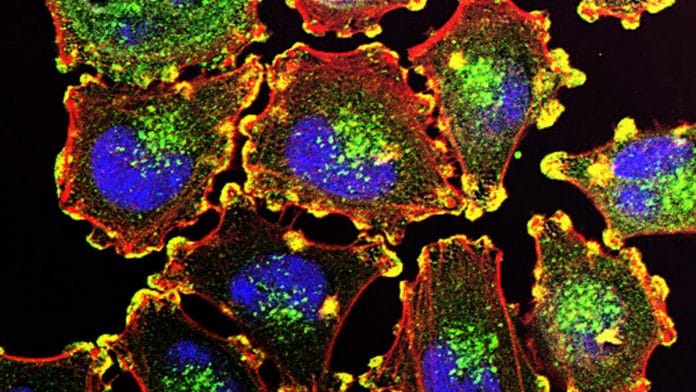


New Delhi: A new AI tool developed by Indian scientists can spot certain hidden cancer cells from gene data. These cells have long been thought to play a key role in cancer recurrence, metastasis and treatment failure.
The tool, named ACSCeND, was developed jointly by scientists from Ashoka University and SN Bose National Centre for Basic Sciences, an institute under the Department of Science and Technology. It analyses genetic information from a tumour to detect cancer cells with stem cell-like properties, according to a press release from the Ministry of Science & Technology. The scientists published their findings in a study in NAR Cancer on 27 July.
“Beyond identifying these dangerous cells, ACSCeND also uncovered the molecular programs that enable them to survive, adapt and evade the immune system. Such insights could help scientists discover new drug targets, identify patients who are more likely to relapse and design more effective precision cancer therapies,” said the government release. ACSCeND is short for AI-based Cancer Stem-like Cell Profiler and Neoplasm Deconvoluter.
Cancer is characterised by the abnormal growth of cells in the body. Most cancer treatments are targeted at killing those cells; however, according to the study, some cells survive treatment. These stem-like cells are difficult to identify because they are both rare and constantly changing their identity. Identifying them can require expensive single-cell RNA sequencing — a process by which scientists examine gene activity in individual cells and identify their characteristics.
The AI tool developed by Ashoka University and SNBNCBS scientists transcends both these problems as it can identify these cells using bulk RNA sequencing, which is more common and less expensive than single-cell sequencing.
“The system combines knowledge learned from high-resolution single-cell sequencing with deep learning to analyse conventional bulk tumour RNA sequencing, allowing these hidden cell populations to be studied in thousands of patient samples where single-cell experiments are unavailable,” noted the release.
Also Read: Quantum physics gets real at Science Gallery Bengaluru. Visitors can now touch and feel it
How does it work?
The way the AI tool ACSCeND works is by first training on single-cell RNA sequencing data to identify the genetic signatures of three distinct developmental states of cancer stem-like cells. These three states — pluripotent-like, multipotent-like and unipotent-like — all have different capabilities to develop into different kinds of cells.
The researchers trained ACSCeND to understand the genetic signatures of each kind of cell, so that it could learn to recognise them based on their signatures.
The next step for the scientists was to provide bulk RNA sequencing data to the tool. Unlike single-cell RNA sequencing, this is a method in which the genetic information from thousands of cells is mixed together.
Through its training, ACSCeND learnt to identify the different genetic signatures in bulk tumour RNA through mathematical modelling and deep learning. It did not sort individual cancer cells; rather, it looked for the genetic signatures of stem-like cancer cells within the mixture.
The scientists tested their tool against existing computational methods and found that it consistently outperformed them across independent datasets and sequencing platforms, the ministry’s release said. They then used ACSCeND to analyse more than 25,000 tumour samples from major international cancer databases, including The Cancer Genome Atlas (TCGA) and PREdiction of Clinical Outcomes from Genomics (PRECOG).
The scientists also said in their study that ACSCeND could help guide treatment by identifying cancer stem-like cell (CSC) states.
By combining single-cell precision with the ability to analyse bulk data, the tool “establishes CSC state as a clinically meaningful, pan-cancer biomarker for guiding stemness-informed therapies”, they wrote.
(Edited by Asavari Singh)