



Bengaluru: What does something as notoriously mysterious and amorphous as quantum physics look like in a gallery? Science Gallery Bengaluru is turning it into something visitors can walk up to, touch and watch happen in its exhibition season Quantum, which opened on 8 August.
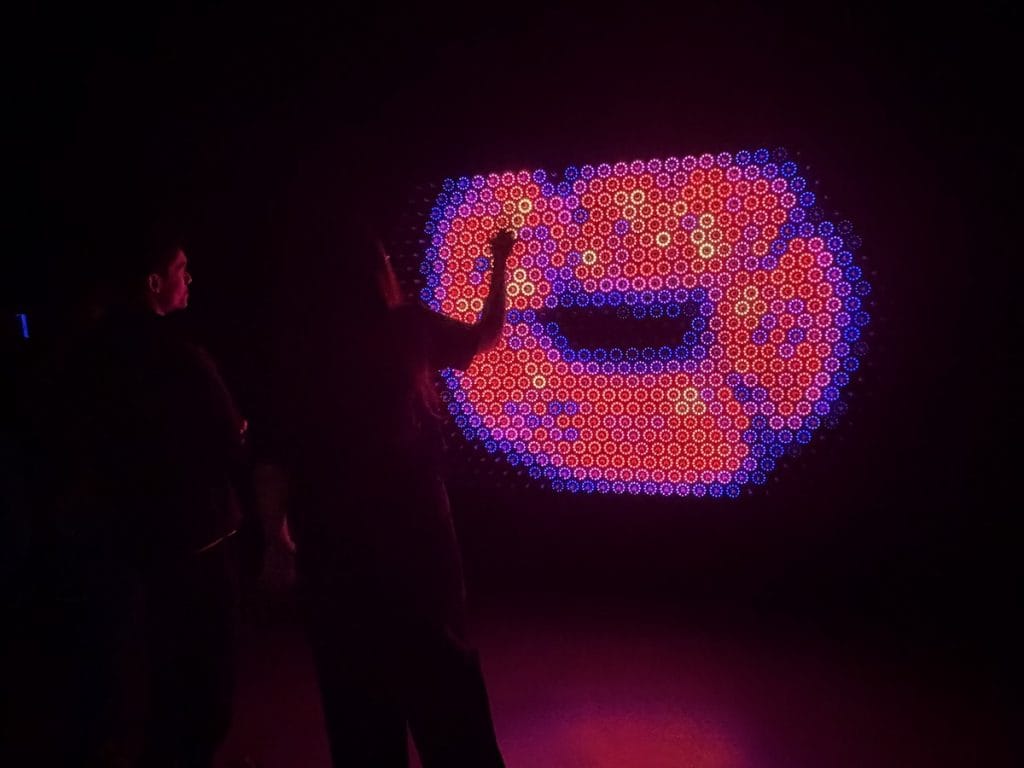
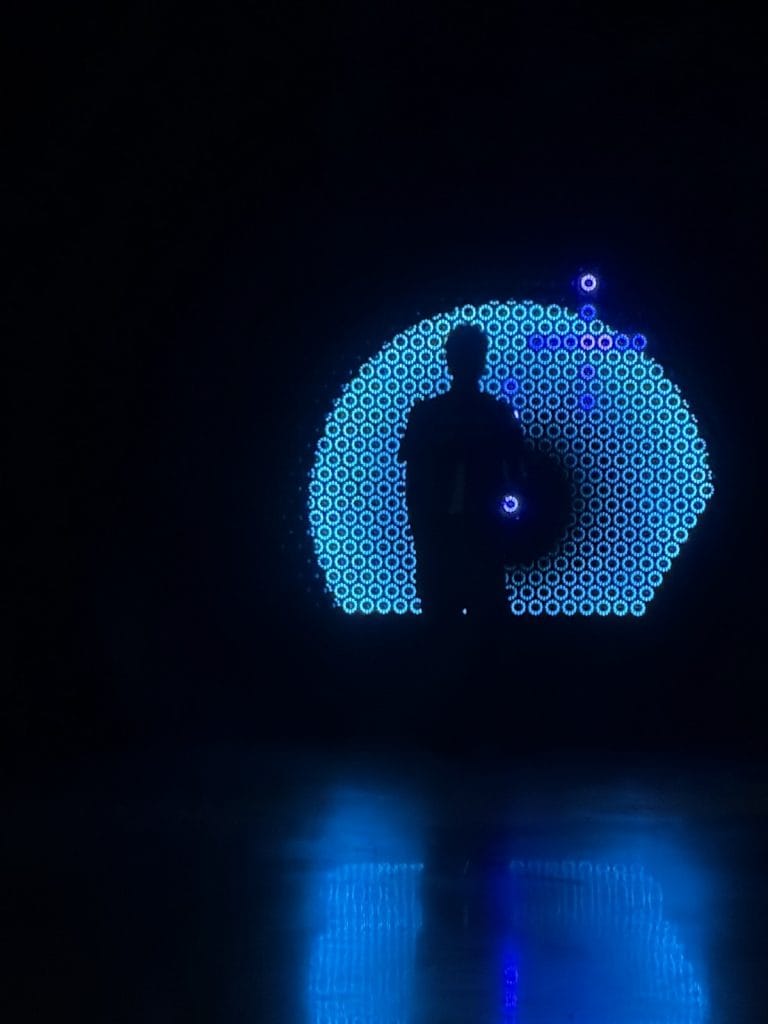
At ‘Quantum Jungle’, an interactive installation by Berlin-based artist Robin Baumgarten, touch a spring and a point of light starts to move, bursting into vivid colours that spread into every place it could go, all at once. Touch another and that cloud of possibilities collapses into a single point at a random spot. Elsewhere are levitating superconductors, glowing quantum dots, video games, and even an installation involving virtual chickens. Together, they are among about 40 exhibits that use art, science and design to make the quantum world tangible.
“Before becoming part of this exhibition, I thought science is deterministic. We know everything that is out there. But this has changed my perception… we can only know the probability of some things,” said Vindhya Kumar, 28, an entrepreneur and a mediator at Science Gallery Bengaluru.
Quantum physics is the science of the microworld—of how the tiniest, subatomic particles interact and behave. And it has both excited and bamboozled physicists since it began taking shape in the early 20th century, when they realised that many physical effects could not be explained by the deterministic laws of classical physics.
While quantum physics powers modern technologies ranging from QLED displays and supercomputers to fibre-optic communication and magnetic resonance imaging, it plays by its own mysterious rules.
The behaviour of particles at this scale defies our everyday intuition. Particles can exist in combinations of possible states, and two particles can stay connected even when separated by vast distances. These ideas have given rise to interpretations such as the many-worlds interpretation, or multiverse, which imagines reality branching into different possible outcomes. It’s been fodder for countless stories in science fiction, fantasy and popular culture, including the Netflix series Dark, where characters are connected across different timelines in ways that blur past and future—an interpretation of quantum concepts such as superposition and entanglement.
“Quantum is abstract also for its practitioners. It is, after all, what we cannot see. Last year was the International Year of Quantum, which brought its discussion into the public,” said Jahnavi Phalkey, founding director, Science Gallery Bengaluru. “We thought this was a good opportunity to plug in to take the conversation further.”
The exhibition will run until July 2027.
Also Read: In Kolkata’s newest museum, language is not read but felt
Seeing the unseeable
Exhibits developed by multidisciplinary artists, scientists and researchers from six countries fill the floor, spanning lab experiments, comics, interactive artworks, and video games.
Among the most striking are copper oxide discs, cooled with liquid nitrogen, levitating above magnetic tracks. The installation offers a glimpse of superconductivity that could inspire a new generation of transport, from floating trains to technologies that are yet to be imagined.
In another spot, glass bottles filled with fluorescent solutions glow under UV light, containing extremely tiny particles called quantum dots (QDs). Scientists can tune these particles to absorb and emit light with extraordinary precision. QDs are already being harnessed in QLED TVs and displays, bringing an almost otherworldly science into everyday household gadgets.
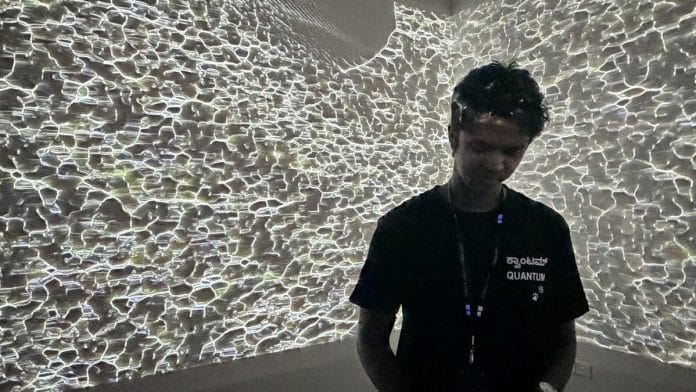
Then there is ‘Quantum Foam’, where graphics on the walls make it seem as though the room is inside a freshly poured glass, surrounded by a fizz of tiny bubbles. It illustrates how even a vacuum is not truly empty. At the quantum scale, particles continuously pop in and out of existence, much like the bubbles that continually appear and disappear in the foam.
Abhinav and Raghav, high-school students from Bengaluru, were visiting with their father, Srinidhi, an engineer at Philips. They had watched several videos about quantum physics on YouTube, but this was their first time encountering the subject beyond a screen or a textbook.
“Children need inspiration. Text can only take you so far. Concepts like these need different ways of reaching students,” Srinidhi said.
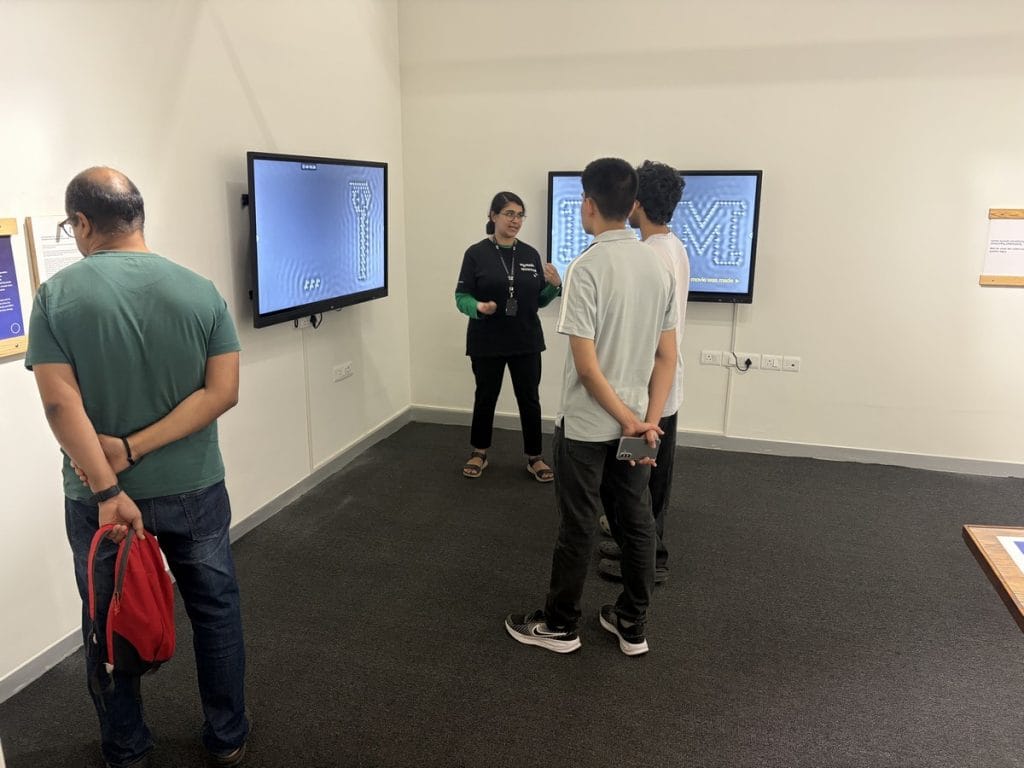
Experimenters take visitors through the installations, explaining what they mean while encouraging them to question, wonder and have fun with the ideas.
“We want visitors to see that quantum science is more than just a set of concepts,” said Rohit Taeja Kumar, one of the experimenters at Science Gallery Bengaluru. “Science connects us in so many ways, and it shouldn’t be seen as something that happens in isolation, or something that only a few people in research institutions can do.”
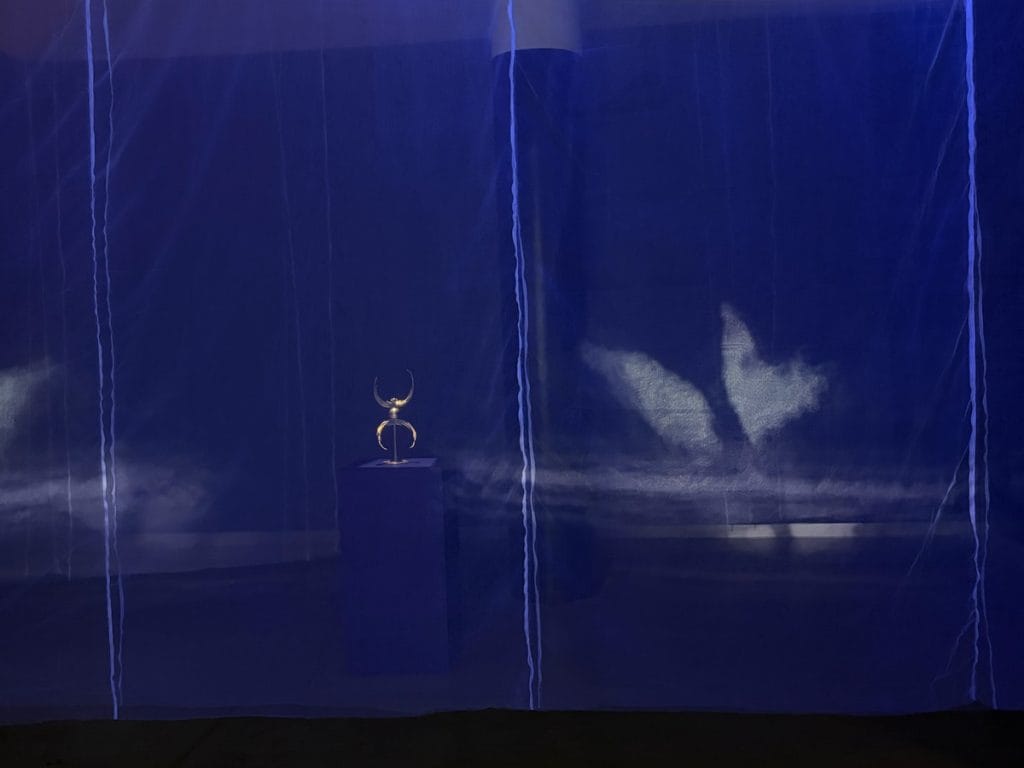
One installation, ‘Fowl Actions at a Distance’, first appears as a fuzzy shadow against a curtain. Slowly, it resolves into chickens pecking and wandering around a farm. The work explores a still-mysterious phenomenon: some birds can sense Earth’s magnetic field and use it to navigate. Recent research suggests that cryptochrome, a light-sensitive protein in birds’ eyes, may display a quantum mechanical effect that makes it sensitive to magnetic fields. The installation nudges visitors to imagine how the world might look from a bird’s perspective.
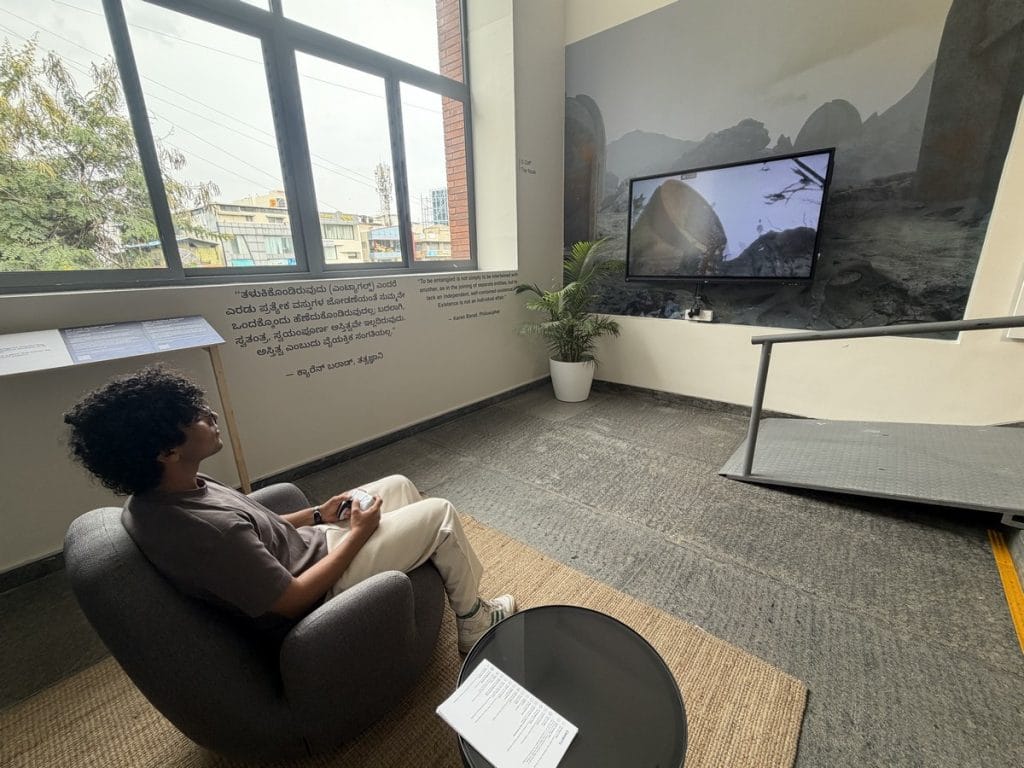
For Jay, 11, the highlight was a VR game in which players try to catch electrons, much like Pokémon. He was visiting with his grandmother Rohini and uncle Sanjeev, a consultant.
“Quantum physics is removed from everyday life. We live in a macroscopic world. This [quantum physics] is happening at a microscopic scale, but we want to understand what we cannot see. That’s human nature,” said Sanjeev.
Also Read: Patna is now a city of museums. Making its history great again
The missing links
The exhibition also asks who gets remembered in the story of quantum physics.
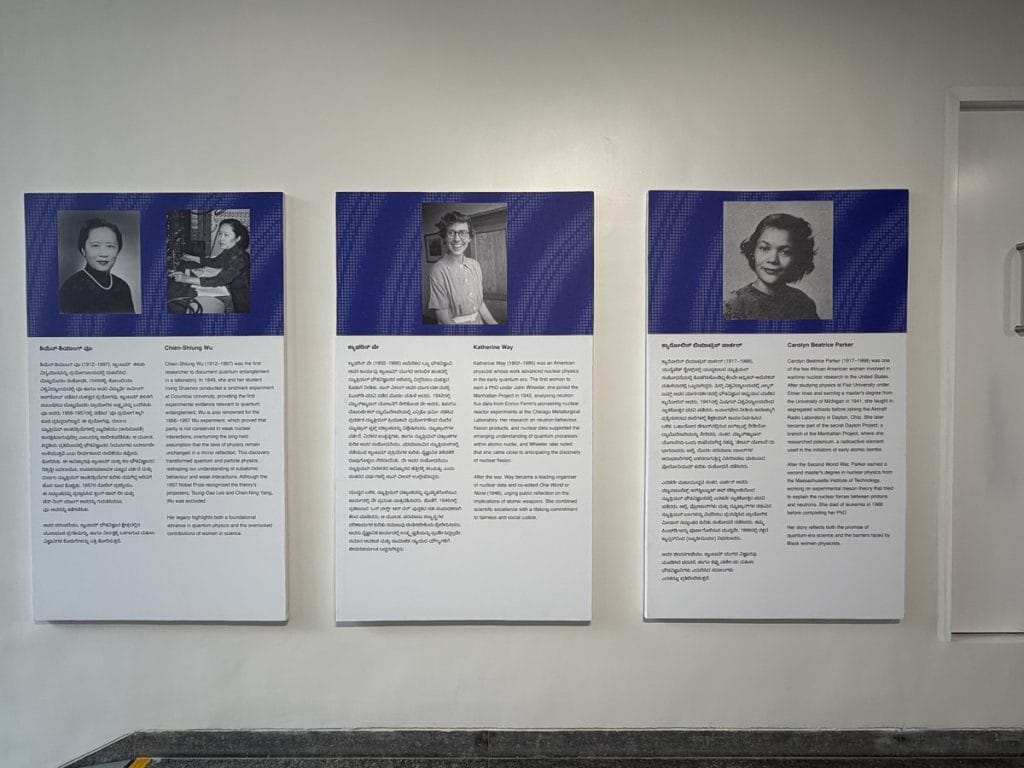
Much of the popular history of quantum physics has centred on a familiar cast of male scientists. Quantum, however, uses display boards to shine a spotlight on women whose stories have been left out of textbooks and conventional tellings of scientific history. There is Katherine Way, whose work helped advance nuclear physics; Chien-Shiung Wu, whose experiments made major contributions to modern physics; and Elizabeth Monroe Boggs, who worked in atomic science.
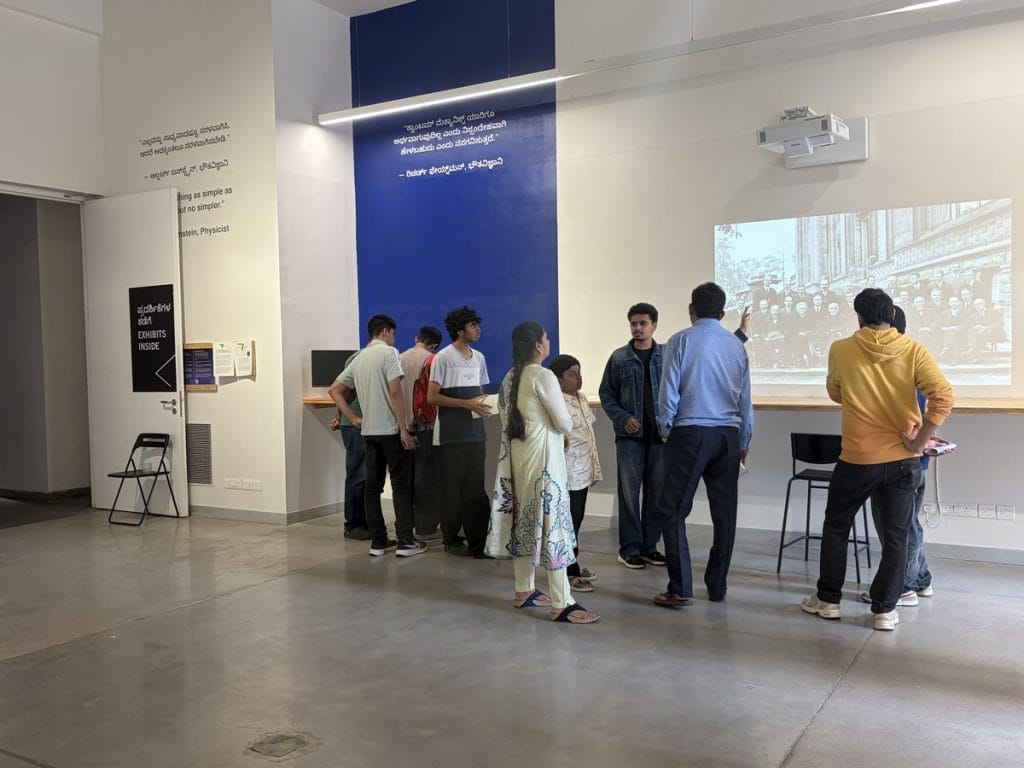
An archival display of photographs brings Indian scientists into the story too, including physicist SN Bose and Bibha Chowdhuri, India’s first woman particle physicist and a pioneering researcher on cosmic rays.
On the first floor, the history gives way to play. ‘Small Void’, a two-player game inspired by quantum entanglement, invites players to find each other in a world modelled on the ecology of lichens.
Evan and Divya, students from Christ University, sat on opposite sides of back-to-back sofas, trying to do just that in this simulated world through a series of call-and-response interactions.
“This exhibition has solidified what I learnt before through YouTube videos. I now see quantum science in a very different way. I didn’t know India has such impact of Quantum Science,” said Evan.
(Edited by Asavari Singh)