


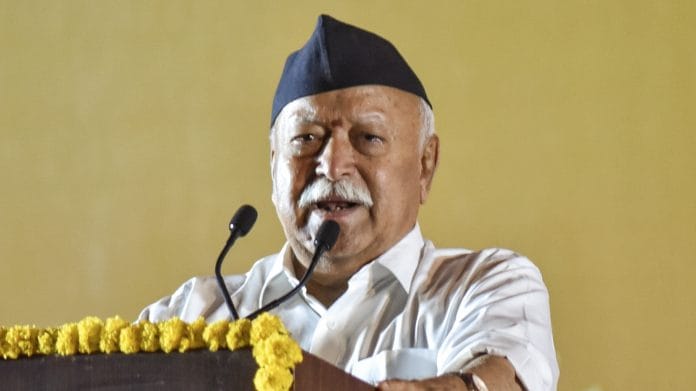
New Delhi: RSS chief Mohan Bhagwat’s latest remarks at a New York event emphasising inclusivity and Hindu-Muslim unity offers hope, said author and activist Ambreen Zaidi.
In an open letter to Bhagwat on Sunday, Zaidi said that while the RSS Sarsanghchalak’s statement that true Hindutva doesn’t exclude Muslims is welcome, the lived reality of Indian Muslims is starkly different, where they are routinely asked to prove their patriotism.
Below is the full letter.
“Respected Bhagwat ji,
Your recent words in New York deserve to be welcomed.
Speaking at the One World, One Humanity faith leaders’ gathering on 29 August, you said:
‘If any Hindu thinks that there should be no Muslim in Bharat, he will not remain Hindu.’
You added that anyone calling himself a Hindu must believe that all paths lead to the same goal, that every human being possesses inherent dignity, and that diversity must be accepted, respected and preserved.
As an Indian Muslim, I applaud this unequivocal assertion. At a time when exclusion is increasingly presented as patriotism and suspicion of Muslims as a test of national loyalty, your words carry enormous moral significance.
Nor is this the first time you have articulated such an inclusive understanding of Hindu thought.
During the RSS centenary dialogue at Vigyan Bhawan in August 2025, you said that Hindu thought does not compel others to change their path and respects other faiths. You described the Hindu ethos as inclusive and rooted in Vasudhaiva Kutumbakam, recognising the same essence in different forms.
I had the privilege of hearing you speak at Vigyan Bhawan, and came away with this thought: if India truly followed what you say in your speeches, it would be a land of peace and brotherhood, where hatred would have no place to stand. I have often wondered whether such a land is achievable at all. Hearing you speak made me believe that it could be. Yet the reality on the ground tells a starkly different story.
Bhagwat ji, there is a painful question that your words compel an ordinary Indian Muslim to ask:
Which India should we believe in the India described in your speeches or the India many Muslims increasingly encounter on the ground?
Between your message and our lived reality lies a disturbing distance.
Muslims are routinely asked to prove their patriotism. Their food, clothing, prayers, marriages and even their names become matters of public suspicion. Calls for their social and economic boycott are made openly. Derogatory labels such as “infiltrator”, “jihadi” and “traitor” have escaped the margins and entered mainstream political conversation.
A monitoring report documented 1,318 hate-speech events targeting religious minorities during 2025. It stated that 1,289 of those speeches targeted Muslims, either exclusively or alongside Christians. These figures come from an independent monitoring organisation and may be contested, but even allowing for disagreement over methodology, the frequency and public visibility of such rhetoric cannot honestly be dismissed.
We have watched homes and livelihoods being demolished immediately after communal disturbances or criminal allegations often before guilt has been established. In November 2024, the Supreme Court was compelled to condemn arbitrary “bulldozer justice” and declare that the state cannot punish an accused person by demolishing a home without due process. Critics have observed that this practice has disproportionately affected poor Muslims; the governments concerned maintain that they were acting against illegal construction.
We have seen mob attacks over allegations concerning cattle. We have heard public demands that Muslims be denied homes, businesses and places of worship. A terrorist attack committed by particular individuals is followed by collective suspicion of an entire community. Even Indian Muslims whose families have lived and died for this country are sometimes made to feel like guests whose citizenship is permanently conditional.
This is not distant reportage for me. I come from a family that has served the nation in uniform across generations in the Army, Air Force and police and I am married to an Army officer who devoted his life to defending this country. Yet I have been called “Pakistani”, “jihadi” and “mulli”, and subjected to unspeakable abuse. I have even been denied housing solely because of my religion. If my identity as an Indian remains suspect despite my family’s generations of service to this nation, I am left wondering: what test of patriotism could ever be enough?
I write this not to diminish the goodwill of millions of Hindu citizens. Innumerable Hindus stand beside their Muslim friends and neighbours every day, uphold India’s pluralism and refuse to participate in hatred. Nor do I suggest that prejudice or extremism belongs to any one community. Every community must confront the intolerance within its own ranks and I have consistently and publicly raised my voice against it within mine.
But the greatest responsibility rests with those who possess the greatest moral and organisational influence.
You lead an organisation that reaches tens of thousands of places and shapes the thinking of millions. Your words, therefore, cannot remain confined to the auditoriums of Vigyan Bhawan or faith conferences in New York. Their real test lies in whether they are heard and acted upon in our streets, electoral rallies, religious processions, television studios and WhatsApp groups.
If a person who seeks an India without Muslims is, in your words, not a true Hindu, will the RSS publicly distance itself from those who repeatedly propagate precisely that idea?
Will it tell its workers, supporters and associated public figures that threatening Muslims, calling for their boycott, humiliating them over their faith or treating them as lesser Indians is contrary not merely to the Constitution, but also to the Hindu ethos you have described?
Will it stand beside an innocent Muslim family when its home is attacked or demolished as visibly as it speaks of harmony from an international platform?
Will the Sangh initiate a sustained national campaign not merely a dialogue or symbolic outreach against anti-Muslim hatred and for the equal dignity of every Indian?
These questions are not accusations. They arise from a genuine desire to believe you.
Indian Muslims do not seek indulgence, appeasement or special treatment. We seek only what belongs to every citizen: equal protection of the law, freedom to practise our faith, dignity in our identity and the right to live in our own country without repeatedly having to establish that we belong here.
Our forefathers chose India, served India, fought for India and, in countless cases, laid down their lives for India. We are not here on anyone’s sufferance. We are part of the story, soil and future of Bharat.
Your latest statement offers hope. But hope must be made visible.
Bhagwat ji, your words are reassuring almost too good yet what many Muslims witness around them is starkly different. Between these two realities, what should a common Muslim believe?
I hope you will help answer that question not through another speech alone, but through an unmistakable movement on the ground one that tells every Indian, in word and deed, that no citizen’s faith makes them less worthy of dignity, safety or belonging. I say this because I sincerely believe that, if you resolve to do so, you possess the moral and organisational influence to bring about this change through your karyakartas, thousands of shakhas across the country and the Sangh’s wider network around the world. You have the power to ensure that the harmony expressed in your speeches becomes a reality in our streets, neighbourhoods and everyday lives.
If that happens, your words in New York will be remembered not simply as a fine statement, but as the beginning of a necessary national course correction.”
(Edited by Aamaan Alam Khan)
Yes . As per international reports 30 percent muslims are extremists and the rest silent supporters and spectators. So no one believes muslims in the non Islamic world . Why India alone ?