





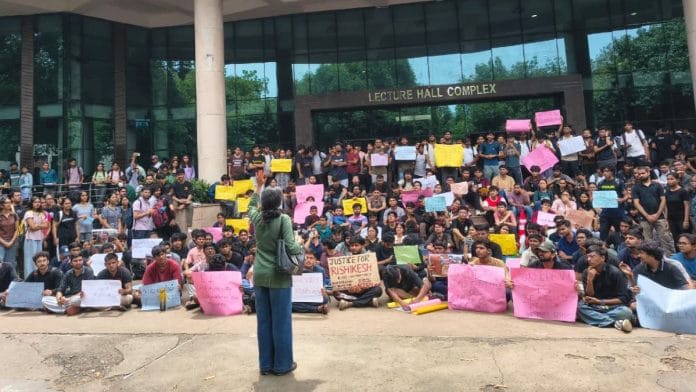

New Delhi: Hundreds of IIT Delhi students assembled outside director Rangan Banerjee’s office Monday to demand accountability after the death of Rishikesh Kumar, a second-year MSc Physics student from Patna, Bihar. The protest, which began at the Lecture Hall Complex at 9 am, shifted to the area outside the director’s office by the evening after the students’ meeting with the administration ended without resolution on the core demand.
“We were protesting at the Lecture Hall Complex because that is where he fell, and now we have moved to the director’s office because this is where decisions are made,” a master’s student at the campus told ThePrint.
On Tuesday, students were back at the Lecture Hall Complex with three main demands: “Investigation, resignation, and compensation.”
Kumar (31) died on 22 August after falling from the sixth floor of the Lecture Hall Complex. As per reports, Delhi Police received the call at about 8:33 am. While no suicide note was found, the police are examining Kumar’s phone and counselling records.
“The counselling records and other relevant information from the institute are being obtained, and the facts are being verified. Further legal action is being taken as per law,” the Delhi Police has mentioned in its official notice.
Students allege that Kumar had been under great distress on account of being denied a research project and hostel accommodation.
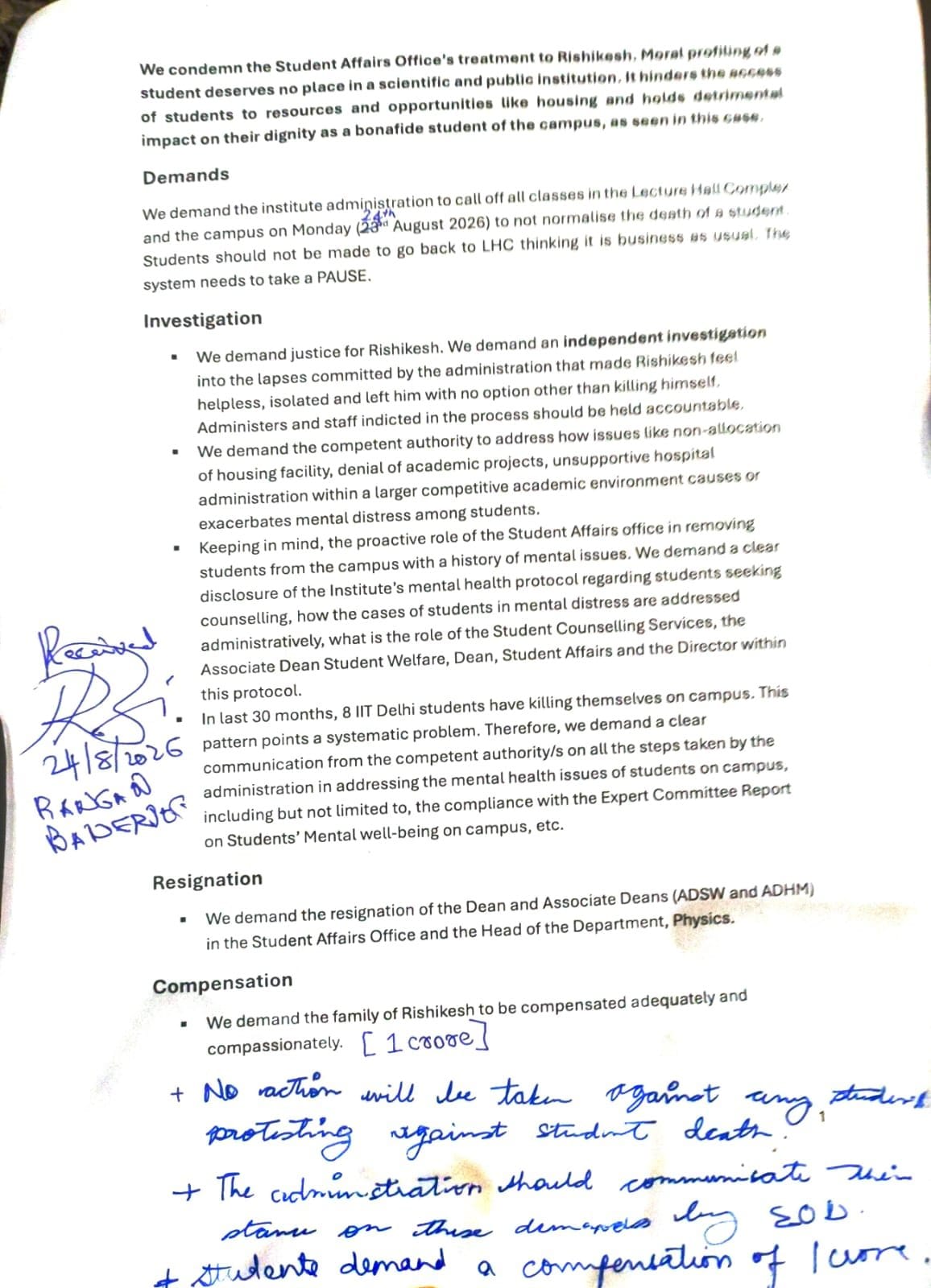
They presented a formal list of demands to the campus administration that was signed as received by director Rangan Banerjee.
“We condemn the Student Affairs Office’s treatment of Rishikesh. Moral profiling of students deserves no place in a scientific and public institution,” the document said. “It hinders the access of students to resources and opportunities like housing and has a detrimental impact on their dignity as a bonafide student of the campus.”
Over 70 IIT students across India have died by suicide in the last five years. Kumar’s death is the second such case at IIT Delhi since March, when Harshit Swami, a first-year BTech student, died by suicide in his room. Since July 2023, eight students have died on the Delhi campus. Now, demonstrators are asking how many more lives must be lost for the administration to create a mental health protocol. Even as the university director responded to the demands via a late-night email, students say they won’t stop fighting until the key demand—the resignation of the dean and associate deans of student welfare—is met.
In the early hours of Tuesday, Banerjee issued an email detailing the institute’s response after the protest. He said the administration had met student representatives and other students multiple times—first in Dogra Hall at 9 am, then at the Lecture Hall Complex, and later in the Senate room and Main Building.
“An External Inquiry Committee is constituted with the mandate of investigating the circumstances leading to the tragedy of Mr Rishikesh Kumar’s death. The committee will discuss with relevant students, faculty and the concerned admin offices, review protocols and processes and make recommendations,” the email stated.
The panel, asked to report within two weeks, includes former Uttarakhand DGP Ashok Kumar (an IIT Delhi alumnus), AIIMS Psychiatry Head Pratap Sharma, two student representatives, and the Registrar as secretary and convenor.
The institute also committed to reimbursing medical expenses, providing support from the benevolent fund, and creating a voluntary contribution fund for Kumar’s family. It announced plans to appoint an external ombudsperson for unresolved grievances and an additional faculty-plus-student mentor system for students with mental health issues who need parental supervision.
The email gave the institute’s account of Kumar’s time on campus. He joined the MSc Physics programme in July 2025, stayed in Shivalik Hostel and performed well in his first semester. In March 2026, he developed mental health issues and was advised by the counsellor and psychiatrist to remain under continuous parental supervision. He withdrew from the second semester. On returning in July 2026, the advice was repeated; he continued living off campus with a parent and later withdrew from the third semester, which the Physics Department approved.
Aside from the email sent at 1 am, the university has refused to address any media queries.
“As long as the demand for resignation is not met, we won’t deter,” said the protesting student who is currently pursuing a master’s degree at the university. “They broke their promise and they delivered the mail at 1 am at night, after they promised that they would do it by the end of the day, but they have failed on that account too.”
Speaking on behalf of the other protestors, he noted that the students are unsatisfied and angry with the administrative response.
IIT Delhi students hold fort untill the demands are met!! Justice for Rishikesh! We demand Accountability!! https://t.co/61mWp7QbEP pic.twitter.com/qoCeLUR93D
— wazziii (@hopelessmalakha) August 24, 2026
‘Counselling services failed Rishikesh’
Classes were suspended across campus on 24 August following student demand. The protestors sought to ensure that Kumar’s death was not treated as routine. The listed demands also include an independent investigation into administrative lapses that left Kumar feeling isolated; accountability for those involved; and a clear explanation of how non-allocation of housing, denial of academic projects, and the response of the hospital administration contributed to Kumar’s mental distress.
The students also seek a disclosure of the institute’s mental health protocol, including the roles of student counselling services, the associate dean of student welfare, the dean of student affairs, and the director. The official list of demands also asked for details of steps taken to address the pattern of student suicides at the institute, including compliance with the Expert Committee Report on Students’ Mental Well-being.
A student who attended the meeting with the administration said it deteriorated after problematic remarks and a walkout by Sreedevi Upadhyaula, the dean of student welfare.
“She made insensitive statements about the student who died; she was part of refusing hostel accommodation (to Kumar). And in the meeting, she even made a casteist remark comparing students to Ekalavya,” the PhD student said on the condition of anonymity.
The administration initially offered Rs 6 lakh as compensation and indicated it would examine the figure further. Students said the institute has agreed to an inquiry but is resisting the demand for the deans’ resignations, which the demonstrators view as an attempt to exhaust the protest.
“The inquiry they keep promising is the easy part,” said the master’s student. “The resignation is what they do not want to give. If the Student Affairs office can refuse housing and then sit in a meeting and speak the way they did, then the people responsible should not continue in those posts.”
The students fear administrative action against those taking part in the protest, and are hesitant to go on record.
Campus security remains tightened, with only those carrying valid IIT identity cards allowed entry. The administration has not responded to media queries beyond the late-night email. Students said they would continue pressing for resignations and fuller accountability.
“Thousands of students are protesting after the MSc student’s death. Rishikesh was fighting depression but instead of helping, IIT Delhi threw him out of Hostel and even denied him Research project,” wrote a user on X.
Lakhs spent in coaching & tuition fees every year to send young students to suicide?
The celebration at enrollment in IITs, all leading to young deaths?
How many deaths will it take till we know that too many students have died?#IITDelhi pic.twitter.com/BDIqNrOwEx
— Neha (@neha_aisa) August 24, 2026
On Sunday, JNU students held a protest outside IIT Delhi’s Gate No 5. JNUSU General Secretary Sunil Yadav said the demonstration was held because suicides at IITs were being normalised.
“The institutions are responsible for the students’ suicides. This cannot be normalised,” he said.
He cited earlier cases, including Rohith Vemula, Darshan Solanki, Payal Tadvi, and said students from marginalised sections were repeatedly forced to dropout or worse.
“Ever since Rohith Vemula’s death, a campaign has been running for the Rohith Act to be implemented. So that no student has to face discrimination,” he said.
The Rohith Act is a proposed central law that seeks to prevent caste-based discrimination in higher education institutions and provide proper redressal mechanisms for students from marginalised communities. Yadav added that data from past cases showed most students who faced such discrimination came from marginalised sections.
IIT Delhi already runs Student Counselling Services. Students say the existing system failed Kumar and want it made more transparent and effective. Even at IIT Kharagpur, which operates the SETU counselling centre, student surveys have repeatedly flagged gaps in accessibility and emotional support despite the formal structure.
“The counselling service exists, but you can guess the effectiveness of it based on the sheer number of suicides,” a protesting student said.
Also read: How Punjab’s Canada dream came crashing down
How Rishikesh Kumar prepared for IIT JAM
In an interview of Kumar uploaded to YouTube a year ago, host Keshav Mishra shared that before getting into IIT Delhi, Kumar was pursuing civil engineering at NIT Rourkela but had to drop out of the course due to financial problems.
“Then he did BSc—he didn’t give up—and in the third year of BSc he gave the IIT exam and got into IIT Delhi… It’s no small feat,” the host said in Hindi.
Kumar revealed that he prepared for JAM while also giving tuitions at home so he could earn.
“After college, I would give tuitions at home, and I would teach at a coaching institute here and there… I prepared for JAM (Joint Admission Test for Masters) through Unacademy,” Kumar said in the interview.
The student who had cracked both JEE Main and JAM enjoyed playing chess and table tennis as well as singing. In the interview, he sang some lines from ‘Dil Ka Jo Haal Hai’, a song from the Ranbir Kapoor-starrer Besharam (2013).
“You’ve come here, so have a good time and leave happy,” he said after he was done singing, a cheerful smile on his face. “People are anyway living sad lives; sadness is everywhere.”
If you are feeling suicidal or depressed, please call a helpline number in your state.
(Edited by Prasanna Bachchhav)