







New Delhi: Nearly a decade after its publication, Musafir Cafe is finally making its way to the screen. The novel, written by Divya Prakash Dubey and published by Hindi Yugm in 2016, will premiere as a Netflix series this year, directed by Ruchir Arun and starring Vikrant Massey. It shows that the Hindi narratives that once gave Bollywood its most compelling works have now been shipped off to the OTT space.
Hindi literature has long been a rich source material for Indian filmmakers. Directors such as Satyajit Ray, Mani Kaul, Shyam Benegal, and Awtar Krishna Kawl turned to literary works at a time when Indian films were at the forefront of the parallel cinema movement.
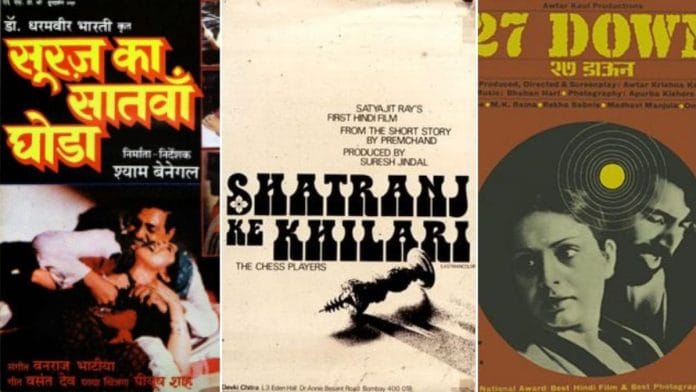
Films such as Gaban (1966), Sara Akash (1969), Shatranj Ke Khilari (1977), Sooraj Ka Satvan Ghoda (1992), and Naukar Ki Kameez (1999) brought celebrated literary works to the screen. However, after the 1990s, such films began to decline. Producers became more cautious about investing in stories whose readership was limited. In an industry driven by box-office returns, literary adaptations gradually came to be viewed as riskier than franchise films, romances, and remixes.
“If you look at America or the West today, every second or third project that gets made is based on some English book, right?” writer Dubey told ThePrint in Hindi.
Musafir Cafe revolves around Chander and Sudha, both of whom are not interested in marriage. However, under pressure from their parents, they meet every weekend. As they try to understand what love means in a modern context, life takes them on separate paths. They reunite a decade later and rediscover their bond.
Dubey didn’t write the novel with the expectation that it would be adapted for the screen. According to him, doing so can dilute the effort a writer puts into their book.
“A book is a different medium. There are words, black words printed on pages, from which you have to create a whole world,” he said. “And it’s a self-sufficient medium. Even if nothing else comes out of it, it is at its best in that very form.”
The writer added that several contemporary works, such as Arthala (2016) by Vivek Kumar and Nilotpal Mrinal’s Vishwaguru (2026), are deserving of being adapted as movies or series. And Dubey doesn’t blame the decline in the adaptations from Hindi literature on writers, directors, or actors. Instead, Dubey said, it is a result of the people sitting in studios not being well-acquainted with contemporary Hindi stories.
In the last few decades, a book must become commercially successful and attain bestseller status before it can earn the trust of producers. The idea is that the lakhs of readers who connected with the book will also be interested in a series or movie. This model has worked for English bestsellers such as The Namesake (2006) by Jhumpa Lahiri, which was adapted into a movie with the same name by director Mira Nair in 2006. The 3 Mistakes of My Life (2008) by Chetan Bhagat inspired Kai Po Che! (2013). More recently, The White Tiger(2008) by Aravind Adiga was adapted into an internationally acclaimed film. However, such examples remain rare when it comes to contemporary Hindi literature.
“The producer gets the confidence that, ‘Oh yes, man, this thing which is becoming so hit, we should definitely make it.’ If you look at it numbers-wise, Hindi books just weren’t hitting the mark from 2001 to 2015,” he said.
Making Hindi books accessible to younger readers involved adapting to their world. Dubey calls it Nayi Wali Hindi, or New Hindi, which seeks to reflect modern realities. Another way Hindi Yugm put the books within reach of younger, middle-class readers is by lowering prices.
“Publishers relied on bulk library purchases to survive. But when our books came out, their MRP was around Rs 100 or Rs 120, so that we could reach the common public directly,” he said.
Why aren’t more Hindi books reaching the screen?
According to Shailesh Bharatwasi, editor-in-chief of Hindi Yugm, even on OTT platforms, adaptations of Hindi books remain rare. And the trend is increasingly driven by filmmakers’ search for authentic and rooted narratives than by any change in writing styles, Bharatwasi said.
As audiences increasingly seek stories grounded in small towns and local cultures, creators have once again turned to books for source material.
“What I do believe is that since a lot of rooted content is currently trending. Especially after the arrival of OTT platforms, there is an increased demand among consumers for highly localized and rooted content such as Panchayat, Gullak, and Jamtara,” he said.
Bharatwasi argued that books often provide the authenticity filmmakers are looking for.
“I believe that the adaptation of books like Musafir Cafe is perhaps because they’re relatable to audiences,” he said.
Other novels published by Hindi Yugm, such as UP 65 (2017) by Nikhil Sachan and Chaurasi (2018) by Satya Vyas have been adapted for OTT platforms as web series. While these works have found audiences in the OTT space, contemporary Hindi novels have rarely made the transition to the silver screen.
Also read: Roti Kapada Aur Makaan captured India’s crises in the 1970s
The economics behind the decline
Mihir Pandya, Hindi professor at the University of Delhi, argues that the economic structure of the film industry played a crucial role in sustaining literary adaptations and parallel cinema.
As India gradually moved from a socialist economic framework toward liberalisation and globalisation, state-backed funding for cinema declined. At the same time, foreign investment entered the media and entertainment sector, increasing the pressure on filmmakers to generate profits. While parallel cinema did not disappear entirely, its influence became less pronounced as commercial considerations gained importance.
“The reason for the rise of parallel cinema was the funding filmmakers received from government organisations and autonomous bodies such as the National Film Development Corporation,” Pandya said.
Films such as Maya Darpan (1972), Duvidha (1973) and Ek Doctor Ki Maut (1990) benefitted from this ecosystem. The film 27 Down (1974), directed by Awtar Krishna Kawl, was adapted from Ramesh Bakshi’s novel Atharah Suraj Ke Paudhe (1965) on a budget of around Rs 8 lakh. Kawl invested Rs 3 lakh from his own pocket.
In recent times, NFDC has supported films such as Lunchbox (2013) and Tanvi: The Great(2026), though such projects remain the exception rather than the norm.
The kind of films being produced in Bollywood changed significantly after the 2000s. The first decade of the new century was dominated by comedies such as Hera Pheri (2000), Golmaal(2006), Bhool Bhulaiyaa (2007), Bheja Fry (2007), All The Best (2009), and Housefull (2010). Family dramas and Rom-coms such as Kabhi Khushi Kabhie Gham (2001), Kal Ho Naa Ho(2003), and Veer-Zaara (2004) also found a massive audience.
The following decade saw a growing dependence on remakes of commercially successful South Indian films. Movies such as Wanted (2009), Bodyguard (2011), Singham (2011), Rowdy Rathore(2012), Drishyam (2015) and Kabir Singh (2019) were reworked for Hindi audiences, offering producers stories that had already proven their box office appeal.
“Once films began relying on commercial funding, only certain kinds of projects could be made. Producers are unlikely to invest crores in a film adaptation simply because a filmmaker admires a particular writer,” he added.
In recent years, franchise films, pan-Indian blockbusters, and action-heavy spectacles have come to dominate the industry. As Bollywood increasingly favours the market-tested formula, adaptations of Hindi literary works are anything but mainstream.
Actor Avijit Dutta, who have worked in films such as Madras Cafe (2013), Mission Majnu (2023) and Gandhi to Hitler (2011), said that Hindi movies today are made for multi-screen urban centres. Rural audiences are not catered, and the reality that Hindi literature touches might scare the producers.
“I find producers are not great readers… rather than concentrate on literature, that, in its specificity, becomes universal, they take the easy way out of doing variations of Korean, Chinese, and Hollywood crowd pleasers,” he said.
(Edited by Prasanna Bachchhav