






Manoj Kumar was a Punjabi refugee from Delhi, driven by a passion for filmmaking and inspired by the legendary Dilip Kumar. He was also deeply politically astute.
Having already made Upkar (1967) to heed Prime Minister Lal Bahadur Shastri’s call of ‘Jai Jawan Jai Kisan’, he returned in 1974 to address the nation’s next chapter. This time, he was responding to Indira Gandhi’s 1971 election slogan, ‘Roti, Kapda Aur Makaan’, which is again in the news today, being compared to Prime Minister Narendra Modi’s exhortation on austerity due to the ongoing West Asia crisis.
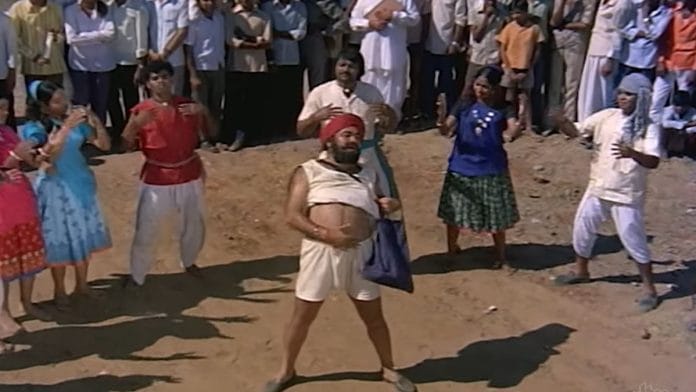
Written, directed, and produced by Manoj Kumar, Roti Kapada Aur Makaan had an ensemble cast of Shashi Kapoor, Amitabh Bachchan, Zeenat Aman, Moushumi Chatterjee, Aruna Irani, and Madan Puri.
A portrait of disillusionment
This is a story of a poor family of three brothers and one sister. Bharat (Manoj Kumar), the eldest, can only find sporadic work as a low paid singer, despite being a graduate. His frustration peaks when their father dies of poverty, prompting Bharat to throw his useless college diploma onto his father’s burning funeral pyre.
This scene was inspired by a news report from 1972 where a young graduate tore off his degree in front of the university vice-chancellor.
His younger brother, Vijay (played by a pre-Deewar Amitabh Bachchan), grows cynical and turns to crime, abandoning the family after a fierce argument with Bharat.
Bharat’s singing partner and romantic interest Sheetal (Zeenat Aman) aspires to live a better life. She takes a secretarial job under a rich businessman, Mohan Babu (Shashi Kapoor), and eventually accepts his marriage proposal, leaving Bharat heartbroken.
A depressed Bharat gets a job in construction, and is kind toward Tulsi (Moushumi Chatterjee), a poor, exploited worker at the construction site.
In one of the film’s most visceral sequences, Tulsi is brutally assaulted in a grocery warehouse and left buried under a mound of flour. Strikingly, Chatterjee shot this intense sequence while heavily pregnant. She inhaled flour and was sick for a long gruelling night, a testament to the raw, demanding nature of the project.
Bharat loses his job when the project is taken over by the government.
Unable to arrange dowry for his sister, Bharat’s principles crumble. He accepts a Faustian bargain from a corrupt businessman, Nekiram (Madan Puri), running illicit operations, to ward off poverty.
The youngest brother Deepak (Dhirendra Kumar) joins the police force. Bharat decides to turn informant and is framed by Nekiram instead. Fate pits the two brothers against each other as Deepak is tasked to arrest Bharat.
Sheetal regrets giving up on her love for a life of comfort. In a bid to protect Bharat, she ultimately sacrifices her life.
A reformed Vijay, who had joined the Army, returns to the family. In classic 70s Hindi cinema fashion, the gritty social drama explodes into a spectacular action crescendo. The brothers and their allies manage to foil the nefarious plans of the bad guys and get them jailed.
With approving nods from his family and prodding by a dying Sheetal, Bharat accepts the resilient Tulsi as his wife.
The prevailing milieu of the ’70s
The 1970s was the first time when the rose-tinted glasses came off; the socialist fantasy clashed with the harsh reality of a growing population and rising corruption in the public distribution system. In a time of agrarian crisis and huge dependence on a good monsoon, everything was rationed. It was a time when one had to stand in line to get the necessities of daily life — kerosene oil, wheat flour, and sugar.
The making
The original choice for Sheetal was Sharmila Tagore. She was more interested in Tulsi’s role. Manoj then turned to Smita Patil who was a television newsreader in Bombay. However, she was not interested in commercial films at that time. He then turned to Zeenat Aman.
In the late 60s, long before Saat Hindustani (1969) marked Amitabh Bachchan’s debut, Manoj Kumar had interacted with the lanky youngster from Delhi and promised him a role in a future film. Manoj Kumar kept his promise and cast him in Roti Kapada Aur Makaan. This is the only movie in which we see them together.
He also gave work to stunt director Veeru Devgan who went on to have a long career in the movies.
The film was shot in Delhi and in different studios in Bombay.
Also read: In Saagar, community clashes with capitalism. The film marked Dimple Kapadia’s comeback
Box office and musical legacy
Made with a budget of Rs 1.3 crore, Roti Kapada Aur Makaan, released on 18 October 1974, was the highest grossing movie of 1974, collecting about Rs 10 crore.
The film’s songs were written by Verma Malik and Santosh Anand, music was provided by Laxmikant Pyarelal, and playback singing by Lata Mangeshkar, Mukesh, Mahendra Kapoor, and Narendra Chanchal. Originally, the popular song ‘Haye Haye Yeh Majboori’ was supposed to be shot on Moushumi Chatterjee, but since she was pregnant, it was picturised on Zeenat Aman.
On the 1975 Binaca Geetmala Annual Chart, the film achieved a rare double crown: ‘Mehngai Mar Gayi’ was ranked first while ‘Haye Haye Yeh Majboori’ was on second number on the chart.
Roti Kapada Aur Makaan got three Filmfare Awards against 11 nominations — Best Director for Manoj Kumar, Best Lyricist for Santosh Anand, and Best Playback Singer (Male) for Mahendra Kapoor.
The movie was remade in Telugu as Jeevana Poratam starring Sobhan Babu, Vijayshanti, Radhika, and Rajnikanth in 1986, and was a hit there as well.
Views are personal.
(Edited by Aamaan Alam Khan)