





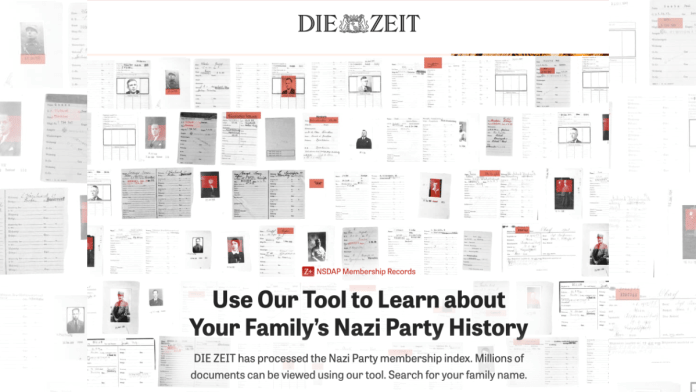


New Delhi: The legacy of the Second World War lives on, bringing with it questions about Nazi party members. Using artificial intelligence, German newspaper Die Zeit has been able to compile a database of Nazi Party members.
Germans can now access the database to search for their family members and their possible ties to Adolf Hitler’s party. The newspaper used digitised versions of records released online by the United States National Archives to create 4.5 million index cards.
Reporters, data journalists, and data scientists at Die Zeit scanned millions of documents to create the searchable database.
The process
When the US archives first released National Socialist German Workers’ Party membership details online, the website crashed. Before this, however, if one wanted to access Nazi Party membership details, a formal request was submitted to Germany’s Federal Archives, or one had to go through thousands of microfilms housed in Washington, DC.
But Die Zeit turned 5,442 PDF files, each containing roughly 3,000 pages of scanned membership cards, into an easily accessible public resource.
The database collected details from both the Central Card Index and the Gau Card Index; together, the records comprise almost 90 per cent of all Nazi members between 1925 and 1945. Jürgen Falter, a political scientist who studies the Nazis, told Global Investigative Journalism Network that only about 40 per cent of the Central and 77 per cent of the Gau survived the war.
The team used optical character recognition (OCR) to convert images into machine-readable text and Google’s Gemini to interpret the text.
Andreas Loos, head of the newspaper’s data science and AI desk, said that the AI models could easily read the difficult visual data, including Kurrent and Sütterlin, two old German handwriting scripts.
“AI was already a major part of our toolkit. Especially in combination with powerful search applications, it will play an increasingly important role in handling and analysing large datasets,” Loos said.
The result
While some errors and AI-generated hallucinations remained, the newspaper asked readers to report them via email to perfect the database further.
Along the way, the team also analysed how Nazi Party membership changed and evolved over the years. In Hitler’s Germany, conscription to the Wehrmacht, German armed forces, was obligatory, but joining the Nazi Party was not.
The journalists found that people joined the Nazi Party in several waves.
“Only a relatively small fraction joined before 1933. After the Party took power, there was a huge spike in new memberships, and they closed the Party to new members. When they reopened it in 1937, you see the second huge spike. Timing is a key factor in understanding the motives,” said Gregor Aisch, a visual data journalist at Die Zeit. He even discovered that his grandfather was a “proud” card-carrying member of Hitler’s party.
The database soon gained popularity even outside Germany and was quickly made available in English as well. Since then, the newspaper has continued to report on stories shared by their readers as well as those that they discovered during their research.