



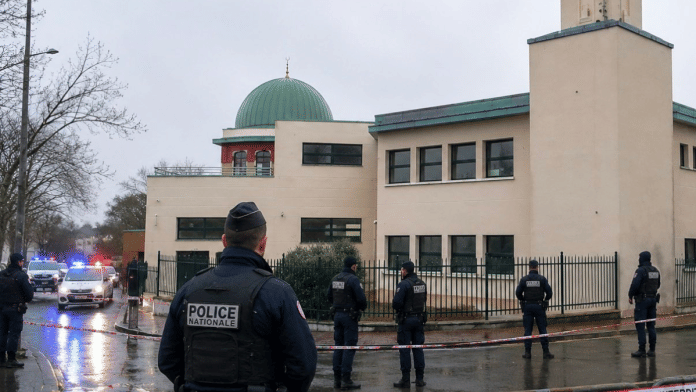

New Delhi: A French regional court has upheld the closure of a mosque in Aulnay-sous-Bois near Paris for six months. The authorities argue the sermons and religious teachings delivered there were concerning.
This, however, is not the first time that France has tried to censor religious thought.
The Chanteloup mosque’s recent suspension by Seine-Saint-Denis prefect Julien Charles was challenged at the Montreuil Administrative Court. However, the court claimed that Charles “did not commit a serious and manifestly illegal infringement of either the freedom of worship or the freedom of expression.”
Authorities objected to the imam’s preaching of seven passages from the Quran as well as traditional Islamic texts such as The Garden of the Righteous and The Forty Hadiths by 13th-century Islamic scholar Imam al-Nawawi, says the Middle East Eye.
The States also objected to references to “hell” and “punishments of the grave” for the “unbelievers”; common themes often found in churches and temples across the country.
Rafik Chekkat, the mosque’s legal counsel, questioned whether imams in the country were still allowed to practice religious freedom.
“In France, can an imam still quote the Quran in the mosque where he preaches?” Chekkat questioned.
The lawyer said that he was very disappointed by the court’s decision, before adding that they will challenge the Montreuil court’s verdict.
“We will file an appeal before the Council of State to defend religious freedom, freedom of expression, and the principle of secularism,” Chekkat said.
What does it mean for Islam in France?
In 2021, a Beauvais mosque was also shut down for six months due to the radical nature of its imam’s preaching, calling it “unacceptable.”
In 2020, France’s Minister of Justice Gérald Darmanin announced a crackdown on 76 mosques in the country. He added that all mosques would be inspected and any found to be “breeding grounds of terrorism” would be shut.
Writing for The Spectator, Matthew Fraser, professor at the American University Paris, said that the bigger question behind the government’s crackdown is the compatibility of certain forms of Islam with French society and values.
“For the French state, its legal powers to control extremist mosques are at stake,” said Fraser, adding that the French Republic faces similar tensions with the Catholic Church.
But, he argues, as France heads toward a heated presidential election, the issue of radical religiosity will only increase.
“Tackling radical Islam cuts across partisan lines, as socialist, centrist, and conservative governments have cracked down on extremist imams. The only exception is France’s far-left parties, which exploit clientelist arrangements with Muslim community leaders to mobilise voters under their control,” said Fraser.