



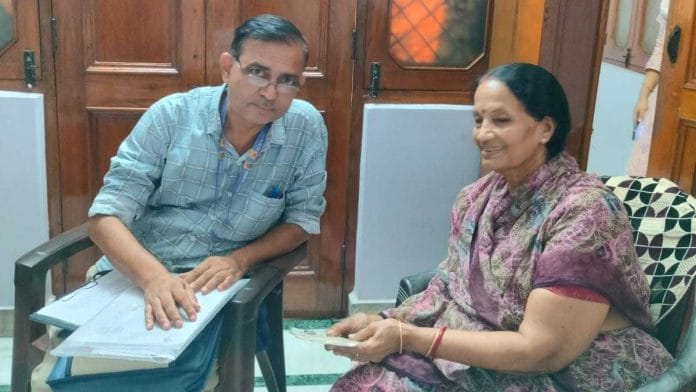
New Delhi: With a thick bundle of enumeration forms tucked under his arm, 52-year-old Booth Level Officer Karun Kumar Bhatt begins another day of door-to-door visits for the Special Intensive Revision exercise in east Delhi’s Vishwas Nagar area.
Before he can even explain his visit, the residents bombard him with their questions: “How do we fill this form?” and “Where can we find the 2002 voter list?” By evening, Bhatt will have answered these questions countless times, guiding residents through a process that most are encountering for the first time.
Since the Election Commission’s Special Intensive Revision (SIR) exercise began in Delhi on 30 June, Bhatt’s routine has remained unchanged. Everyday, he starts at 9 am with house visits, distributes forms, explains the procedure to residents, collects completed forms, and corrects mistakes. For him, the challenge is not the walking or paperwork, but making people understand the exercise.
“The government started the process without creating enough awareness or giving proper guidance to people. Most residents still don’t know what it is about. So the first task is to convince them that we are genuine officials,” Bhatt says.
From voters struggling to locate their names on the 2002 electoral rolls to migrant families tracing decades-old records, Booth Level Officers are at the forefront of tackling a wide range of concerns on the ground. Juggling between paperwork and verification, BLOs have found themselves taking on the role of counsellors and problem-solvers—answering the same questions repeatedly, clearing doubts and guiding people through the revision process.
“Many people don’t believe us or refuse to talk because they have no information about the process. Some ask us to come later, which means repeated visits to the same houses and more time spent to complete the exercise,” says a BLO from Old Delhi, requesting anonymity.
More than 13,000 Booth Level Officers (BLOs) have been deployed across all 70 Assembly constituencies in Delhi to conduct the SIR exercise, which is aimed at updating electoral rolls. BLOs are usually local government employees—including teachers, Anganwadi workers, ASHA workers, and clerical staff— who are assigned election duties in addition to their regular work. But their work does not end after field visits.
“BLOs are the most vulnerable workers in this process. Their working hours are hardly counted,” says Sushil Sharma, BLO Supervisor, East Delhi. “After spending roughly eight hours on the ground visiting homes, BLOs must scan and digitise each form using a government app.”
Also Read: What SIR in Delhi’s Shaheen Bagh looks like. Hunting for documents, avoiding rumours
When residents have no documents at all
As BLOs help residents trace their names on the reference 2002 electoral rolls, they are encountering one of their biggest challenges — cases where voters are unable to find their own names or the names of their parents or grandparents in the current voting list. This prevents them from getting the enumeration form, the first step to get through the multi-phase SIR process.
“We often come across people who do not have a voter ID or EPIC (Electors Photo Identity Card) number. In such cases, we collect their basic details — name, address, constituency and other information — and try to trace their electoral records,” said a BLO from Vasant Kunj in south Delhi.
He explained that after locating a voter’s basic details and EPIC number, BLOs try to match the information with the 2002 electoral rolls. For migrant voters, they also check electoral records from their home states to establish the connection.
Recalling a recent incident involving a migrant family from Bihar, Bhatt explained how he helped the family locate their names in the electoral rolls of both Delhi and Bihar.
“I sat with them and checked the records online. After not finding their names anywhere, I guided them through the next steps. They first had to fill out Form 6 and later submit the required identification documents,” said Bhatt.
In rare cases, neither the voters nor their parents can be traced in any electoral list. In such a situation, the individual will need to submit Form 6 online through the Election Commission’s voter portal and get enrolled as a new voter. But such voters will be called for hearings by the concerned Election Registration Officer (ERO) during the second phase of the SIR verification process. The voters may be asked to show additional documents including birth certificates, passports, educational certificates, government IDs, and residence certificates.
“Our role is no longer limited to explaining the procedure. When people cannot find their names or documents, they often panic,” said the officer from Vasant Kunj. “We have to reassure them, provide emotional support, and guide them about the next steps, including the notices or additional documents they may be asked to submit.”
Filling the enumeration form correctly
Bhatt, who is a fine arts teacher at a government school in New Seelampur, has been taking up BLO duties for more than a decade. But the ongoing SIR exercise has brought on different kind of hurdles.
“Where do we find the 2002 voter list?” has become the most common question Bhatt and other BLOs are asked every day. A simple query, but one that often takes up a significant part of their time as they sit with residents and search through old records day in and day out.
BLOs often carry physical copies of the 2002 electoral rolls with them during their field visits. These records are not limited to their assigned polling areas; many BLOs also carry lists from nearby blocks to help out residents more effectively. They also keep scanned copies of the electoral lists on their tablets or mobile phones. If they can’t locate the required information in the printed records, they access the digital copies to verify details.
The 2002 electoral rolls have been made the benchmark reference as it was in 2002 that the SIR exercise was last conducted in Delhi. The Election Commission has digitised the 2002 electoral rolls and uploaded them on its website for verification. The benchmark year depends on the last time electoral revision was carried out in that state. For instance, the reference electoral roll year for Bihar and Uttar Pradesh is 2003, while that for Delhi and West Bengal is 2002.
Although the list is available online, many residents struggle to navigate the website or locate the required information.
“People are not able to find the details on their own, so we have to sit with them and search for their names, their parents’ names, and sometimes even their grandparents’ names,” Bhatt says.
For BLOs, the task does not end with helping people find their details. Once residents locate their names on either the 2002 or the current electoral list, the next challenge begins—ensuring that the enumeration form is filled correctly.
“Despite explaining several times and asking people to first practise on a photocopy before filling the original form, many still make mistakes and return asking what should be done next,” says another BLO from Old Delhi. To deal with such errors, BLOs have started keeping extra photocopies of enumeration forms so that residents can try again without losing the original document.
He pointed out at the stark contrast between the voters he encounters on a daily basis. On the one hand there are people who panic over the tiniest mistakes, and on the other, there are voters who are too casual and don’t take filling the form seriously. “Many feel that correcting mistakes or completing the process is our responsibility.”
(Edited by: Aakriti Handa)