





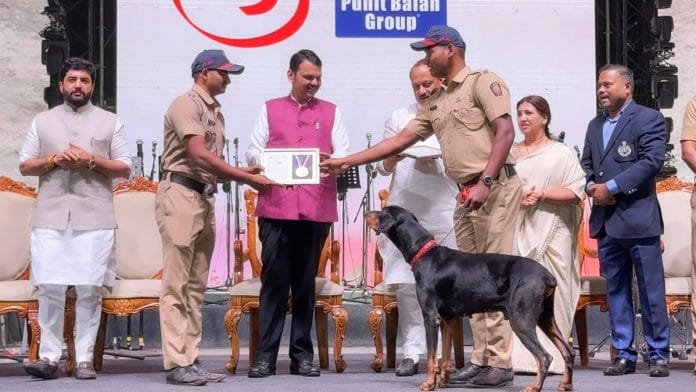

Mumbai: Retirement for Maharashtra’s police dogs will no longer mean being separated from the people they have worked with for years.
Under a new state government decision, dogs retiring from the police force after completing 10 years of service will be allowed to continue living with their handlers. The Maharashtra Home Department will pay for their food, medical treatment and other upkeep.
The move changes the earlier practice of placing retired police dogs for adoption once they were no longer fit for active duty.
Chief Minister Devendra Fadnavis said on Saturday that animals that had spent a decade serving the police force should be cared for after retirement as well.
The decision recognises the unusually close working relationship between a police dog and its handler. The two train and work together as a team, often from the dog’s early years.
Maharashtra Police uses trained dogs to track suspects, detect explosives and narcotics, locate evidence and assist Bomb Detection and Disposal Squads. Their work depends not only on training but also on familiarity with a handler’s voice, commands and habits.
Why the change?
Government sources cited by news agency ANI said some retired dogs had found it difficult to adjust after being moved to unfamiliar homes and separated from their handlers. In some cases, the animals reportedly struggled to settle into a new routine and even refused food.
The question of who should care for these animals after retirement is not new in Maharashtra.
In 2017, Mumbai Police sent the Maharashtra Home Department a proposal seeking financial assistance for retired sniffer dogs. The proposal was described as a possible “pension” for police dogs and sought funds for food, medicines and other expenses after the animals left active service.
At the time, retired dogs could be handed over to members of the public after prospective adopters were screened by a committee. The arrangement was intended to prevent the animals from being abandoned, but it also meant that dogs that had spent years with one handler could be moved to a completely different household.
The latest decision reverses that approach for eligible dogs. Instead of asking handlers to find adopters or bear the cost themselves, the state will allow the animals to remain with them and meet the expenses of their post-service care.
Also read: China raises the bar for 2nd World Humanoid Robot Games
How others do it?
Maharashtra is not the first state to consider such support.
Karnataka introduced a retirement-care arrangement for police dogs in 2019, when the state government approved financial assistance for handlers who kept retired dogs. The decision followed concerns that the animals, after years of service, often remained dependent on familiar handlers and required continuing veterinary care.
Kerala has also provided for retired police dogs to remain with their handlers, with departmental support for their maintenance. The policy was put in place by the state police in 2021 as part of a broader effort to improve the welfare of service animals after retirement.
In several other states, including Delhi, police departments have used adoption programmes, departmental kennels or case-by-case assistance rather than a uniform lifetime-care policy. The arrangements vary, but the underlying problem is similar — police dogs may retire from duty, yet they continue to need food, treatment and supervision for years.
Maharashtra’s decision places that responsibility formally on the state. For dogs that spend much of their lives learning to follow the same voice and routine, retirement will now mean stepping away from police work, but not from the handlers who worked beside them.
(Edited by Saptak Datta)