





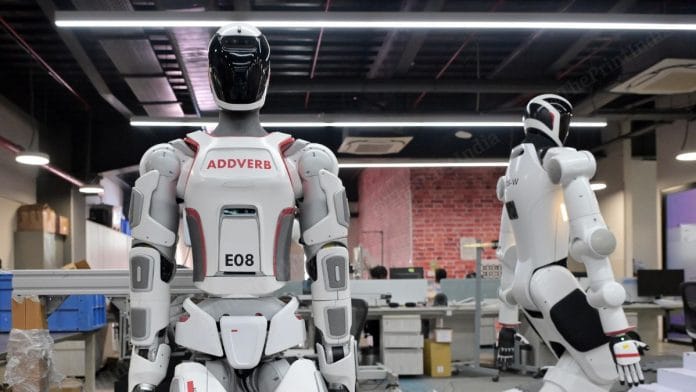

Mumbai: At Beijing’s Ice Ribbon this weekend, athletes will sprint 100 m, lift weights, play football, fight, dance, and try their hand at table tennis. Others will fold clothes, sort books, tighten screws and respond to fires.
The catch? None of them are human.
China’s second World Humanoid Robot Games formally opens on 22 August, at the National Speed Skating Oval, built for the 2022 Winter Olympics. Over five days, a total of 2,056 humanoid robots from 666 teams across 16 countries will compete in 1,301 contests across 51 events. Just over 500 robots participated in the inaugural edition last year.
The competition is international, but heavily Chinese. Of the 666 teams, 641 are from China, accounting for 1,975 robots from 157 companies and 200 universities and research institutions. Teams from the US, Germany, and Japan are also participating, while Brazil has put together a national team comprising five RoboCup squads.
Jiang Guangzhi, director of the Beijing Municipal Bureau of Economy and Information Technology, said rules developed for the competition could eventually help shape technical benchmarks for real-world applications.
“Once robots master these last-meter skills, they can turn medals into orders and move directly from the competition arena to real-world workplaces,” Jiang said. He is also the deputy executive director of the games’ organising committee.
Despite Saturday being the formal opening, scenario-event preliminaries began last Sunday. Robots have already been tested on tasks including inspecting library shelves and carrying out a simulated emergency operation at a Beijing fire station.
When Beijing launched the games last August, the idea was not simply to see which robot could run fastest or land the best kick.
The races, football matches, and combat events are essentially stress tests dressed up as sport. Robots have to stay upright, read their surroundings, and react in real time, putting hardware and software under pressures that controlled laboratory demonstrations do not always replicate.
The inaugural edition brought together 280 teams from 16 countries across 26 events. Unitree Robotics finished with the largest medal haul, with 11 medals, including four golds. Its H1 robot completed the 1,500-metre race in 6 minutes 34.40 seconds, while X-Humanoid’s Tiangong Ultra won the 100-metre in 21.50 seconds, completing the race autonomously rather than through remote control.
Also read: Comedian Zarna Garg gets locked inside Hermès bathroom, calls it ‘Shakespearean tragedy’
This year, take away the remote control
The Games have grown sharply since their 2025 debut, but the bigger shift is in difficulty.
Organisers have tightened rules to test how much robots can actually do on their own. Except for the 100-metre and 400-metre hurdle events, track and other competitive events must now be completed fully autonomously.
Time limits have also been cut sharply: from three minutes to one for the 100-metre, 15 minutes to five for the 400-metre and 40 minutes to 15 for the 1,500-metre.
The event list has nearly doubled from 26 to 51. Thirty are competitive events and 21 are scenario-based. Along with racing, football, and martial arts, robots will now compete in weightlifting, tug of war and table tennis. More than 100 teams have entered dance events ranging from street dance and cheerleading to ballroom routines.
But some of the more consequential tests are happening away from the track.
Robots will pack warehouses, assemble industrial components, perform hotel and household tasks, handle tools, connect cables and carry out fine movements such as picking up beans and tightening screws. Some contests are being held in actual workplaces rather than purpose-built arenas.
There is even an athletes’ village of sorts. The new ‘Robot Home’ can store more than 1,500 machines and charge at least 1,200 batteries.
The opening night will feature a seven-a-side football exhibition and 100-metre and 400-metre heats. Weightlifting medals follow on 24 August, while freestyle fighting and five-a-side football finals are among the contests before the games close on 26 August.
(Edited by Aamaan Alam Khan)