





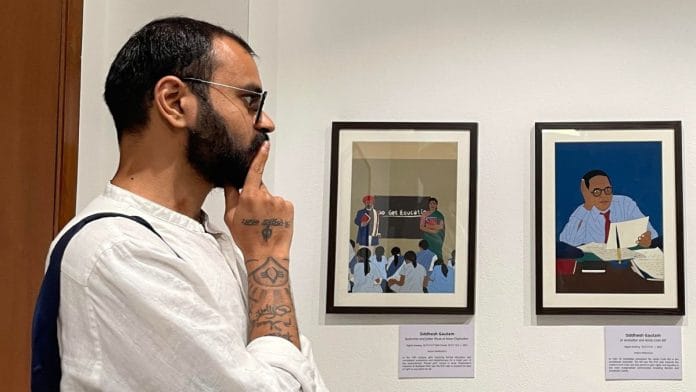


New Delhi: Ambedkarite artist and writer Siddhesh Gautam found a crucial element missing from the Cockroach Janta Party protest — ideology.
“Call me old fashioned, but protest is incomplete without discussions on ideology,” Gautam told ThePrint in a candid interview. “Success of a protest does not come from your demand being fulfilled. It comes when you make leaders for the future.”
Gautam, better known as Bakery Prasad, spent more than a decade dispelling stereotypes around anti-caste movements. In his own words, he challenges one to “expand your mind and evoke feelings of agitation, exploration, and deeper connection with the self”.
In his new book, The Blue Book: An Anti-Caste Graphic Novel, Gautam uses dreams to imagine conversations with anti-caste thinkers. Across eight chapters, from social reformer Savitribai Phule to BR Ambedkar, he weaves real life experiences with imagination and creative liberty. In each chapter, he attacks the social norms and gives a solution to it. Whether it is emphasising on the existence of social reformer Fatima Sheikh or imagining Ambedkar cooking custard for his first wife Ramabai Ambedkar, Gautam blurs the lines between lived experience, history, and imagination.
“I was able to do this book because I have actually imagined and dreamt about talking to these people like they are my friends or they are my mentors,” he said.
In the book, Gautam argues that showing solidarity with marginalised people can become performative, and that real action begins with confronting caste within one’s own family and community. In the book’s distinctive blue and white palette, he draws Ambedkar’s kitchen to make that message tangible. He applies this critique to the CJP protest, saying protests challenge the existing system, which is not working for people.
But, he said, something good came out of the CJP protest.
“A replacement happened. And a replacement happened because there was pressure,” he said. “You did not get an educated person as education minister. You did not even get Sonam Wangchuk as your education minister. You did not get a future out of that protest”.
Ambedkar in kitchen
In the book, Gautam dreams of becoming an animal. While speaking to the mystic saint Ravidas, he takes the form of a crow; in the Buddha chapter, he becomes a cheetah. The book is a reflection of his inspirations, experiences, and ideas.
Gautam argued that he was fascinated with Jataka tales, especially this notion of animals having characters like human beings. A reason that even when he transforms into an animal, his face remains the same throughout the chapters.
“I was always very influenced and inspired by how animals and humans, who share the same earth and the same environment, are so distant from each other. That strangeness I always used to feel is there in our society,” he said.
In Chapter 5 of the book, again in his dreams, Gautam lands up in BR Ambedkar’s kitchen as an ant. He finds Baba Saheb cooking a lavish meal with Bombil fry and custard for faceless people and Ramabai. He talks to Ambedkar about feminism and what it means to be performative. Gautam says there is a line between performance and action.
“Sometimes I wonder whether these faces are the ones which make these discriminatory systems, like race, like caste. Is face responsible? I don’t know if it is or if it is not. But I carry that face everywhere. It is something that I just cannot be away from,” he said.
Gautam carries the critic within him — whether in his book or the social movements that brought the young students together. He appreciated CJP founder Abhijeet Dipke for managing a following of 22 million without making caste identity a central point.
“I really appreciate Abhijeet for breaking that pop cultural restriction that we had. We can start a pop cultural movement on our own without our caste identity,” he said.
But he argued that the CJP protest was a “nice way of dissenting”. However, “that is not protesting,” he added.
“Protesting is way much different. It takes much more. It is not just lathi that you are going to get. It is much more than that,” he said, adding that “people have been robbed of their youth because of protest”.
Also read: Prateek Kuhad to make acting debut. Film is set in Delhi’s indie music scene
Dreams of Fatima Sheikh
In the last chapter of the book, Gautam boldly draws Fatima Sheikh, whose existence has always been questioned by historians and thinkers.
But for Gautam, he wants to believe that Fatima Sheikh worked with Savitri Bai Phule, as a reformer. With Fatima Sheikh, he takes creative liberty.
But even in this creative freedom, Gautam argued that even if Fatima Sheikh is a lie, he wants to believe it.
“It is an important lie,” he said.
“Women have never been documented in history properly, ever. Maybe Fatima did not have that sort of personality. Maybe she just left a mention of a name in a text of Savitri Mai. But maybe she was more important. And I want to live that reality — or even that possibility,” he said.
Fatima Sheikh is a part of Gautam’s dream, which he has always found an abstract process. The book is a product of his dreams, which, he says, have fascinated him since childhood. Gautam has also dedicated a chapter to his childhood where he draws a man wearing a skull cap as his uncle.
He grew up between Muslims and Dalits in Uttar Pradesh’s Nagina. Nagina is a different place from most of the Hindutva imagination, Gautam said. He witnessed solidarity and peace back then. But, now when he goes back to the same place, he sees changes — an invisible line.
His childhood memories of chicken and pork hanging together in the meat shop are gradually diminishing.
“I am not a historian. So I have this freedom because I am an imaginative person. I am a creative person. I am writing a sort of fiction, graphic novel,” Gautam said.
(Edited by Aamaan Alam Khan)