



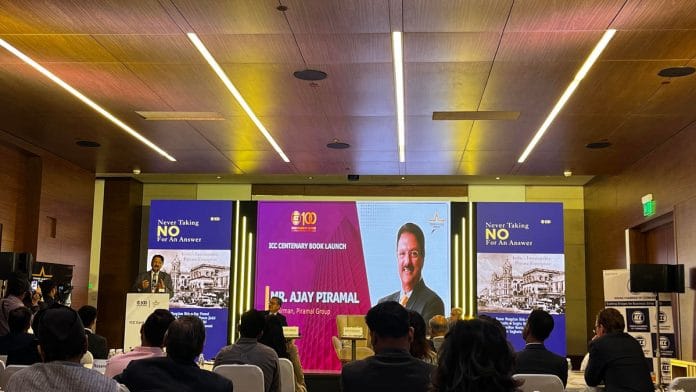
Mumbai: Billionaire Ajay Piramal says the last six years have been among the most uncertain he has seen, with Covid, wars across the world, climate change and now artificial intelligence. But he argues that India has advantages that others might not.
“How do we manage in an uncertain climate, I think, is a challenge that all of us have today. You can look at the glass being half empty or it can be half full. And I think, as far as I believe that India is concerned, we should look at the glass half full,” the Piramal Group chairman said at an event in Mumbai.
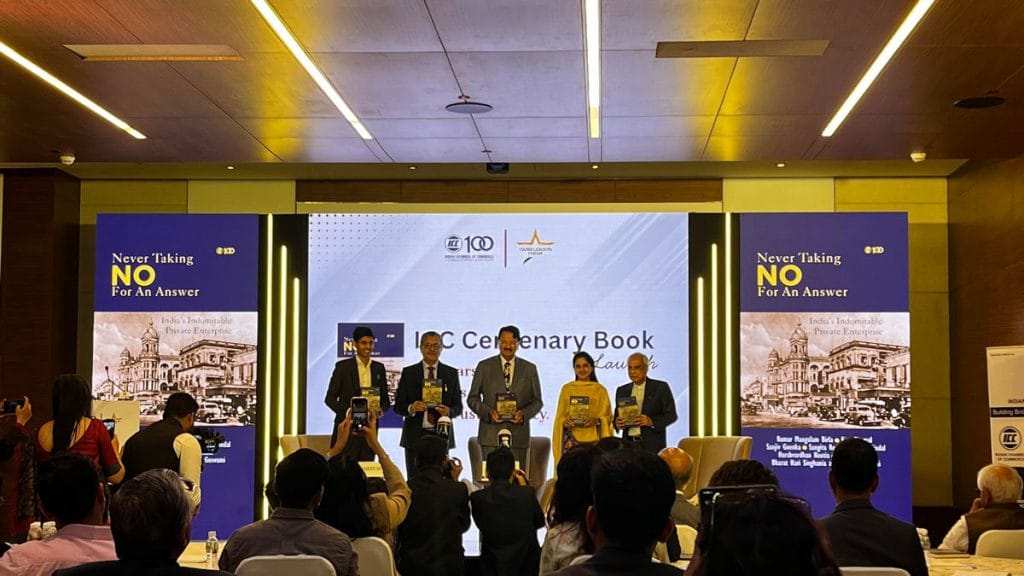
Piramal was speaking as chief guest at the launch of the Indian Chamber of Commerce’s (ICC) centenary book, Never Taking No For An Answer: India’s Indomitable Private Enterprise, edited by economist and former NITI Aayog vice-chairman Dr Rajiv Kumar. It traces 100 years of Indian enterprise and features contributions from business leaders including Kumar Mangalam Birla, Ajay Piramal, Sanjiv Goenka, Naveen Jindal, Sangita Reddy, Bharat Hari Singhania, Harshvardhan Neotia, Ratan Jindal and economist Omkar Goswami.
“The ICC Centenary Book was a tribute to the Indian business leaders who had contributed to nation-building and played a significant role in strengthening the Indian economy over the last 100 years,” said ICC Director General Dr Rajeev Singh in his welcome address. He added that the book documents how Indian businesses navigated successive economic eras: competing with British companies under colonial rule, enduring the Licence Raj, resource scarcity and policy constraints, before economic reforms opened up private enterprise.
For Sangeeta Jain, chair of the ICC Maharashtra State Council, the book captures the “spirit of Indian enterprise”, defined by ambition and “the courage to turn challenges into opportunities”.
Also Read: Indian art is a ‘quest for self’, said author who spent 50 years writing a book on Classical Art
‘This is the time for youth’
Despite shocks from events such as the Russia-Ukraine war and the Israel-Hamas conflict, Piramal said India was well placed to weather uncertainty, with its large domestic market, entrepreneurial base and young population.
He called this “the time for youth”, contrasting India’s demographic position with ageing populations and low birth rates across several developed economies.
To make the most of those advantages, he said India needed to increase its focus on manufacturing.
“Services do not provide employment for the semi-skilled, for the lower-skilled people,” he said. “We have to move towards more manufacturing. And in that, again, can we do precision manufacturing? And can you do defence? These are big opportunities.”
AI was another major theme of his address. Rather than fearing it, Piramal said businesses should look at how it could improve access and productivity.
“As all business, if it is run well, AI can be a force for good,” he said, citing his financial services business, where AI could help assess borrowers without conventional credit histories and widen access to loans.
But Piramal acknowledged that the transition would come with costs and cause some displacement of people working in certain areas. His answer to that is skilling people and opening up new opportunities for them.
What AI could not replace, he argued, were qualities central to leadership: integrity, authenticity and humility.
“By Integrity, I mean, that there is alignment between what you think, what you say, and what you do,” Piramal said. “Humility is not a sign of weakness. I think it is a sign of strength. If you are humble, it means you have enough confidence in yourself that, yes, I am not perfect.”
An ‘owner’s mindset’
Piramal paired these values with what he called an “owner’s mindset”: being prepared to take risks and accept accountability when they do not work.
“If we are going to remain safe all our life, you are not going to progress. If you see the success stories of all the people who you have featured in this book, sometime or the other, either they have taken risks or their forefathers have taken risks,” he said.
Piramal offered his group’s acquisition of DHFL during the Covid period as an example of finding opportunity during a crisis. The financial services sector was under severe pressure then, he recalled, but the difficult environment created an acquisition opportunity that may not have existed in normal circumstances.
“It just shows that even in difficult times, there is always something, there is another door which opens. We have to just sit back and be calm and think about it,” he said.
Also Read: You want to do business? Try sales first, says Zoho’s Sridhar Vembu
‘Need to rebuild trust between business & govt’
The friction between private enterprise and government also made it to the discussion. A trust deficit had crept in, according to Dr Rajiv Kumar, former vice-chairman of NITI Aayog and earlier chief economist of CII. He pointed to Mahatma Gandhi’s relationship with the Birla family as an example of the closer ties that once existed between political leadership and business.
“This relationship between the private sector and the government, I think, needs to be brought back to that level of trust, mutual trust between the two segments. And I think that will take us very far,” he said.
Drawing on his experience in government, Kumar said institutional resistance to change and “complacency” were persistent problems.
“The favourite state of existence in a large part of the bureaucracy is the status quo,” he said.
Kumar also had a message for corporate India — spend more on innovation.
“You’ve got to make R&D expenditure in every company greater than the expenditure on government relations,” Kumar said, arguing that innovation and technological breakthroughs would be essential if India hoped to become a developed economy and to tackle regional inequality.
Ultimately, he said, the challenge went beyond just the government and private sector.
“The biggest challenge that I feel today is to build this trust between the four principal stakeholders in our country — the business, the government, the academia and the civil society. If we can do that, we can conquer the 21st century and make it India.”
(Edited by Asavari Singh)