



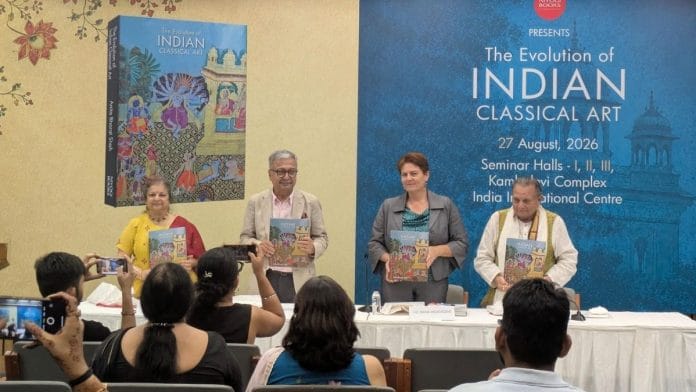
New Delhi: A book five decades in the making was unveiled on 27 August before an audience of barely twenty.
Evolution of Indian Classical Art, written by museologist and collector Anita Bharat Shah and published by Niyogi Books, traces the journey of Indian art from the aniconic Vedic yagya to the richly symbolic sculpture and painting traditions that followed. At the launch, it was described as Shah’s magnum opus.
The book launch was held at the India International Centre. The panel consisted of retired IAS officer Ramendra Singh, Lithuanian Ambassador to India Diana Mickevičienė, Padma Shri and Sangeet Natak Akademi awardee Bharat Gupt, and the author.
The small size of the audience stood in quiet contrast to the scale of the research on display. Only scholars, colleagues, and a handful of well-wishers attended the launch. Halfway through his address, Raghuveer Singh, the evening’s chief guest, said he wished more people had been present. The publisher blamed the monsoon.
Bharat Gupt, a former Delhi University professor, spotted a former student in the small gathering.
“A great consolation,” said Gupt, “that people still remember (us).”
Ambassador Mickevičienė began her address with a personal reflection, describing how a scholarship to study art history at Delhi’s National Museum years ago had shaped her own lifelong engagement with India.
She dwelt at length on the aesthetic theory of Rasa and Bhava. Mickevičienė recalled how a brief training in Bharatanatyam had taught her, more than any classroom, what it meant for an audience to be transformed into rasikas, united by a shared aesthetic experience.
She then turned to the deep linguistic kinship between Lithuanian and Sanskrit, two of the most archaic surviving languages in the Indo-European family
“Rasa is only one of them,” she said, presenting the author with a small glossary of shared words as a gift.
Professor Bharat Gupt, addressing the gathering next, focused on the word that anchors the book’s title.
“Classical is not a very popular word anymore,” he observed. “Even in the West, they’re trying to be more woke and less classical.” In India, he argued, the classical continues to command attention because it remains woven into everyday life.
He rejected the sharp European distinction between high classical and folk forms, noting how traditions in India continually transform one into the other. Most emphatically, he insisted that art is not commerce, it is devotional.
“Art is not for sale… It is primarily a sadhana.”
He insisted the visual arts carried the same integrative purpose as yagya, especially when other forms of expression faced obstruction. Painting, particularly within the Vallabh Sampradaya, preserved the kernel of that tradition into modern times. He urged young readers to study the book carefully.
Also read: ‘Not transgender. I’m first gender’—new book on Chapal Bhaduri, Bengal’s Jatra Rani
Art is sadhana
The evening then moved into a conversation between chief guest Raghuveer Singh and the author. Singh, who said he had first approached classical art through modern historical frameworks rather than aesthetic theory, admitted the book had reordered his understanding – the idea of art as sadhana, he said, is “so quintessential an Indian concept.”
Shah took the conversation back to first principles, to the link between the Vedic yagya and the later emergence of divine form.
“It is from here that art has come out,” she said. The first three ages—Vedic, Brahmanical and Upanishadic—were aniconic. “There was no form worship, only yagya was performed.”
When saguna bhakti arose in the Puranic age, people needed a form through which to connect with the Divine. Saints, through deep meditation, beheld the forms in vision.
“They did deep meditation, and in their meditative vision they saw the form,” she said. The resulting iconography of Vishnu, Shiva and other deities has remained stable across centuries and geographies “because it’s the truth, the vision that they saw.”
Indian art, she emphasised, “is a quest for the Self.”
From there she traced how the yagya’s principles for consecrating space and time were carried into the grammar of form-making, through texts such as the Natya Shastra (the Fifth Veda) and the Vastu Sutra Upanishad. Geometry, the five elements, and the cosmic order of jyotisha shaped composition down to the smallest detail such as the vertical agni-rekha, the horizontal water-line, the diagonal line of action.
Returning at the end to rasa, Shah distinguished it from bhava — the latter being the first, instinctive response to an art object, and the former “that intense aesthetic emotion that you experience in your heart… a refined experience… that makes you feel one with everything.”
The event closed without significant audience engagement. Shah said she hoped the book, the product of what she called a lifetime’s research, would find its way into university curricula, so that younger readers might reconnect with the depth of their own artistic inheritance.
Of her own role in creating it, Shah confessed, “I don’t know whether I have written this book or it has been inspired.”
(Edited by Janaki Pande)