







New Delhi: There is a particular kind of political knowledge that lives outside textbooks — it lies in the shape of someone’s brows, the cut of someone’s saree, or in the shape of someone’s face. It is the kind of knowledge that India’s editorial cartoonists have always understood.
In the weeks surrounding the 2026 Assembly elections in West Bengal, Tamil Nadu, and Assam, India’s editorial cartoonists have decoded not just the moves of political parties but also those of citizens, converting months of ground reality into strokes of ink.
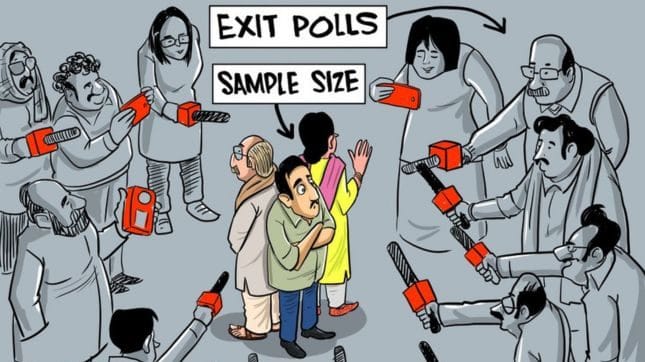
Before a single vote was counted, one of the more unusual confessions in Indian polling history emerged: a leading agency quietly withdrew its West Bengal exit poll. The reason was the silence amongst the voters. Ground reports indicated that 70-80 per cent of sampled voters had refused to speak to surveyors, particularly women.
Face-to-face interviewing, which has long been the agency’s preferred method, had produced a sample too thin to mean anything.
Sandeep Adhwaryu, Chief Cartoonist at The Times of India, turned this into a cartoon. It shows two surveyors with registers approaching a woman in a white-bordered red saree and a man who is holding a vegetable-stacked shopping bag. “Who did you vote for?” they ask. The response is a long, looping “Hmmmmm… mmmmm…”, which Adhwaryu shows by spreading the response across three panels. “Got it. Starts with ‘M”. Lock it!” the surveyors declare, scribbling confidently.
In a single exchange, Adhwaryu captured what the polls could not: that Bengal’s voters had decided not to name who they voted for, which is precisely why everyone kept guessing the mandate till late-afternoon.
Satish Acharya, for his part, drew 14 microphone-wielding figures closing in on just three respondents. The ratio alone was a joke. West Bengal, a state where the act of expressing a political preference has carried consequences in the past, was this time producing noise that was close to nothing.
‘Mandated people’
Then there was the question of who was even allowed to vote. In another cartoon, Adhwaryu showed a suited figure carrying a briefcase marked “SIR” — a nod to the Election Commission of India’s ongoing Special Intensive Revision (SIR) exercise, ostensibly meant to clean up electoral rolls by removing duplicate, migrated, and deceased voters, and identifying illegal immigrants.
The figure, red marker in hand, has crossed out “People’s” from “People’s Mandate” and converted “Mandate” into “Mandated” — leaving behind the phrase “Mandated People.”
West Bengal’s outgoing Chief Minister Mamata Banerjee had questioned the SIR in the Supreme Court arguing that the process was designed for deletion rather than inclusion, that it is going to be used as a tool for disenfranchisement rather than electoral hygiene. The controversy had made the exercise the defining anxiety of Bengal’s campaign season.
After the results, Deccan Herald’s Sajith Kumar captured the aftermath in two pieces.
One shows a slipper screeching across a page with its sole imprinted on the map of Bengal. The word “SCREECH!” accompanies it.
The image portrayed an idiom of public fury and humiliation. The BJP’s historic breakthrough in Bengal has ended the long dominance of TMC. It showed that anti-incumbency had done its job. The chappal was still moving.
The other cartoon by Kumar shows a rural voter being told that his candidate had promised to eat fish every day in office, a campaign gesture that in Bengal carries more cultural weight than it might elsewhere. In fact, days before the state went to polls, the Bharatiya Janata Party’s candidate from Kolkata’s Barrackpore was seen campaigning door to door while holding a fish in his hand. For many Bengalis, fish is identity and when politicians invoke it, they are trying to tell the masses that they are one of them.
Tamil Nadu had a different drama, though it carried the same theatrical vocabulary.
Adhwaryu’s pre-result cartoon featured a recognisable caricature of actor-turned-politician Vijay being handed what was described as a “standard India script.”
The standard political formula, as explained by a bespectacled figure in the first panel of the cartoon was: “…start as saviour, become victim in 5 years, and return as saviour”.
When Vijay asks about “delivery” in the second panel, the answer is brisk — if it fails then blame it on the “villain”, the elderly figure responds.
In the final frame, Vijay is before a camera, dabbing sweat from his forehead with a handkerchief, muttering that he must sharpen his acting skills.
Vijay, whose Tamilaga Vettri Kazhagam (TVK) entered its first election with enormous symbolic weight, was being handed not a mandate but a screenplay.
After Tamil Nadu produced a hung Assembly, Satish Acharya’s post-result cartoon for South First brought the political puzzle into focus. Vijay’s TVK has emerged as the single largest party but without majority, making coalition arithmetic tricky.
In his cartoon, he displaces Tamil Nadu’s map, shaped like a jigsaw puzzle with a chunk missing. Vijay holds a piece. Behind him, a figure identifiable as Amit Shah nudges him forward. Across the map, MK Stalin holds another piece. Shah says: “Join us! Big fan saar! I’ve seen all your videos with CBI!”
The piece Vijay holds is not just metaphorical: he has power, but due to lack of a clear majority, there are good chances that it will not survive by being sovereign.
Vijay has appeared before the CBI three times in connection with the September 2025 Karur stampede at a TVK rally, in which 41 people died; he has not been named as an accused.
The cartoon’s “CBI videos” line points toward the long-standing Opposition charge that central agencies are deployed as political instruments.
Also read: 2026 election results show power is rarely defeated by rivals. Credibility matters more
Exit poll ‘predictions’
The most recurring cartoons during this election were about the persistent failures of exit polls in the past.
A cartoon that Mika Aziz made for The Hindu shows a batsman in a torn jersey labelled “exit polls.” The jersey is patched up in multiple places with mismatched material. His bat is similarly broken and re-taped, with one cracked section marked “2021” and another “2024.” The cartoon is captioned: “#Assembly polls 2026.”
Acharya, in another election piece, showed two individuals walking under the protection of six armed guards while a bystander tries to identify them. “TMC? BJP?” he asks. “Exit poll analysts,” his companion replies. A newspaper lying on the ground declares: “Exit polls predict Mamata’s exit.” This time, the analysts had apparently predicted correctly.
Nala Ponnappa’s cartoon needed no event to anchor it. On Twitter, he posted a cartoon that shows a raised hand with an inked voting finger, with speech bubbles directed at the unmarked fingers. “Should things go wrong,” they say, “who else can we blame but you?”
Not all of the season’s cartooning was about results or predictions. Mika Aziz’s other election panel showed objects flying through the air near a polling booth, figures barely visible through the chaos. A journalist grips his microphone, shielding himself, a speech bubble reading: “No, not war! I’m covering polls.”
Violence had broken out at multiple polling booths during the first phase. Taken together, the 2026 election cartoons formed an archive that the exit polls can never record: what it actually felt like to be in these elections.
It showed that the cartoonists were watching. They always are.
(Edited by Aamaan Alam Khan)