



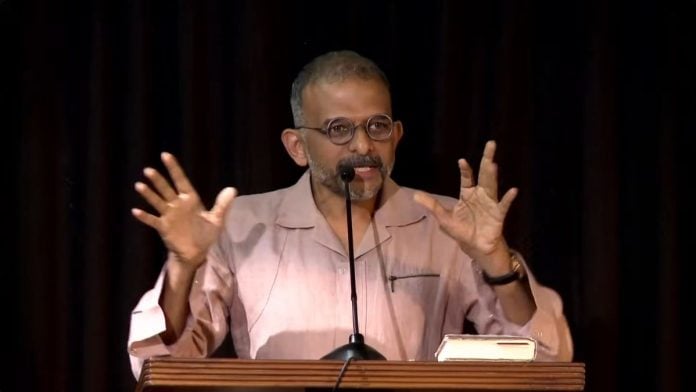
New Delhi: During a discussion on India’s national anthem, inside a packed auditorium at Delhi’s IIC, TM Krishna asked: “Can there ever be one song, one melody that represents all of us?”
While the melody of the anthem is progressive, its Sanskritised language is exclusionary to many, the Carnatic musician and writer contended. In a radical proposition that posits a solution for overcoming this shortcoming, Krishna suggested that we should have allowed the anthem to be sung in every Indian language in the same tune.
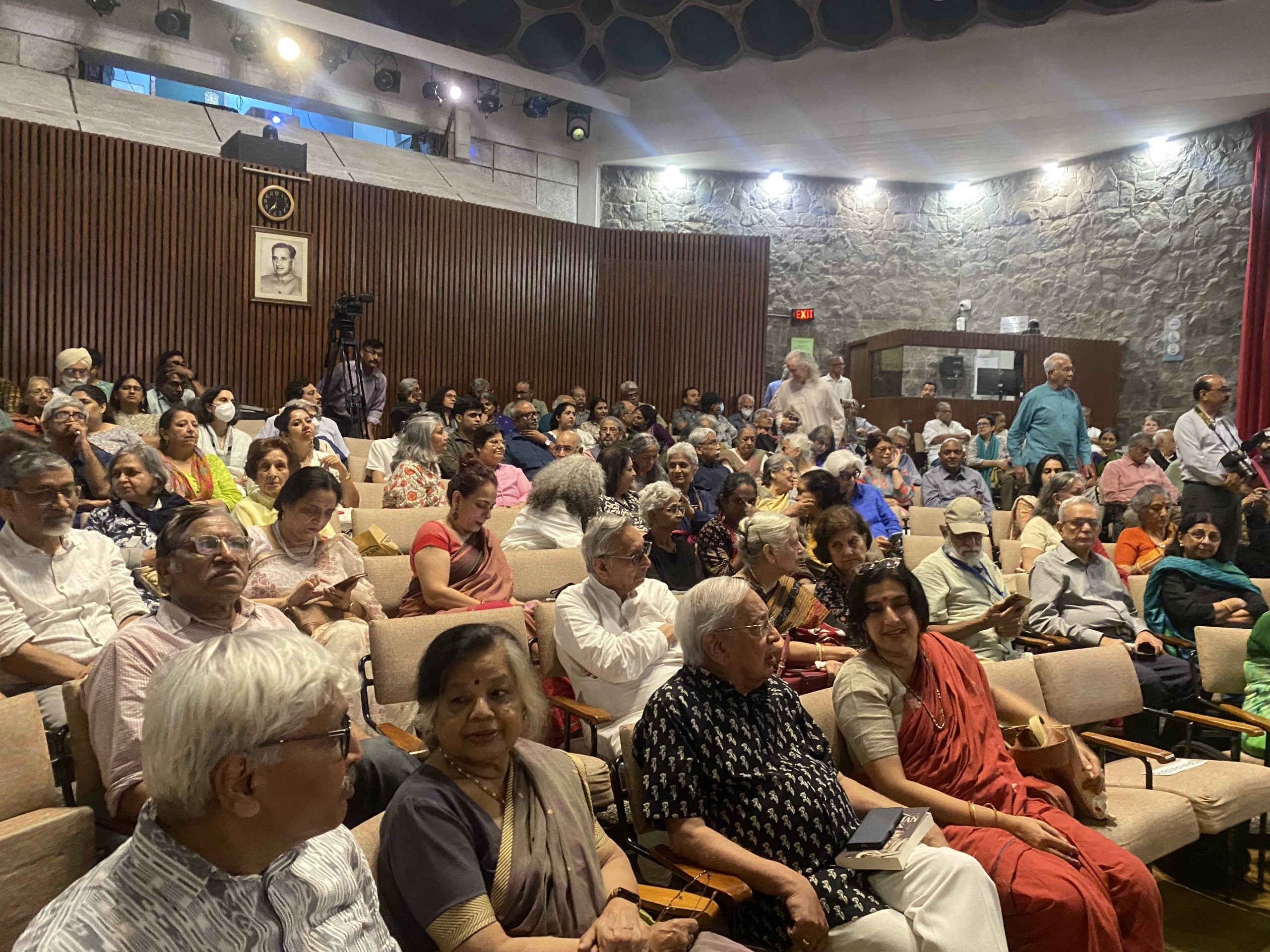
Around 200 odd people, including the intellectual creme de la creme of the city, waited eagerly for TM Krishna’s talk titled ‘I Sing therefore I am’ to begin.
The lecture began with an opening address by documentary filmmaker and activist Suhas Borker. It was moderated by political psychologist Ashis Nandy and ended with a concluding note by scholar Kapila Vatsyayan’s nephew and founding professor of Plaksha University, Aditya Malik.
Prodding the notion of ‘democratic’ music, Krishna turned his attention to the opening line of the national anthem.
“That’s the most fascinating part of the song. It proposes the fact that we are not the same,” he said. “Jana gana mana– The manas [mind] of the plural is what he’s [Rabindranath Tagore] immediately speaking about.”
The melody of the anthem is exemplary too, he continued.
Krishna cited the interpretation of a Sri Lankan scholar to highlight that the anthem ends on the fourth note, or the madhyama, as opposed to the fifth note, implying there is “movement forward.” It signifies an opportunity in the context of the nation, as opposed to a conclusion.
“If there is one problem with this song in terms of its welcoming for everybody,” however, said Krishna, “it’s the language of the song.” The Sanskritised Bangla is not the lingua franca of the people of this country.
He argued that if we had wanted the anthem “to be a shared collective transcending the limitations that all our other cultures inherently have, we should have allowed it to be sung in every Indian language in the same tune.”
“A Tamil Jana Gana Mana, a Kannada Jana Gana Mana, a Gujarati Jana Gana Mana,” he invited the audience to imagine.
Democratic joy and music
At the lecture dedicated to the memory of Kapila Vatsyayan–a leading scholar of Indian classical dance, art, architecture, and art history–Krishna pushed the audience to grapple with the contradictions inherent in Carnatic music.
“There are certain fissures or points of tension that remain when you enquire about yourself as a musician or an artist,” he said. “You are dealing with form, with history, with mythology, and with reality. And it is often not possible to reconcile these various strains.”
He then invited the audience to consider possible ways in which the form could be made more democratic. Because, he said, “It is only when it is democratic do multiple forms grow. When it is not democratic, form is dead.”
It is a kind of wisdom one gains after pulling apart and putting back together all the strands of verses and melodies. And years of practice.
Krishna’s fondest memories of music surround the joy of chasing a note as a young student, practising it repeatedly during class, the whole evening, over the dinner table even, before finally getting it right.
“When you start singing, when you’re literally belting it out in the classroom when you are 8 or 10 years old, you don’t have an agenda to be a musician. You’re not performing. You don’t have an audience. You don’t care about anything. But in that act of repetition that can be tiresome sometimes,” he added, “there is joy, which you suddenly discover.”
And much of this pleasure lies in the ephemeral nature of sound, which evades being pinned down.
Krishna pressed that the “classical world” insists they don’t have any social or political utility. “It aligns more closely with terms such as “spirituality,” which “helps you [the classical musician] to levitate a few feet above the earth,” he said.
The art form cannot disentangle itself from questions of power, money, and social hierarchy. Elaborating on this, Krishna said that this tradition is rooted in “a certain kind of Hinduism which is embedded in caste.”
“The classical bubble is largely homogeneous in terms of society…Be it in terms of caste or religion,” he noted. Participation in and enjoyment of the art form is thus shaped deeply by one’s social location. This makes pleasure and enjoyment entirely products of social conditioning.” The joy of classical music, thus, was never democratically available to all, argued Krishna.
Also read: From art walls to urban forests—New Delhi’s Lodhi Colony gets its first Miyawaki Forest
‘Can I listen to another’s music willingly?’
The problem Krishna sees is two-fold. Not only does someone from outside the classical tradition feel intimidated by it, but Krishna also found himself unable to appreciate the music foreign to his upbringing and social location. But that’s exactly what is needed for the art form to stay alive. We must willingly build a connection with what we don’t understand.
Krishna wants us all to step out of our room of acquired and conditioned taste and listen to another form of music. To give up control and open oneself up to the world of variety.
“Form is very important in art…But form has to be a receiving form. Form that does not receive, to me, is not form at all,” he said. “It’s just something that is fossilised in an idea that is not real.”
A student was carrying a copy of Krishna’s book for him to sign. A professor who works in the department of Language and Education told ThePrint that he enjoyed Krishna’s “rebellious music,” and respected the fact that he had taken Carnatic music beyond the upper-caste clutches.
(Edited by Ratan Priya)