



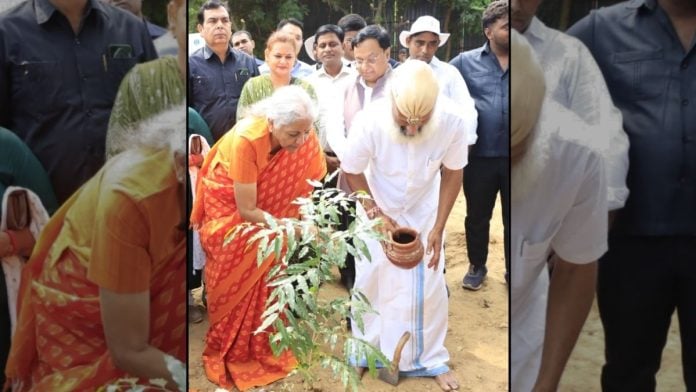
New Delhi: Lodhi Colony, known for its clean, green lanes, art-covered walls, and pleasant streets, is perfect for walks. Home to the Lodhi Art District, the neighbourhood has now added another element to its identity with the newly inaugurated Miyawaki forest.
The New Delhi Municipal Council (NDMC) has started developing Bharat Vann, a one-acre urban forest at Lodhi Colony Park in Central Delhi using the Japanese Miyawaki technique.
Union Finance Minister Nirmala Sitharaman inaugurated the green initiative on Thursday as part of an urban afforestation drive launched in collaboration with the NDMC. It was also part of the celebration of the 76th birthday of Prime Minister Narendra Modi.
The project was undertaken alongside the ‘Ek Ped Maa Ke Naam’ campaign, which promotes public participation in environmental conservation and encourages people to increase plantation.
Speaking at the launch, Sitharaman said Bharat Vann would create a dense green space using indigenous plant species suited to New Delhi’s local conditions.
“On PM Modi’s 76th birthday, today, this programme is being held in Delhi with the NDMC. The project will use indigenous plants suited to the local environment. The area will provide citizens with space for walking, meditation and yoga,” she said.
She further said that besides enhancing the city’s greenery, the area will offer residents spaces for walking, meditation and yoga.
Also read: Gujjar pride swells after Kalyan Bainsla. ‘They stand at border, grow the food you eat’
From walking tracks to yoga
A key part of this new green initiative is the Miyawaki Forest, a Japanese method of creating dense urban forests. More than 10,000 saplings are being planted across an area of approximately one acre.
With the Miyawaki method, the plants are predicted to grow rapidly and may reach a height of 10-12 feet within a year.
A Miyawaki forest is a small, dense micro-forest made mainly from native trees, shrubs, and plants. Japanese botanist Akira Miyawaki developed the method in the 1970s. It is designed to create green spaces quickly, especially on degraded or abandoned land.
The Miyawaki method is considered an effective way to create forest cover in a short period. In this project, the plantation uses 76 different native and climate-adapted species, including fruit-bearing trees, shrubs, flowering plants, and large trees that will eventually provide shade.
The forest area will also include walking tracks and spaces for yoga, pranayama, and open-air meditation.
The Jhansi Division of Northern Railway, in collaboration with the Uttar Pradesh Forest Department, has used the same method to transform railway land in Jhansi. The project involved planting 1.15 lakh (1,15,000) saplings across 3.39 hectares.
“From unused Space to a greener place. Jhansi’s railway land is taking a greener turn, with 1.15 lakh saplings across 3.39 hectares growing into a dense native woodland through the Miyawaki method,” posted North Central Railway on Thursday.
(Edited by Saptak Datta)