



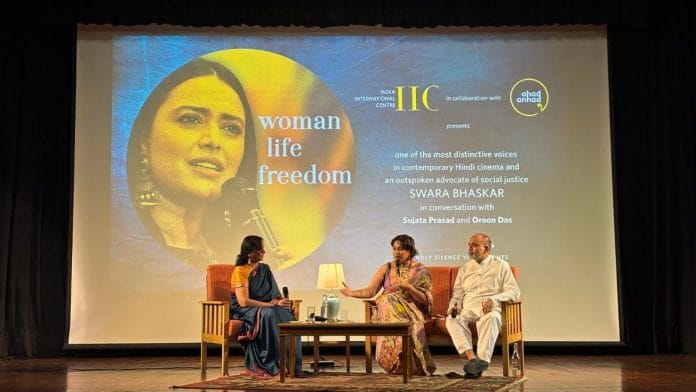
New Delhi: Actor Swara Bhasker has divided the internet with her remarks at the Women | Life | Freedom talk at India International Centre on 31 August. She said that the jauhar scene in Sanjay Leela Bhansali’s Padmaavat sent a wrong message to rape survivors.
“I thought that if God forbid, I was a rape survivor, what is this film telling me? I would feel like a coward if I didn’t commit suicide to save my honour,” she said.
Bhaskar added that there is a rape epidemic in Indian society. “Is this what we want to tell our survivors that they don’t deserve to live, that if you actually would have been an honourable and brave woman, you would have killed yourself? Are we saying that rape is the end of a woman’s life? This scene was so problematic.”
According to the actor, it was her reaction to the film that “ruined” her career. Although she had defended Padmaavat when it was attacked by the Karni Sena, she sent an open letter to Bhansali criticising the scene.
The letter, Bhaskar said, prompted angry calls from several male directors. Some asked why she was taking political positions when she was an actor.
It was a characteristically candid admission during a conversation that swung between feminism and films, protests and privilege, love and loss–with jokes, anecdotes and more than a few self-deprecating digs at herself along the way. She was speaking to author Sujata Prasad and actor Oroon Das at a packed IIC auditorium on Sunday at the event organised in collaboration with Ahad Anhad collective.
Not brave but not scared
Speaking at the public forum about similar controversies surrounding her name, the actor said that she does not think she is particularly brave. She said she has been protected enough to have “no right to be scared”.
“I have this delusional confidence that nothing will happen to me,” the actor said, explaining why she continues to speak out on political issues, on minority rights, interfaith marriages and other such polarising topics, even when she knows it can cost her work.
Bhasker traced her understanding of feminism to her years at University of Delhi’s Miranda House, where she was a part of an openly feminist English department. For her, feminism is not simply about individual empowerment but about recognising that the oppression of women is institutionalised—in law, culture, politics and everyday life.
She called feminism “the toughest ism” because, unlike other political struggles where the enemy is often external, feminism can require confronting people closest to you.
“In every other ideology, the enemy is outside,” she said. “But for women, for feminism, your oppressor is your father, your brother, your husband, your boyfriend, people you love the most.”
Her own encounter with sexism, she said, became clearer after she entered the film industry. Growing up in a liberal family with an educated, working mother, she had not thought much about gender dynamics at home. It was in cinema that she began noticing how differently men and women could be treated.
Her outspoken politics has also come at a professional cost, she said. Bhasker, however, was wary of being cast as fearless. She instead spoke at length about the privilege she had grown up with–an upper-middle-class Delhi family, caste and religious privilege, and the security of knowing she had always had somewhere safe to return to.
“I have never had the experience of being questioned for my identity or for being shamed for my identity,” she said. “So I have this confidence.”
That privilege, she argued, also makes it harder for her to justify staying silent.
“There are other people in India who should be scared,” she said. “Why should I be completely unaffected?”
Also read: What’s it like to be a Muslim in Awadh? Not everyone can ‘afford tehzeeb’
Acting, national politics and love
The question of speaking up also came up when Bhasker spoke about her visit to Gaza. “If all we can do is bear witness, then we must witness,” she said, describing the importance of not turning away when there was little else an individual could do.
But she was equally clear that political causes did not need celebrity endorsements to become legitimate.
“Do not depend on celebrities to amplify and validate causes,” she said. “These causes stand on their own.”
The evening was peppered with stories about what happens when celebrity and politics do collide. Bhasker recalled meeting Reliance chairperson Mukesh Ambani at a party during the anti-CAA and NRC protests. She said she had struck up a conversation with him about the protests before telling him to speak to his “friend” and ask why he was doing this.
The anecdote drew laughs, as did several of Bhasker’s recollections about her family, films and career.
She also spoke affectionately about her acting career and the actors and directors who shaped it. Bhaskar discussed the preparation that went into some of her most demanding roles. For Nil Battey Sannata (2015), in which she played a domestic worker and mother at 27, she interviewed her own mother and spent time with domestic workers in Agra, following them to work, visiting their homes and listening to their stories. The film, which she had been warned would be “career suicide”, became her first solo hit.
For Anarkali of Aarah (2017), she immersed herself in the character to an almost absurd degree, smoking bidis as part of her preparation. She joked that after all that effort, the crucial bidi-smoking scene was eventually shot in silhouette.
There was, however, an unmistakable wound beneath much of the humour. Speaking about the impact of her political positions on her career, Bhasker said she loved acting deeply and found it painful not to be able to do as much work as she wanted.
Her memories of protest were similarly personal. Bhasker spoke about participating in the anti-CAA/NRC protests, Shaheen Bagh and the farmers’ movement. What stayed with her, the sense of fraternity: strangers from very different backgrounds sharing space and finding moments of ordinary connection.
And freedom, for Bhasker, ultimately seemed inseparable from love. She spoke about her love for acting, her husband and the country she grew up in.
“I think that you fight for what you love,” she said. “And there is no bigger romance than that.”
That is also why she continues to share her political opinions.
“We are fighting for India,” she said. “The India of our Constitution, the India we love. And so we must fight for it.”
(Edited by Ratan Priya)
How saddening is it that a Kashmiri Pandit woman – whose family must have been traumatised by the violence and depredations of the Islamists – chooses to fangirl over Swara Bhaskar. Of all people on earth, she finds her ideal in Swara Bhaskar.