





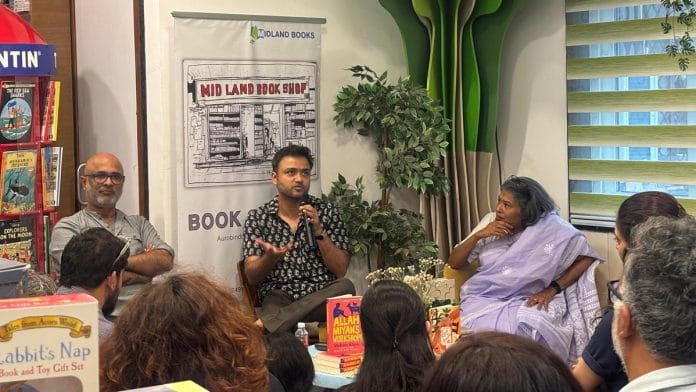

New Delhi: From a monument being bulldozed in Lucknow to a teenager trying to make sense of his father’s arrest on suspicion of terrorism, two new books look at Muslim lives in Uttar Pradesh’s Awadh region. At “Tales from Awadh” at Delhi’s Midland Bookshop on Saturday, another thread connecting them emerged: death.
Around 50 people were crammed into the small book-lined space for the discussion, which brought together Homecoming author Omair Ahmad and Maaz Bin Bilal, translator of Mohsin Khan’s Allah Miyan’s Workshop. Historian and writer Madhulika Liddle moderated the conversation.
Neither book, the speakers noted, is ostensibly about death. Yet in both, death alters the lives of those left behind. The conversation also widened to memory, disappearing cities, childhood, religion and the lives people build around forces they cannot control.
In Allah Miyan’s Workshop, a death changes the practical circumstances of 14-year-old protagonist Gibran, as much as it affects him emotionally. In Homecoming, loss is bound up with a changing Lucknow and the disappearance of a way of life.
“The death was always at the centre, that is what the book rests on,” Ahmad said. “Death makes fools of us all.”
Human beings, he added, are not psychologically equipped to confront death directly, instead turning to rituals, philosophy and religion to make sense of something they cannot fully comprehend. But Ahmad’s interest in Homecoming lies less in death itself than in what follows it.
“While it rests on death, it is not about that. It’s about the lives,” he said. “That is both what makes death so harsh, but that is what we take away, that is what we carry.”
That idea also runs through Ahmad’s portrait of Lucknow, whose social world he said has changed dramatically. Homecoming was loosely inspired by a relative who was his “doorway to Lucknow,” a quintessential gentleman from an era when, Ahmad said, there was increasingly little room for such people.
“The cities we grew up in do not exist anymore,” Ahmad said. “They’re gone, they’ve changed. And that’s not a good thing or a bad thing, it just is.”
Also Read: Rakhi Sawant is the new queer icon, takes centrestage at Delhi drag contest
The politics of everyday life
Liddle said the two books could resonate beyond their specific settings because of their attention to human emotion. Both novels, however, also have their own takes on the particularities of life in Lucknow, including its famed tehzeeb, or manners.
In Allah Miyan’s Workshop, Liddle observed, the characters live in circumstances where survival leaves little room for refined manners.
“You can’t afford tehzeeb when you are trying to get your two meals,” she said.
Politics appears in both books without becoming their central subject. In Allah Miyan’s Workshop, Gibran’s father is arrested on allegations of abetting terrorists. Homecoming registers contemporary politics through the destruction of a Muslim tomb and a reference to “sarkari Musalman”.
Liddle asked whether a writer can really write about Indian Muslims today while keeping contemporary politics entirely outside the frame.
“Unless you are privileged yourself and you’re writing from a position of privilege, how can you write anything without getting politically involved?” Bilal said. “There’s politics to everything.”
Ahmad distinguished between being interested in politics itself and being interested in what politics does to people. Recalling his journalism days, he described reporting on Mayawati’s statue politics. He initially approached the story through political arguments, but conversations with Dalit organisations changed his understanding—for many, the issue was not simply political symbolism, but representation.
“They had never seen themselves or their aspirations in a place that could be celebrated,” he said. “The state has a face, and that face, when it is consistently not you, is a different face than a democratic face.”
For Bilal, Allah Miyan’s Workshop draws from both progressive literary traditions and Islamic texts. Its religious references, including the names of Gibran’s animals, engage with Islamic ideas while questioning their taboos.
“While it is squarely Islamic, it’s also very universal, because it’s about the child, and the cruelties the child faces in this world, or animals face in this adult world of ours,” he said.
(Edited by Asavari Singh)