



New Delhi: The Somnath temple has been rebuilt seven times. The first temple is believed to have been built by Somasharma, the founder of the Pashupata order.
“However, no trace of that temple has survived. But still no believer links or starts the history of that site with destruction or the re-creation of a temple. For us, the sacred site is associated with the dawn of our civilisation,” said historian and Rajya Sabha MP Meenakshi Jain at the India International Centre (IIC).
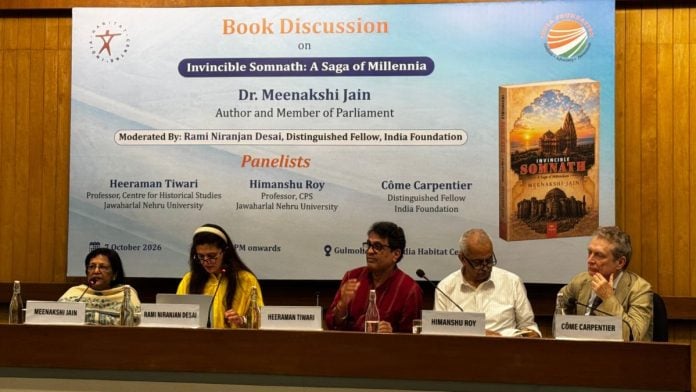
Historians gathered at IIC to discuss Jain’s new book, Invincible Somnath: A Saga of Millennia. For the book, Jain said she sifted through ancient scriptures, inscriptions, archaeological evidence, foreign travellers’ accounts and historical chronicles. Somnath is one of Hinduism’s most revered religious sites and is traditionally regarded as the first of the 12 Jyotirlingas.
The discussion examined the history of Somnath and the politics surrounding it, from the Nehru era in newly independent India to Prime Minister Narendra Modi’s tenure. The panelists included Heerman Tiwari, professor and chairperson of the Centre for Historical Studies at JNU; Himanshu Roy, Political Science professor at JNU; and Côme Carpentier de Gourdon, French-born scholar and indologist.
“The Somnath tells us a very fascinating story that this civilization survived not because of kings or warriors. It survived because of the determination and contribution of ordinary people,” said Jain.
When Somnath was almost in Pakistan
Although the Somnath temple was rebuilt as many times as it was destroyed, Jain said there was a point when India could have lost the temple to Pakistan.
A month after India became Independent in 1947, the status of Junagadh became a contentious issue, after its ruler chose to accede to Pakistan.
“Imagine what we would be talking about today if Junagadh had gone to Pakistan and Somnath was a part of Pakistan. We have lost so much of our sacred heritage because of the division of the country,” said Jain.
She added that the state’s then-Diwan, Shah Nawaz Bhutto, and its ruler, Nawab Muhammad Mahabat Khanji III, had actively kept the Indian government in the dark about their plans.
Sardar Vallabhbhai Patel, meanwhile, kept the Indian Army positioned at the border of Junagadh.
“And when the right moment came, they entered Junagadh and that is how Junagadh became a part of India,” said Jain. “When Sardar Patel went to Ahilyabai’s temple at Somnath, he took a pledge that he would rebuild the temple of Somnath.”
Also read: Author Neera Chandhoke is wary of Indian knowledge systems—‘where are Dalits, Adivasis, women?’
The Nehru-era debate
Panelist Himanshu Roy spoke about the politics surrounding Somnath during the Nehru era. Roy quoted Jain’s book as saying that Nehru viewed the reconstruction of the Somnath temple as “Hindu revivalism.”
“When the decision for the temple’s reconstruction began, the Urdu press carried out the public reaction. It said, ‘If Somnath is renovated, it will have to be evinced. A new Ghaznavi must come from Ghazni,’” said Roy.
Roy said Nehru subsequently wrote to President Rajendra Prasad, urging him not to accept the invitation to inaugurate the temple.
“He [Nehru] felt that a bad press, international press, because this is a secular state that is taking shape, is damaging for India. The reconstruction of Somnath is damaging the secular state,” Roy said.
The panelists also discussed PM Modi’s tenure and how it has witnessed a revival of temples, be it the Ram temple in Ayodhya or the Kashi Vishwanath temple.
(Edited by Ratan Priya)