



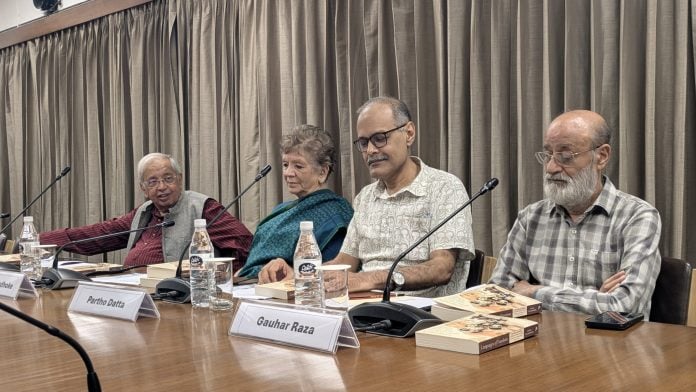
New Delhi: Freedom is a process, not a destination, political theorist Neera Chandhoke argued at a discussion of her new book.
“I think the worst thing that a government can do is to disallow us from fighting for people’s freedom, for our fellow citizens’ freedom, and in a way, not even allowing us to talk about unfreedom,” she said at the India International Centre, speaking at a discussion of her new book, Languages of Freedom: The Idea of India in Political Theory, Bombay Cinema and Progressive Urdu Poetry.
The evening on 30 September came as Umar Khalid’s bail plea was denied yet again. The shadow of the silent acknowledgement of the news hung over the room.
“There is no case against them; there are no FIRs against them,” Chandhoke said, speaking of the former student activists currently in jail. “Four years, five years they are in jail. Now that denial of freedom is serious, I think we have to come together to fight over it.”
Joining Chandhoke on the panel were Hindi poet Ashok Vajpeyi; scientist, prominent Urdu poet, documentary filmmaker, Gauhar Raza; and cultural historian and musicologist Partho Datta.
Opening the discussion, Vajpeyi called the book “unusual” for how it treats poetry, theatre, and cinema “as languages of freedom”.
He insisted that while freedom is usually understood in the language of political science, politics, and social movements, the book tries to expand the geography of that language into other areas. He singled out the chapter on Urdu poetry.
“The analysis of Urdu poetry is particularly important at a point when Urdu as a language is being accused of being communal, which is of course untrue,” he said. “At that point of time, to assert that this has been a major language of freedom is important.”
Flipping through his copy, bookmarked with colourful paper tabs, Vajpeyi read out several passages. He ended with one addressed to poets.
“A poet will be lacking in her vocation and her passion, if she does not address the sorrows of the world, and tell us in her own powerful way that there must be no more Auschwitz,” he read.
Raza traced a gradual awakening in Urdu poetry, from Ghalib’s era through Altaf Hussain Hali, Shibli Nomani, Hasrat Mohani, and Akbar Allahabadi.
He quoted a couplet by Fani Badayuni:
“Yahan kotahi-e-zauq-e-amal hai khud giraftari,
Jahan baazu samatte hain wahi sayyad hota hai.“
(Where you are unwilling to act,
captivity is of your own making.)
The book, Raza said, shows that the freedom struggle saw unfreedom in two forms: imperialism on one side, social evils on the other.
India in political theory, Bombay cinema
Datta chose to take the historian’s perspective and focus on chapters others had overlooked. He joked that Chandhoke had complained to him, “very good-humouredly,” that nobody was reading them.
He said he had prepared for the discussion by watching a lecture by Quentin Skinner on YouTube, in which Skinner, citing Nietzsche, argued that concepts with histories do not have stable definitions. The book, Datta said, illustrates this brilliantly.
He called the chapter on MK Gandhi one of the best he had read.
Datta then explained Chandhoke’s critique of thinkers such as Rammohan Roy, Vivekananda, KC Bhattacharya, and Gandhi. The late 19th-century Indian intellectuals, he said, accepted that India was a great civilisation but asked whether its thought contained concepts for modern associational life and politics. Indian philosophy had a great deal to say about the individual self, but much less about the collective self. So they reached for older words such as Swaraj and Swadesh, and coined new ones such as Satyagraha.
The problem, in Chandhoke’s account, is that these categories were drawn from Hindu philosophy and texts. Even in a “benign” form, Datta said, that made them exclusive.
He argued that the link between religious thought and politics is a 19th-century construction, emerging when thinkers began insisting that India’s political thought must be sought in its religious texts. It is neither natural nor inevitable. An alternative is possible, he stressed, a political vocabulary that does not rest on a single religious tradition.
On the book’s final question, how to write Indian political theory, Datta placed it beside Dipesh Chakrabarty’s Provincializing Europe (2000).
“It has to be plural. It has to be a mix of the modern and the pre-modern. It has to be neither authentic nor naively historical,” he said, quoting Chandhoke. Indian political theory must critique Brahminism and reconnect with the Mughal past.
“Can we even think of Khayal without Islamicate cultures?” Datta asked.
Chandhoke then spoke about why she wrote the book. Rousseau, she said, gave the best account of unfreedom with his line that ‘man is born free but is everywhere in chains’.
“Do we ever get free? One set of chains, we break, or somebody breaks them for us, and another set strikes us in the face, like Medusa’s serpents,” she said.
Bombay cinema, especially, shows chains replacing chains. Within four years of former prime minister Jawaharlal Nehru taking charge came Awaara (1951) and Baazi (1951), both with heroes who end up as criminals to help a sick mother or sister. The ideals of the freedom struggle had dissipated quickly.
“Freedom has no formula,” Chandhoke said, adding that neither Gandhi’s Hind Swaraj, Plato’s Republic nor Thomas More’s Utopia offers a recipe for it. It cannot be organised, she said, and begins with the freedom to think, a right in the Universal Declaration of Human Rights.
She added that she is wary of the push for “Indian knowledge systems.”
“It is Hindu, Sanskritic and Brahmanical. Where are your Dalits? Where are your Adivasis? Where are the women?” she asked.
Also read: Jamini Roy to MF Husain, Delhi exhibition houses the many modernisms of Indian art
‘Sanjhi virasat’
Chandhoke closed with an anecdote about MF Husain, who was asked in Cuba whether he was not a Muslim. He replied that his Islam went back to the 7th century but his Indian identity to many more centuries, and that he was both. She said Ali Sardar Jafri’s poem ‘Main Hindustan-i-Musalman Hoon’ sums this up, and that Indians are children of the Gita as much as of the Bhakti and Sufi traditions.
“The task of a responsible scholar is not to divide people,” she concluded. It is to find commonalities, which she calls sanjhi virasat or shared legacy, and to build “a transformative political theory”.
In the question-and-answer session, an academic writing a book on Indian political theory said that if anything is essential to the tradition, it is pluralism. The texts of India’s interpretive traditions, he said, are not only religious but also philosophical, artistic and, generally, common sense.
Chandhoke responded that ideas do not travel equally across regions.
“The same ideas are not going to work in Maharashtra, where there is a powerful Dalit movement. Kerala is matrilineal, and Tamil Nadu is different again.” Rather than a single Indian political theory, she said, “we might be able to do regional political theories.”
(Edited by Prasanna Bachchhav)