



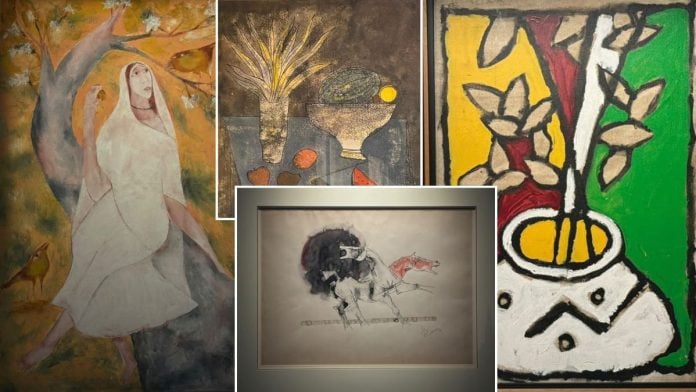
New Delhi: A woman in a white saree sits on a branch, looking sideways at a bird perched next to her. The painting suggests a world in which boundaries between the person, the creature, and the landscape barely exist—they all appear to belong to the same visual space.
In Haku Shah’s sparse style, the stillness leaves room for a sense of exchange between the woman and the world around her.
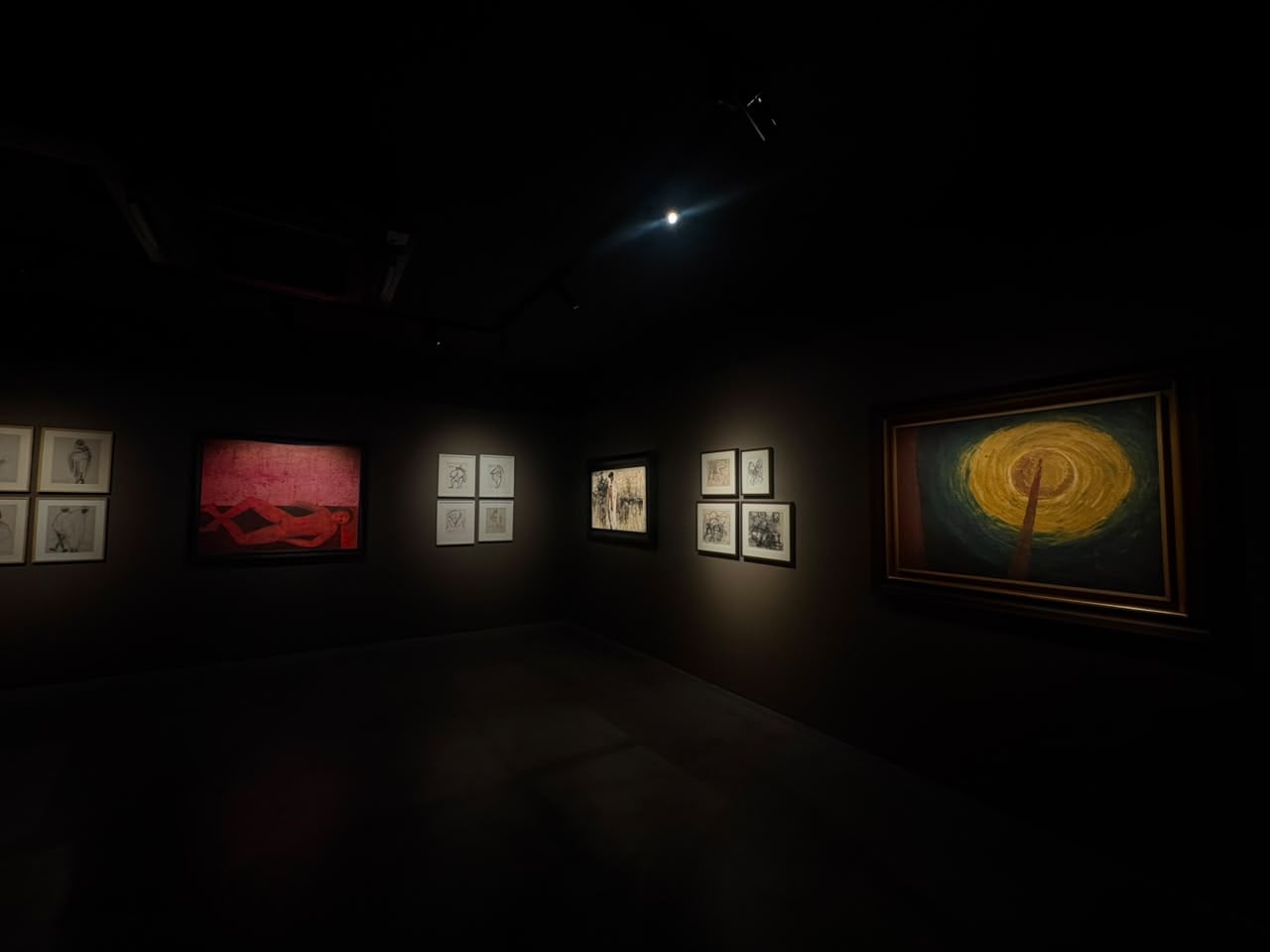
The painting is on view at Thapar Gallery as part of ‘Many Modernisms: Figuring the New Artistic India’, an exhibition that brings together artists who offer incredibly diverse ways of seeing and representing a country in transition.
On view until 15 October 2026, the exhibition features works by Jamini Roy, Amrita Sher-Gil, KK Hebbar, MF Husain, FN Souza, Sadanand Bakre, Sohan Qadri, B Prabha, Haku Shah, and others. The works move between folk traditions and modern influences, figuration and abstraction, showing the many ways Indian modernism took shape across regions and generations. The exhibition also examines how modernism developed differently in places such as Santiniketan, Mumbai, Hyderabad, Chennai, and Delhi.
Ashish Thapar, director of Thapar Gallery, said the exhibition was an attempt to bring these different strands together.
“I think modernism in India is a later concept than in Europe, because in Europe, modernism ended by the end of the Second World War. But India was still young as a country after Independence. And so, in a very short period, we saw all those ‘-isms’ happening within India. We were running at a fast pace. That’s why there were so many different, diverse things happening,” Thapar said.
The work of Haku Shah
Shah’s paintings rarely announce their ideas. A cowherd, a fruit seller, or a woman carrying a pot appears against a spare background, with little detail.
Born in Valod, Gujarat, the artist was known for paintings rooted in rural life, folk traditions, and spirituality. He spent much of his life working with and documenting India’s folk and tribal traditions. His recurring images of cows, trees, shepherds, and other figures draw on the visual language of folk and tribal art, using simple lines, shapes, and colours.
Their simplicity results from an artist who knew exactly what he wanted to leave out.
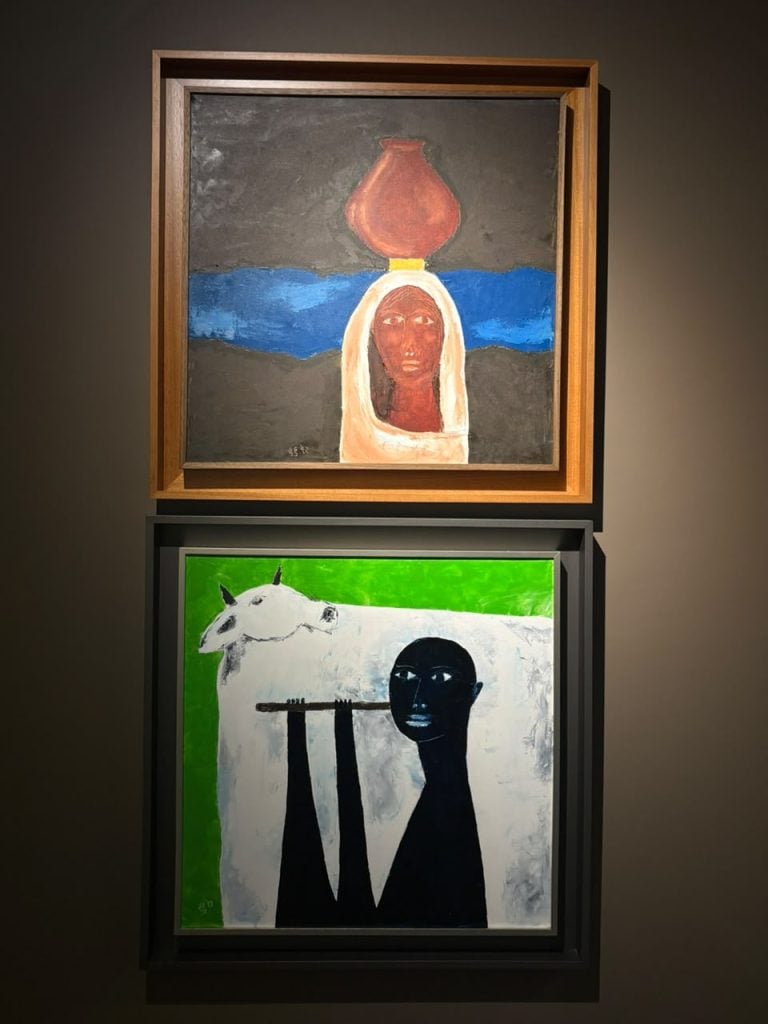
“Most of his canvases have a sort of Krishna figure. His treatment, the way he painted, was so simple. He would not put in many layers and make it complex. I think when people look at his works, they see them as too simple at times. But that simplicity is very difficult to achieve. Only a master can do it,” Thapar said.
Shah’s figures often carry a spiritual dimension, particularly through the recurring presence of Krishna. Yet, the artist did not call these paintings a Krishna series. He described his subjects as cowherds and sheep herders, allowing the everyday scene to remain at the centre of the work.
In one painting, two cows appear alongside two figures of Krishna. When someone at the gallery asked why there were two Krishnas, Thapar recalled explaining the thinking behind the work.
“Because Shah sees Krishna in everybody,” he said.
Across artists, regions, ideas
The exhibition follows a broad chronology, beginning with Roy and Sher-Gil, before moving to the Progressive Artists’ Group and later generations. But the arrangement is also a journey through the places and ideas that shaped modern Indian art.
“There were a lot of different things happening at that time, both in terms of the forms and the ideas. Some artists were working figuratively, while others were exploring abstraction. There was also a lot of spiritual work,” Thapar said.
Santiniketan offered one strand, with artists drawing on Indian traditions and indigenous visual forms. In the erstwhile Bombay, the Progressive Artists’ Group looked outward, absorbing international ideas about modernism while developing its own language.
The differences are visible in the works themselves.
Sher-Gil, who returned to India in 1934, increasingly turned to Indian subjects after years of studying and working in Europe. Roy developed a style rooted in folk and indigenous traditions. The Progressive Artists, including Husain, Souza, and Bakre, explored different forms of figuration and abstraction while engaging with international modernism.
Qadri moved toward abstraction, using colour, form, and repetition to explore ideas of meditation and spirituality. His work eventually moved away from representation altogether, drawing on Tantric thought and other Eastern spiritual traditions.
Souza repeatedly returned to religious imagery. His treatment of Christ, churches, and biblical subjects was shaped in part by the Catholic imagery he encountered growing up in Goa, even as his work remained deeply personal and often confrontational. His religious paintings drew on both the wider imagery of Christianity and the churches of his childhood.
Prabha’s paintings frequently centred on rural women, using elongated figures to draw attention to their work, poverty, and the hardships of rural life. Her work brought another side of India’s changing society into the exhibition.
For Thapar, bringing these artists together shows how several different versions of modernism emerged simultaneously.
(Edited by Prasanna Bachchhav)