





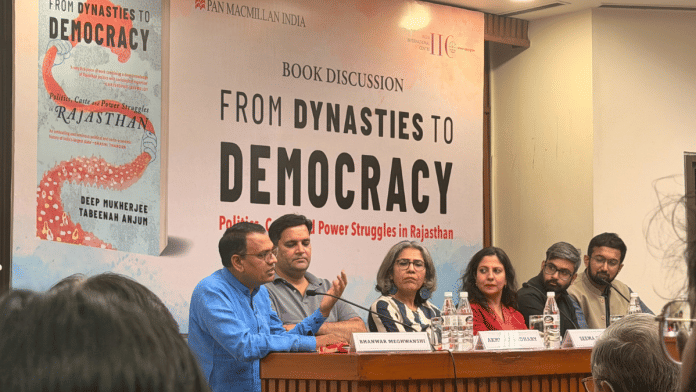


New Delhi: Late evening on 18 May, a panel of journalists, lawyers and activists convened to discuss a state that, as moderator and political editor Aditya Menon put it, “defies very simplistic one-line explanations.”
Journalists Deep Mukherjee and Tabeenah Anjum’s recent book Dynasties to Democracy: Politics, Caste and Power Struggles in Rajasthan is the first comprehensive account of contemporary Rajasthani politics in English. During the book launch at the India International Centre Annexe, the authors explained why a book of its kind had taken so long to write.
“We kept looking for a book like this, and we could not find one,” Anjum said.
Anjum hails from Kashmir, whereas Mukherjee’s hometown is in Bengal, but the co-authors have spent years reporting from the state, positioning them perfectly as outsiders with fair knowledge of Rajasthani politics.
“Rajasthan is our karmbhoomi. Hailing from Kashmir taught me to look beyond landscape,” Anjum added.
The book, she said, was born partly out of reportorial frustration: stories that wouldn’t fit into a daily newspaper and notebooks full of accounts that never found their way into print.
The book’s origin story got a laugh from the audience. It was 2021, in the middle of the Ashok Gehlot-Sachin Pilot political crisis, when Anjum tallied up their weekly word counts. It was 8,000 and 10,000 words respectively, and so they decided to write a book instead.
“We didn’t talk about it again for months,” she admitted. Five years later, here they were.
Rajasthan’s past and present
Mukherjee offered a glimpse into the book’s central argument: that Rajasthan’s political peculiarities are best understood through history. After Independence, unlike in most other states where the Congress swept to power on the goodwill of the freedom movement, in Rajasthan it barely scraped through—winning 82 seats against a formidable feudal opposition. The Jodhpur Maharaja, contesting as an independent, defeated Jai Narayan Vyas, the state’s most prominent freedom fighter.
“Such a thing was unthinkable elsewhere,” Mukherjee said.
The Jagirdars had realised that democracy was coming and the best way to retain power was to contest elections. They did, and they largely won.
That history of feudalism bleeding into democracy, Mukherjee argued, explains much of what one sees in Rajasthan today—including the communal rhetoric. He cited a 1952 election speech in which the Maharaja of Jodhpur, Hanwant Singh, told his constituents that if the Congress came to power, they would build a factory where hundreds of cows would be slaughtered.
“Such rhetoric would not feel out of place today either,” Mukherjee added.
Also Read: Silent protest to slogans—why Cottage Emporium workers are angrier even after Rs 81 cr relief
The beginnings of a religious tempest
The panel took a sharp turn when Bhanwar Meghwanshi, a writer and activist who was previously associated with the Rashtriya Swayamsevak Sangh (RSS), spoke about how the organisation found its footing in Rajasthan. Unlike the rest of the country, where the RSS built on Hindu-Muslim tensions, in Rajasthan, it made its early alliances with the princely class and found support from organisations such as the Arya Samaj. Meghwanshi explained that the state’s relatively small Muslim and Christian populations meant that the usual template didn’t quite apply.
“So they (RSS) started pitting different castes against each other. That started in 1928 and is still ongoing,” he said.
He described growing up in an area with no Muslim households within a radius of eight to ten kilometres, where anti-Muslim sentiment nevertheless arrived without fail.
Lawyer and human rights activist Akhil Chaudhary brought the Rajasthan’s bovine protection act into focus. Under which, he said, even intra-district cattle transport requires bureaucratic permission—a law that has become a vector for communal targeting in practice.
The liveliest intervention of the evening came from Seema Chishti, editor at The Wire, who praised the book warmly before launching into a broader argument. Journalists, she said, often make a hash of books, but this was a rare exception.
“You have drawn from history to write like reportage, and teased out the complexities without losing the reader,” Chishti said.
She also pointed to what makes Rajasthan such a puzzle: a state with a deep feudal past that nonetheless produced the right to information movement; one where caste stratification runs deep, but in some constituencies, BJP and Congress candidates have jointly addressed Milad-un-Nabi rallies.
“It has casteism, but it does not have casteism in the way UP and Bihar do,” Chishti said.
The book carries endorsements from French political scientist Christopher Jaffrelot, journalist Rajdeep Sardesai, and Member of Parliament Shashi Tharoor, among others.
Late Sankarshan Thakur, editor of Telegraph India, called it “a path-breaking reference” for anyone wanting to understand the weave and weft of Rajasthan’s politics. Given how sparse the existing literature beyond Rajasthan’s palaces is, it may be the only reference for some time.
(Edited by Insha Jalil Waziri)
How much money these Anti Hindu Anti national bastards received from Deep state of US, George sarus, vatican , Muslim brotherhood, Wahabis for this statement?what the hell you can do in Hindu country hindustan?better shut up and get lost.jai Hindu rashtra Jai Hindus.