



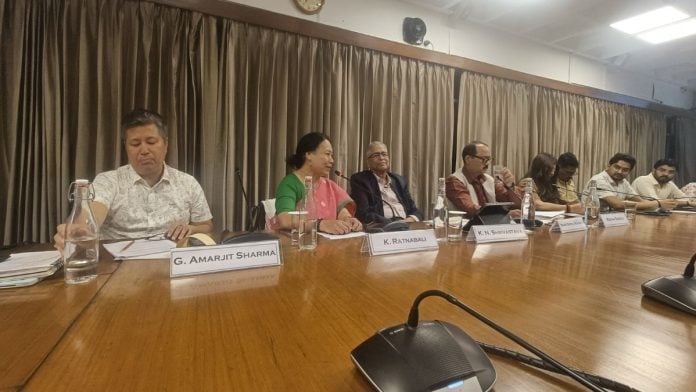
New Delhi: Development in Northeast India may need to look beyond conventional models of growth and draw on something the region already possesses: generations of indigenous knowledge about living with its distinctive ecology.
At a panel discussion in Delhi Tuesday, academics argued that traditional practices in the Northeast—from agriculture and forestry to handloom, bamboo and cane work and community-based resource management—could support sustainable livelihoods and economic transformation if backed by stronger institutions, market access and modern science.
For Professor K Ratnabali, Dean, Academic Affairs, University of Delhi, sustainability has become a necessity rather than a choice.
“In today’s context, we always talk about sustainability, but it’s not an option. It is something compulsory if we want humanity to survive,” Ratnabali said at the discussion, titled Indigenous Knowledge Systems as Drivers of Economic Transformation in Northeast India: Institutional Pathways and Sustainable Development, held at Delhi’s India International Centre (IIC).
“The learnings people have acquired over generations, because they have learnt to live with nature and safeguard it along with their own livelihoods, are very critical,” she said.
The Department of Political Science, IIC and the Ministry of Development of North Eastern Region (DoNER) jointly organised the discussion. The panel included Nani Gopal Mahanta, Vice Chancellor of Gauhati University, G Amarjit Sharma, Special Centre for the Study of North East India, Jawaharlal Nehru University (JNU), and Professor Rekha Saxena, who moderated the discussion. IIC director KN Shrivastava chaired the panel.
The speakers argued that the region’s development needs to be rooted in its distinct geography, institutions and traditional practices, while combining these with modern science and technology.
“The knowledge system can also be recognised as a source of innovation, entrepreneurship and livelihood. Indigenous knowledge should not just be confined to a heritage symbol, but should be taken as a living and evolving source for the development of the region,” Shrivastava said.
He said industries could play a vital role in connecting indigenous knowledge with contemporary research and act as a bridge between communities and researchers.
“The traditional knowledge of individuals and knowledge about natural historical processes really give us a lot of lessons about how we can live in harmony with nature, so that we do not face the kind of climatic disasters that we are confronting nowadays,” Shrivastava said.
Indigenous knowledge systems
The Northeast’s indigenous knowledge is increasingly being discussed not just as cultural heritage, but as a potential economic and ecological resource.
Saxena said indigenous knowledge systems are embedded in everyday practices, including agriculture, forestry, biodiversity management, traditional medicine, weaving, handloom, bamboo and cane-based livelihoods, food systems and community-based resource management.
These, she said, are not merely cultural practices, but forms of economic activity and community institutions that have historically supported local livelihoods.
“At the same time, the challenge is to move beyond viewing this indigenous knowledge only as something to be documented or preserved and to recognise its potential contribution to innovation, entrepreneurship, livelihoods and sustainable development,” Saxena said.
She added that this would require looking beyond the market alone and considering the role of institutions, federalism, local governments, universities, intellectual property, benefit-sharing and community autonomy.
Saxena asked the panel whether indigenous knowledge systems could provide a distinct pathway of economic transformation for Northeast India, and what institutional conditions would make such a pathway viable.
Mahanta said the region’s hilly terrain and largely landlocked geography meant that development models needed to take local conditions into account.
“A more locally grounded approach could build on small and medium enterprises, local value addition, indigenous knowledge and resources, sustainable agriculture, forestry, handicrafts, tourism and renewable energy sectors. The purpose is not to deny industrialisation, but the Indigenous Knowledge System can definitely provide a viable alternative or a method to be adopted simultaneously,” Mahanta said.
Also read: From Dublin to Kolkata. How an Irish band discovered its Indian sound
The Northeast’s role
Mahanta said northeastern India already has a form of federalism that could be described as “asymmetrical federalism”, with a plethora of institutions. The challenge, he said, was coordination and collaboration among them.
Mahanta cited a NITI Aayog report that raised concerns about rapid infrastructure development and other forms of industrialisation in the region, while advocating a community-led indigenous tourism framework and the preservation of sacred tree groves.
For Ratnabali, documenting and studying indigenous practices is an important first step towards integrating them with economic development.
“When we talk about getting access to those knowledge systems and then integrating them with economic development, it is very important to document and study those practices,” she said.
There is also a need to create awareness within communities about the significance of products, processes and practices developed over generations, she said.
“After awareness, there is a need to train and build capacities of the communities, and the next step is to develop the supply chain,” Ratnabali said.
But the Northeast is also facing disruptions from business- and growth-driven development projects, including infrastructure projects.
Such projects can make indigenous ways of life more precarious and vulnerable, Sharma said, because interventions can disrupt the “intimate ecological linkages across elevations and distances” in the region.
(Edited by Prashant Dixit)