



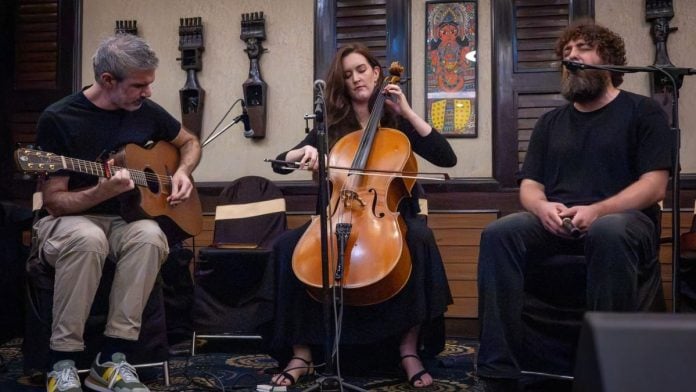
New Delhi: For Irish folk-fusion band Saltaire, its first trip to India quickly became an exercise in discovering how unfamiliar music can feel strangely familiar.
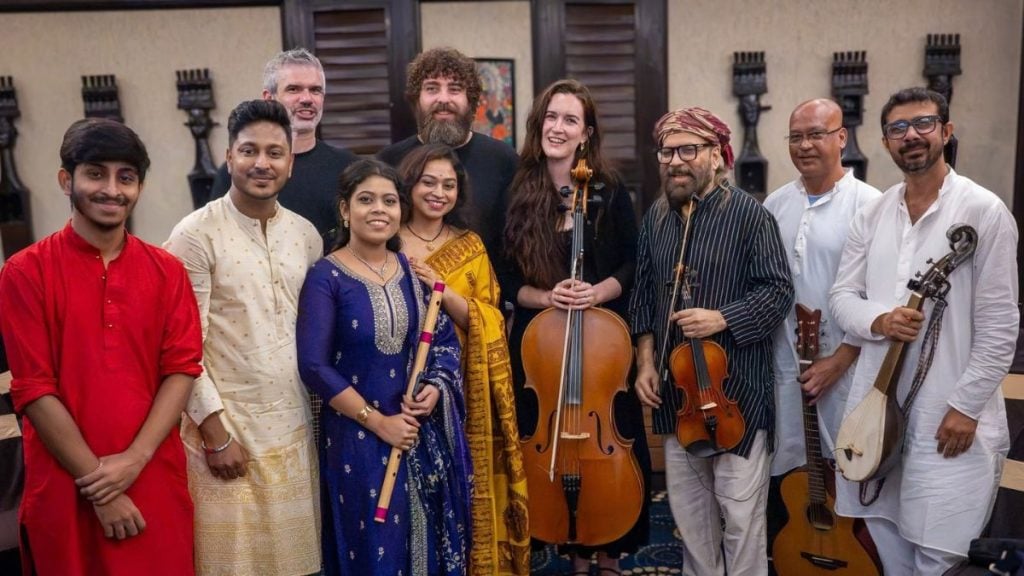
In four days, the Dublin-based trio taught old Irish songs to school students in Kolkata, learnt from musicians at Ziro in Arunachal Pradesh, joined an open-mic jam session and even tried silkworms and grasshoppers. At every stop, the musicians found unexpected points of connection between Irish and Indian musical traditions.
“We were absolutely blown away,” lead singer Kaitlin Cullen-Verhauz told ThePrint.
Saltaire—Cullen-Verhauz on vocals and cello, Ian Kinsella on guitar, and Eoghan Pádraig Ó Ceannabháin on flute and vocals—describes itself as a folk-fusion group that arranges traditional Irish tunes, reimagines old folk songs and writes original music within the tradition. Its four-day India tour, which ended Monday, was supported by Culture Ireland and the Embassy of Ireland and formed part of celebrations marking Ireland’s presidency of the Council of the European Union.
For the musicians, the journey was about finding where the Indian and Irish traditions could meet.
“There’s deep resonances between the two cultures, historically, politically, musically,” Cullen-Verhauz said.
The most striking confirmation came from the audiences. People repeatedly told the band that although its music was foreign to them, it “somehow still resonated and felt like home”.
Diversity and experimentation
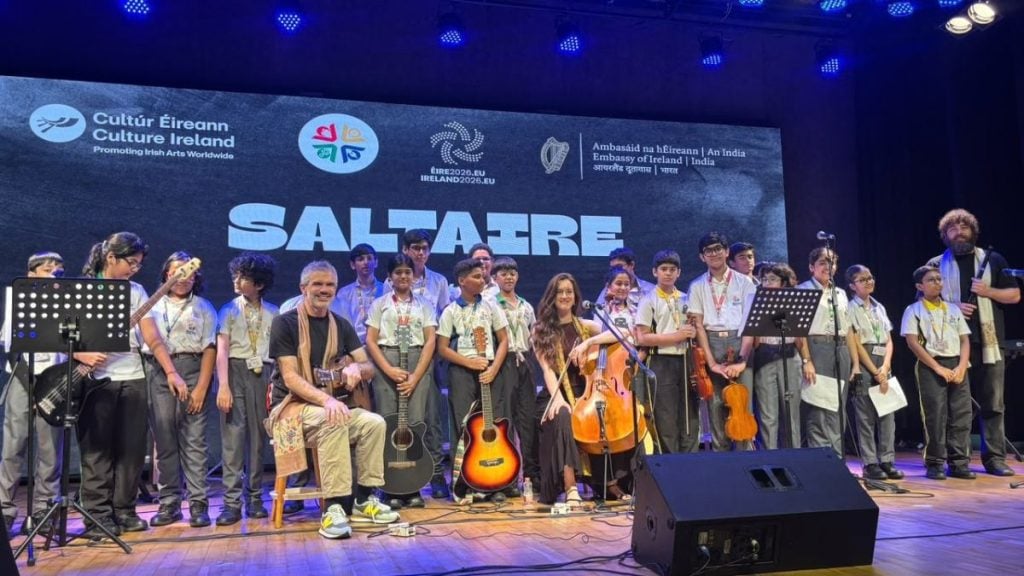
In Kolkata, Saltaire’s stay began with students at Newtown School who had never heard traditional Irish music. Over two days, the trio set out to change that.
They first taught the students “The Spanish Lady”, an old Irish song that the children learnt in a day. The next day, Saltaire introduced them to instrumental Irish traditions, including jigs, reels and polkas. Ó Ceannabháin explained Irish musical modes and time signatures, spoke about the Irish language and taught the students the Irish vocal technique known as lilting.
The workshops culminated in a concert at the school. After just two days of preparation, the students performed the song, tune and chorus they had learnt, joining Saltaire onstage.
“We did a song from the ensemble, a song of our own, and even an Irish language song and honestly, the crossover was wild. Turns out our jigs and their melodies share the same scale—who knew? We mashed it up, I geeked out over the bamboo flute, and honestly, I’d jump at the chance to do it all again,” Ian said.
Also Read: A rare look at Picasso, Dalí, Miró’s experiments with printmaking
Beyond borders and cultures
In Ziro, the experience was entirely different. This was the first time an Irish band was performing at the music festival. The musicians found themselves drawn into the local music scene, watching performers from different parts of India and other countries, including sitar players and an ensemble from Manipur.
The night before Saltaire’s concert, they joined a jam session at an open-mic space, moving between jazz, funk and other styles with musicians. For Cullen-Verhauz, it became one of the band’s most memorable experiences at Ziro because it allowed the Irish musicians to connect directly with musicians from the region.
“It was beautiful in terms of the setting and the exchange of energy. The crowd was so generous and engaged. They were really listening to the music, to all of our stories. We were all laughing together throughout the set. There were no nerves throughout the set at all because they just made it so easy to play. So fun, so enjoyable,” she said.
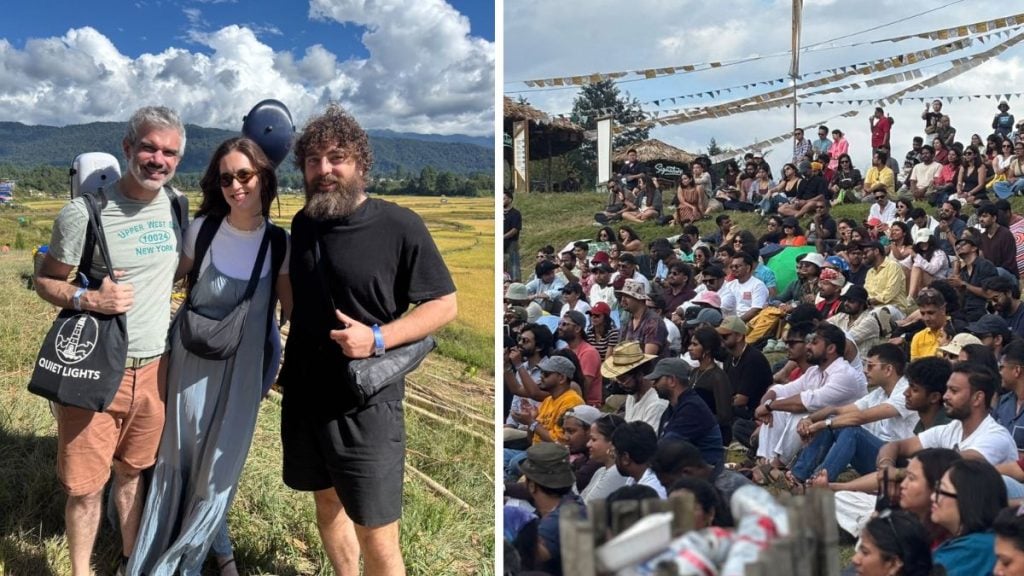
The festival itself left an impression too. Its stages were built by hand from bamboo, and Cullen-Verhauz was so intrigued that she spoke to a member of the architectural team about the process. The night before Saltaire’s performance, the musicians watched a Palestinian DJ incorporate live instruments into his set using several keyboards.
The next day, Saltaire performed traditional tunes it had recorded and arranged over the years alongside original material. Ó Ceannabháin, a prolific Irish-language singer-songwriter and instrumentalist, brought his own music to the set, sang in Irish and played flute.
“Ian got the crowd lilting as he sang to them in the Irish language and I think we made some really meaningful connections musically,” Ó Ceannabháin said.
By the time the tour ended, the band had already received suggestions for venues in different parts of India and expressions of interest in bringing its music back.
“The second we get a chance, we’re coming right back,” Cullen-Verhauz said. “This definitely isn’t the last you’ve seen of us.”
(Edited by Stela Dey)