





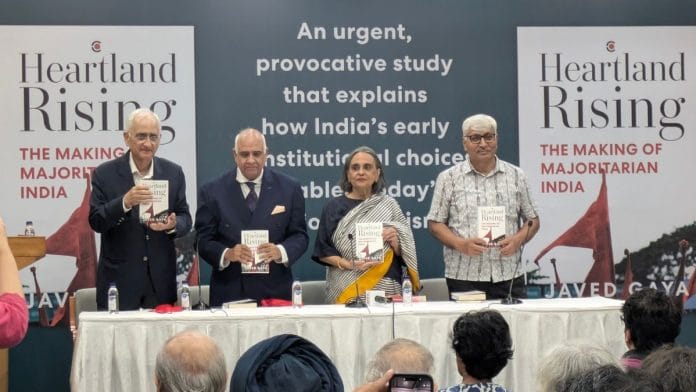


New Delhi: As a steady monsoon downpour lashed the capital on 3 August, roughly 40 to 50 people gathered in the Seminar Hall at the India International Centre for a conversation as turbulent as the weather outside. It was the launch of Heartland Rising: The Making of Majoritarian India, a new book by author Javed Gaya.
The book traces the roots of majoritarian politics in India back to Partition and beyond. The discussion panel brought together Gaya in conversation with senior advocate and former Union Minister Salman Khurshid, and Delhi University Hindi literature scholar and literary critic Apoorvanand, under the moderation of senior advocate and family law practitioner Malavika Rajkotia.
Introducing his thesis, Gaya located the origins of India’s majoritarian turn not in recent decades but in the political culture of undivided Uttar Pradesh from 1937 onward, where cultural dissonance with the Congress, he argued, alienated many Muslims and fed the Pakistan movement. He suggested that the loss of “largely non-communal” states like Punjab and Bengal during Partition left the “Cow Belt” (UP and Bihar) as the country’s dominant political bloc.
Matters of the moo republic
Gaya was also sharply critical of former Prime Minister Jawaharlal Nehru’s economic policies.
“This was the big problem I think of Nehru… he never really understood how culture mattered,” Gaya said. “He thought that if there was growth and development, then all these cultural issues would wither away, and they would not be important. Unfortunately, it didn’t work like that.”
Rajkotia noted, to laughter from the room, that Gaya’s working title for the book had been “The Moo Republic”, which was dropped on account of being potentially too offensive.
When Rajkotia questioned about the “strategic restraint” shown by the Congress government during the 1992 Babri Masjid demolition, Khurshid likened episodes such as the Babri Masjid demolition and the 2002 Gujarat riots to a boil on the body — painful and unsightly, but not proof that “the whole body” was unhealthy. He conceded, however, that the very restraint meant to contain matters “may have unleashed the beast.”
Apoorvanand rejected the comparison outright.
“My argument is that it is better to view it as blood cancer. This was not a boil,” he said, speaking in Hindi. “The majoritarian instinct was present in the very manner in which India was constituted, not just in the text of its Constitution.”
He recalled two letters Indira Gandhi wrote to Nehru in 1948 and 1949, complaining that one of his ministers was renaming towns from “-abad” to “-pur.” If it kept up, she joked, she would have to rename herself “Firoza Begum.”
Ping pong balls
The conversation later turned to Indian Muslims. Khurshid argued that caste-based politics in Uttar Pradesh, under leaders such as Mayawati and Mulayam Singh Yadav, could not have succeeded without the “additional muscle that Muslims provided.” Over time, he said, that support went unrewarded, leaving Muslims to swing back and forth between such parties and the Congress.
“Muslims have made themselves into ping-pong balls,” he said, describing a cycle of being courted and abandoned in turn. He pointed to the Sachar Committee as a rare, ultimately undermined, attempt to address the community’s position.
“It was not about Muslims and non-Muslims; it was about Muslims amongst non-Muslims,” he said, calling it “a brilliant thing” that was later “completely demolished.”
Rajkotia, for her part, observed a social double standard in how religious identity is read in India. “A nice, whisky-swirling type of cultural Muslim is highly acceptable and even popular,” she said, “but a practicing Muslim is almost treated with contempt.”
Also read: Abhijeet Dipke will go to Jharkhand, support student protesters. Calls CJP a ‘pressure group’
Federalism and education
Gaya devoted attention to what he called the erosion of Indian federalism since 2014, arguing that changes to Finance Commission formulas – including the use of 2011 census population data rather than the 1971 figures fixed by the 42nd Amendment – have disadvantaged southern states that curbed population growth and invested in social indicators.
“Giving money to the North is like throwing money down the well,” he said, citing the Southern leaders, “since it isn’t having any impact on social indicators.”
Apoorvanand added to the point by describing a decades-long “pedagogical exercise” conducted through RSS-linked schools such as the Saraswati Shishu Mandirs. He said such schools have produced a certain kind of nationalists.
He said this framework has, since 2014, moved from RSS-run institutions into government schools and universities:
“What was happening in RSS schools has now begun happening in government schools and universities too, including through appointments of teachers sympathetic to that ideology who are set to remain in place for the next 25–30 years,” he noted.
Responding to an audience question on textbook revisions, Apoorvanand argued about a deeper problem.
“I don’t call it ‘saffronisation,'” he said. “I say that in a way, it is the ghatiyakaran [degradation] of education.” He added that after reading these books, a student “can neither understand math properly, nor geography properly, nor history properly.”
The framing of “strategic restraint” itself drew a challenge from the floor.
“I consider the term ‘strategic restraint’ a very soft and sophisticated term for many of the events that took place,” one audience member said. They mentioned JP Narayan’s 1976 engagement with the RSS, the Babri demolition, and the Godhra train tragedy as episodes where “no real action was taken except making committees.” The audience member also argued that “accountability is the most important factor in social relations.”
This is where Khurshid came to the defence.
“It’s not a black and white world, there are shades of grey,” he said, “but you can go wrong in shades of grey.” He added that critics rarely specify what a stronger response might have achieved: “Nobody ever says so! They only stop by saying, ‘that was not good enough.'”
(Edited by Ratan Priya)