



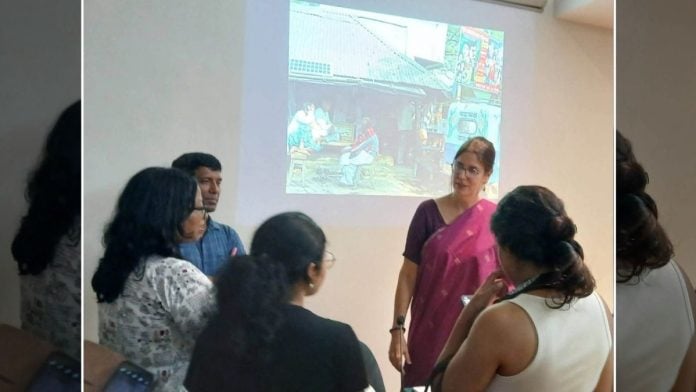
Kolkata: “Bihari is a term that’s loaded in Bangladesh,” environmental anthropologist Annu Jalais said at a recent talk in Kolkata, describing how Urdu-speaking Muslims who stayed on after 1971 continue to carry the stigma of having sided with Pakistan.
“Biharis were favoured by Pakistan before Bangladesh became an independent country. But after 1971, they were called Razakars, a far-right auxiliary paramilitary force put up by the Pakistani army in East Pakistan to take on the freedom fighters,” Jalais said at Kolkata’s Jadunath Bhavan Museum and Research Centre, Ballygunge, where she spoke on Partition’s forgotten people and the communities left stranded by changing borders.
The event, titled “Partition’s forgotten people: Subaltern spaces across fluid borders”, highlighted a community that has been othered due to language and alleged closeness to the Pakistan Army during the 1971 war.
More than five decades after Bangladesh’s Liberation War and two years after the July 2024 uprising that ended Sheikh Hasina’s rule, many Bihari Muslims, who are branded as Pakistanis, remain on the margins of Bangladeshi society. The discrimination remains, and they are still forced to work as barbers, butchers, and rickshaw pullers.
Language over religion
The London-headquartered human rights organisation, Minority Rights Group, has reported that there are approximately 3,00,000 Bihari Urdu-speaking Muslims, mostly Sunni, citizens of East Pakistan who remain stranded in camps in Bangladesh.
“Many from the younger generation have learnt the Bengali language and simply adapted to the Bangladeshi identity,” Jalais said.
Moved by the plight of people trapped in a country that doesn’t consider them their own, Jalais has travelled between West Bengal and Bangladesh, carrying photographs for partitioned families who have not seen each other in decades.
During her travels to Bangladesh, Jalais met a man named Gazi in the Satkhira region, on a small island called Koikhali.
“He had come with his immediate family about 60 years back, at the stroke of midnight, with nothing but the clothes on his back,” Jalais said.
Although in the beginning Gazi had been able to keep in touch with the rest of his family in India, he had not heard from them in many years. As the years passed, it became increasingly difficult to travel to the other side of the border without official documentation.
Gazi had told Jalais about his family and the circumstances in which he had left.
“I, who had a passport and travel permits, decided to visit his 90-year-old brother and family back in India. Following the address that he gave me, I went to a village in the Basirhat subdivision in the North 24 Parganas of West Bengal. When I located the house and found the old man, I showed him a photo of his brother and his children. His eyes started to water. We struck up a conversation, and I probed, ‘Why did you not leave?’” Jalais said.
After some moments in silence, the old man told Jalais: “Why did he leave?—that’s the question you should ask, and I can’t answer it for him.”
In a report published by The Guardian, Bihari Muslim lawyer Khalid Hussain was accused of being the son of a war criminal on his first day at high school.
“A group of Bengali kids surrounded us and made it clear that we were not welcome. The incident still shocks me to this day,” Hussain, who was 12 at the time, told The Guardian. “But we just wanted to learn.”
In 1971, the report states, the Biharis found themselves in a diplomatic dilemma as they were linguistically tied to Urdu-speaking West Pakistan.
“They were living in Bengali-speaking East Pakistan when a brutal nine-month war broke out between the two states. During the war, many Biharis sided with West Pakistan, which resulted in repercussions for the whole community, including their homes being seized after the war. This forced the Biharis into temporary settlements, where most remain to this day,” the report states.
Also read: TM Krishna wants ‘Jana Gana Mana’ sung in every Indian language, in the same tune
‘Stigma has remained’
Bangladeshi author and political affairs columnist Sahidul Hasan Khokon told ThePrint that the marauding Pakistani Army had employed most Bihari Muslims who had settled in East Pakistan to spy on Bengalis.
“They stayed alongside Bengali speakers of East Pakistan and would often pass on information about Bengali freedom fighters who had answered Sheikh Mujibur Rahman’s clarion call for an independent Bangladesh to Pakistani army officers, which resulted in their capture, torture and killings. They were once the eyes and ears of Pakistanis who wanted to deny us our freedom. Unfortunately, that stigma has remained,” Khokon said.
Khokon said between 1971 and 2008, Bihari Muslims were not even recognised as citizens in Bangladesh. A high court ruling in 2008 officially recognised Biharis, specifically those born after 1971 or who were minors at the time of independence, as Bangladeshi citizens.
Jalais said the July uprising of 2024 that brought down the Sheikh Hasina regime also ended up questioning many of the foundational principles of the 1971 war of independence. Bangladesh watchers have argued that after August 2024, Bangladesh has pulled away from India and tried to get closer to Pakistan.
But that, Jalais said, may not change the way Bangladeshis have always looked at Bihari Muslims. Khokon said there might be a political attempt to bring Bangladesh geo-politically closer to Pakistan, but societally, it will still be a long time before Urdu and Urdu-speakers are accepted in the country.
For Jalais, however, her travels between West Bengal and Bangladesh are shaped by the stories of people marginalised by borders and sweeping political changes.
Jalais said that at Gazi’s 90-year-old brother’s place in India, she was stopped by a woman who pulled out a photo of a young bride.
“You see,” she had told Jalais, “I found a good man in Satkhira (in Bangladesh) and married my daughter to him. I’ve lost her number and am sick with worry for her as she hasn’t called in two months. I’ve heard that you have a passport. Do you think you could look her up next time you’re in Satkhira? Tell her that her mother prays for her every day.”
(Edited by Saptak Datta)