



New Delhi: When protests over the Lokpal Bill swept Delhi in 2011-2012 during the UPA government, Union Law Minister Veerappa Moily did not see the agitation as a threat to the government. Instead, he saw an opportunity to resolve a long-pending legislative issue through dialogue.
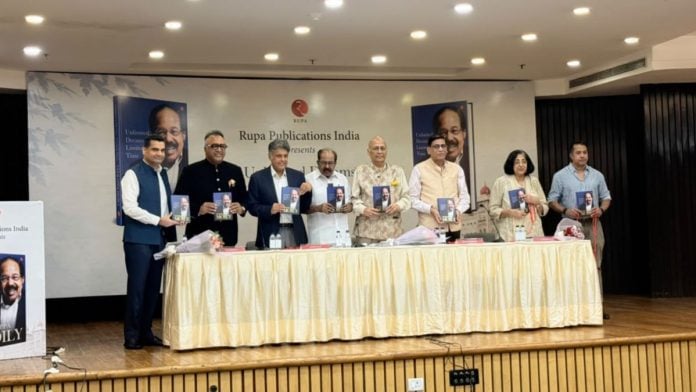
Speaking at the launch of his autobiography, Unlimited Dreams, Limited Time, at the India International Centre in Delhi on 9 October, Moily recounted how the government responded then.
“We were not afraid of the agitation,” Moily said.
For Moily, the episode captured something fundamental about democracy—dissent, however noisy, is not necessarily a sign of failure. It can also be a means of strengthening the system.
“Protests are inevitable and in a democracy, they can serve a valuable purpose. It helps sustain democracy and enables people to fight for their freedoms,” he said.
At the book launch, Moily revisited moments that shaped his political career, from the Lokpal agitation and his interactions with former prime ministers to his attempts to push through reforms that initially met resistance. His stories offered a glimpse of a politician who, despite holding important positions in government, remained driven by what he described as a persistent restlessness.
Joining him on the panel were Congress leader Abhishek Manu Singhvi, former Union minister Manish Tewari, Professor Faizan Mustafa, Professor C. Raj Kumar and retired IAS officer Vineetha Rai.
Turning agitation into legislation
The Lokpal Bill had remained pending for years when the anti-corruption movement led by Anna Hazare gained momentum. Arvind Kejriwal and several opposition leaders were also part of the campaign, which brought thousands of people onto the streets and put the UPA government under pressure.
Moily, who was serving as Law Minister, recounted suggesting to former Prime Minister Manmohan Singh that a joint committee be formed, bringing together members of Parliament, legal experts and representatives of the agitation.
The idea was to move the debate from the streets to the negotiating table without dismissing the concerns driving the protests.
“We constituted the committee, and the agitation that had spread across Delhi and other parts of the country was halted as discussions progressed. The committee reached a consensus, and the bill was subsequently passed by Parliament,” said Moily.
‘Unlimited dreams, limited time’
The title of Moily’s autobiography reflects a tension he said has followed him throughout his life: the feeling that there is always more to accomplish, regardless of the time, opportunities or platforms available.
Despite his long career in public life, he said he had never quite been able to settle into a sense of having done enough.
“That restlessness has continued throughout my life,” he said.
One example was his attempt to develop India’s electronics sector at a time when it had yet to emerge as a major industry.
Recalling a visit to Silicon Valley in the United States, Moily said he addressed a gathering of entrepreneurs and senior executives from companies such as Intel and Tandem. He announced his ambition to establish a Silicon Valley in Bengaluru.
The ambition, however, did not immediately find support at home.
“I announced that I would establish a Silicon Valley in Bangalore,” he said, adding that no IAS officer was willing to join what they considered his misadventure.
Convincing industry to accept CSR
Another major initiative Moily recalled was the introduction of corporate social responsibility (CSR) provisions in company law.
When he took charge of the Companies Bill, the question was whether the legislation should include a provision requiring companies to contribute toward social objectives. The original draft prepared by D.J. Hirani did not contain it.
Moily said he wanted to do more than make incremental changes to the Companies Act of 1956.
“I made it clear that I did not want to simply amend the Companies Act of 1956. I wanted a comprehensive and modern company law,” he said.
The proposal, however, faced resistance from sections of industry. Manmohan Singh quietly alerted him that influential industrialists were opposed to some provisions and that the government could face criticism.
Moily responded by holding consultations with major business groups, including representatives of the Tata, Birla and Ambani business houses.
He said he sought to persuade them that CSR would not undermine their businesses but could encourage a stronger commitment to society and improve their public image.
“Today, we can see the benefits of corporate social responsibility. It has made resources available for social objectives and community development,” he said.
When Indira Gandhi lost her patience
Among the political episodes Moily recounted was an assignment given to him by former Prime Minister Indira Gandhi concerning Kerala.
He said Gandhi once called him after learning that some Congress leaders in the state had supported a Marxist government. She wanted him to speak to the leaders and find a way to bring Congress back to power in Kerala.
Moily was not convinced he was the right person for the job.
“It was an enormous task. I told her that I did not think I could accomplish it and suggested that the assignment be given to senior leaders such as PV Narasimha Rao and Pranab Mukherjee,” he recalled.
But Gandhi was unwilling to let the matter rest. She reminded him of the assignment twice and eventually confronted him over his failure to act.
The moment of reckoning came when Gandhi visited Kolar and called Moily to ask why he had not taken even a single step toward completing the task.
“She was furious and told me that she would not see my face again unless I completed it. I had no choice but to take up the challenge,” said Moily.
He recalled that the government subsequently collapsed and Congress formed the government in Kerala.
Also read: How Belgian painter Balthazar Solvyns documented Hindu society of 18th-century Bengal
A life documented through writing
The panel discussion also turned to Moily’s literary work, which has run alongside his political career.
Professor C. Raj Kumar said writing had become part of Moily’s DNA, shaping not only his literary pursuits but also the development of his ideas on governance and public policy.
“He has written not only about public policy and governance but also about literature and other subjects,” said Raj.
Singhvi, meanwhile, spoke of Moily’s ability to confront difficult phases of life without allowing them to overwhelm him.
“He is driven by extraordinary energy and perpetual optimism, and this is one of the rare qualities that keeps him going,” said Singhvi.
For Tewari, the autobiography was as much a record of personal conviction as it was an account of India’s political journey. He described the book as a chronicle of courage, conviction and the ability to face adversity with equanimity. What stood out, he said, was the absence of bitterness in Moily’s recollections.
“The book contains no trace of bitterness. Instead, it recounts a full and rich life in a matter-of-fact manner,” said Tewari.
(Edited by Ratan Priya)