



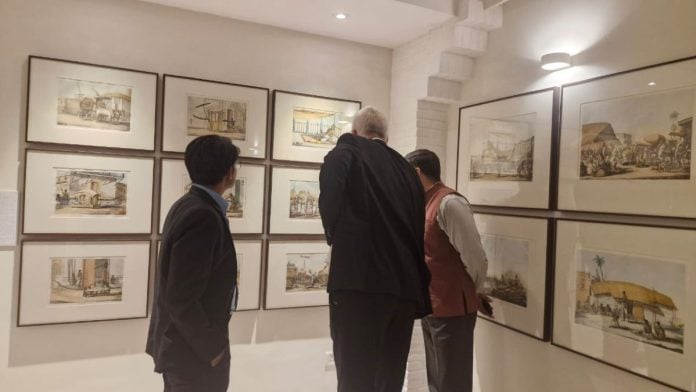
New Delhi: At the Belgian ambassador’s residence in Delhi, the domed red-brick complex looked almost subdued under the evening light. Inside, the brightly lit interiors opened into a corridor with framed etchings of what looked unmistakably like old India, in muted colours. This was the India that Flemish artist Franz Balthazar Solvyns encountered in Bengal more than two centuries ago.
Its people, professions, music, boats and everyday life took centre stage at the residence.
On the visit of Annick De Ridder, Flemish Minister for Mobility, Public Works, Ports and Sport, an exhibition titled ‘From Antwerp to Calcutta: Balthazar Solvyns in India’ was organised. It was a collaboration between Delhi’s DAG and the Embassy of Belgium in India. It had earlier been inaugurated by Belgian Prime Minister Bart De Wever and Union Minister for Culture and Tourism Gajendra Singh Shekhawat.
The exhibition featured a small selection from painter Balthazar Solvyns’ 288 hand-coloured etchings documenting the Hindu society of 18th-century Bengal. Aditi, a member of the exhibition team at DAG, guided guests through Solvyns’ etchings. She explained why the work matters.
Europeans had been in India since the 1600s, yet until the mid-18th century the West learned about the subcontinent mostly from text. The artists who followed primarily painted landscapes.
Born in Antwerp in 1760, Solvyns trained as a marine painter at the city’s Academy of Fine Arts. When he reached Calcutta in 1791, he turned to people rather than mere landscapes.
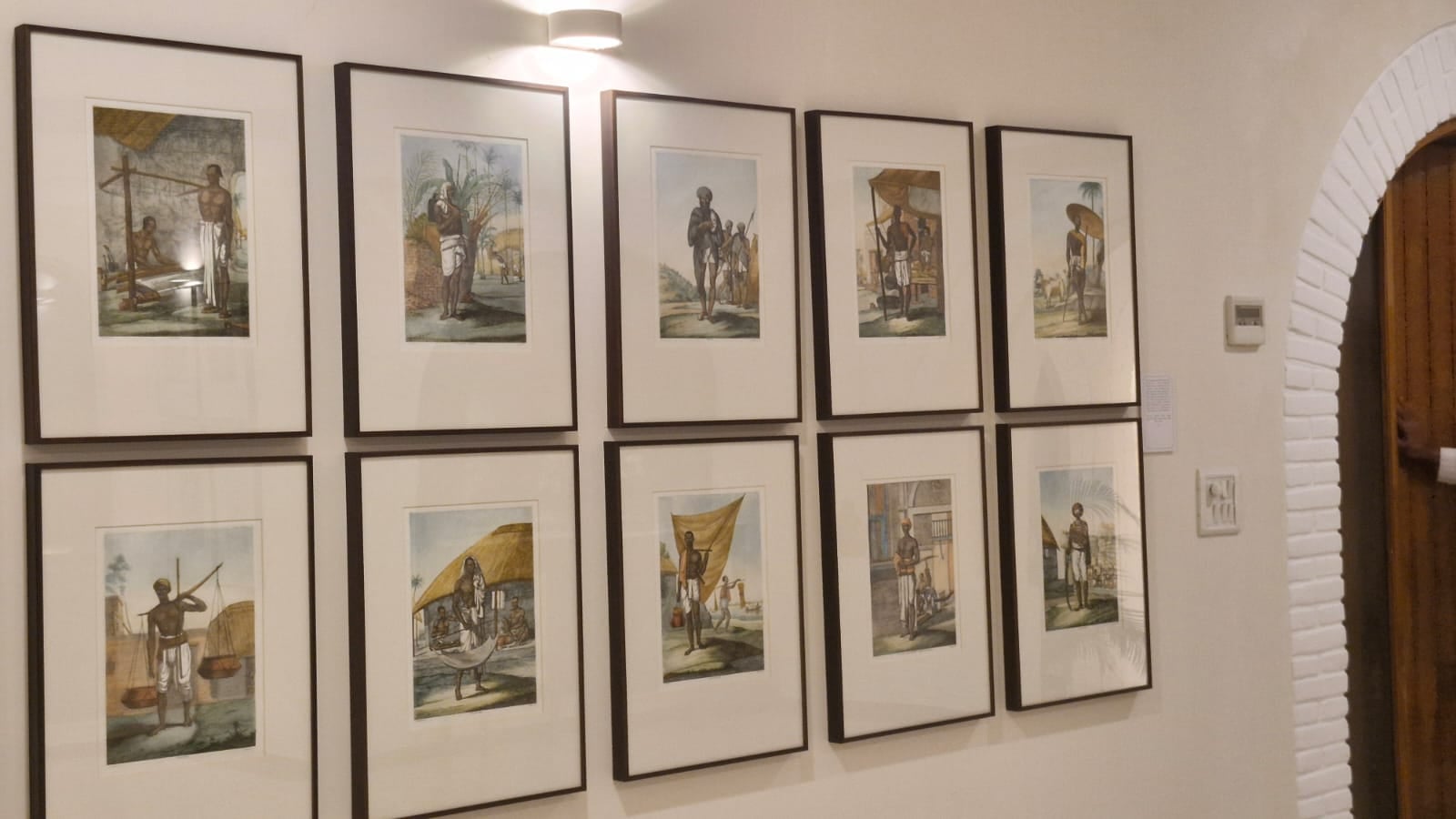
The etchings showed individual figures in detailed clothing, along with tools associated with their work.
Clothing, employments & the country
In one etching, a man in a white turban stood before thatched huts, a bamboo pole across his shoulders and a bundle swinging from each end. Several paintings featured men carrying loads on their heads, and one depicted a weaver sitting at a wooden loom. Others showed professions like potters, cowherds, and sweet makers.
Most artworks displayed men wearing plain white dhotis, bare-chested and barefoot, with cloth draped over a shoulder or wound into a turban. Only a few others were more elaborately dressed: a man in a long green coat holding a hookah, and another one showing men in orange and red turbans surrounding a figure in white robes seated on a carpet.
Solvyns saw the dresses as a view of a simple, content society, where fashion did not really evolve.
One aspect that the eye catches is the scarcity of women. In the displayed selection, the prints were crowded with carriers, weavers and attendants, while women appeared rarely, except for a few, like a lone figure wrapped in pale cloth before a thatched hut. Another displayed a woman seated cross-legged on a patterned carpet, a saffron shawl drawn over her head, wearing gold earrings and necklaces, a hookah coiling beside her and attendants gathered close.
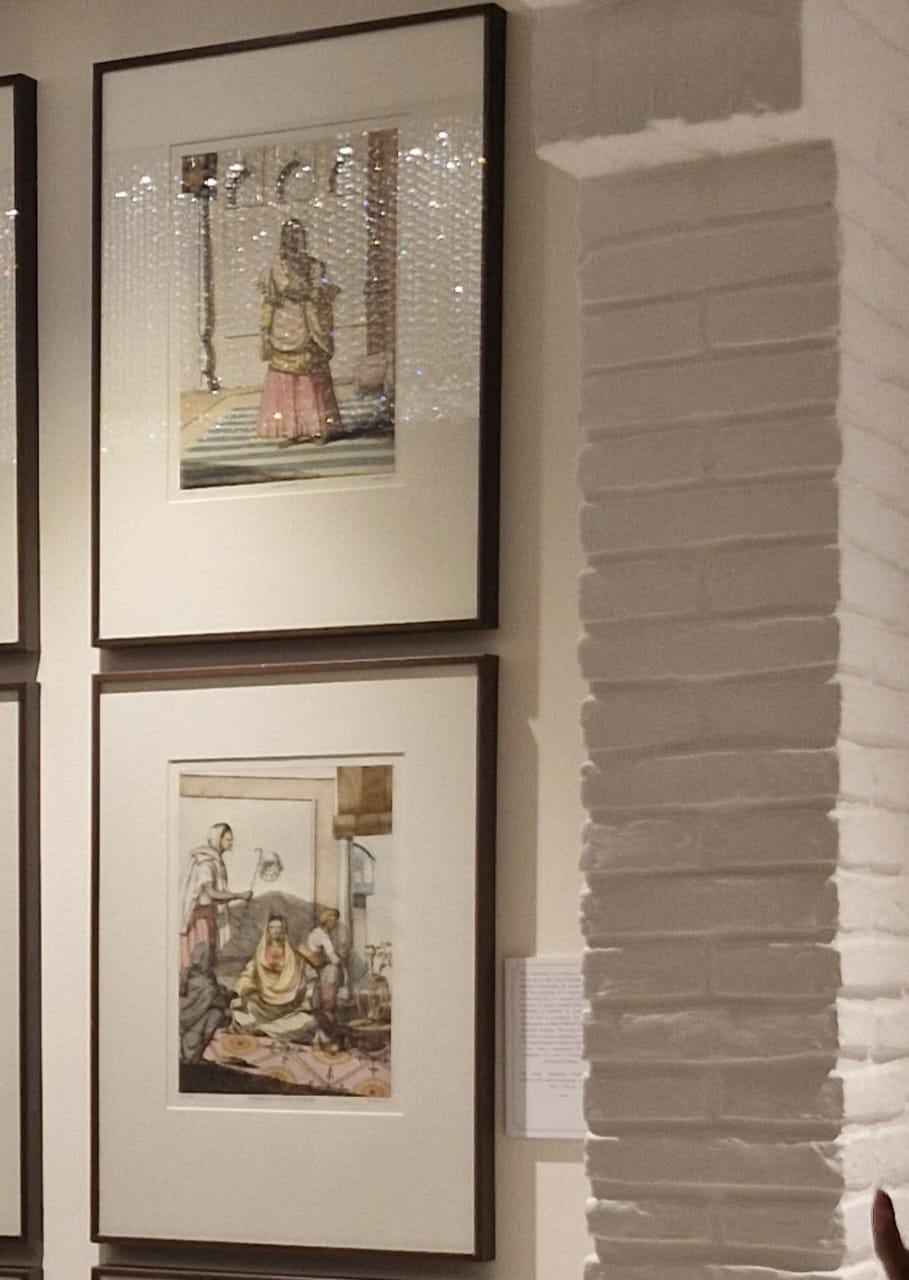
A review of an earlier showing of the series interpreted this scarcity as a reflection of the patriarchal society Solvyns recorded.
A few paces on, hung Solvyns’ marine oil painting ‘A View of Calcutta, from below Fort William, looking north with shipping’. It was on display for the first time. Guests clustered around it, their gaze following the vast river.
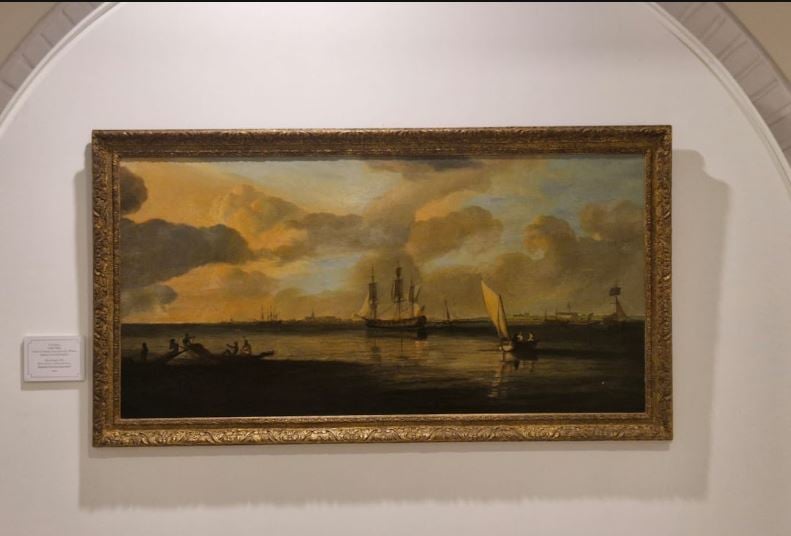
Much of the canvas was sky, with large clouds catching the warm evening light above the calm, dark Hooghly waters. A large sailing ship occupied the centre, while a smaller boat with a white sail moved across the water to its right.
On the left, boatmen paddled through the shadows. Beyond them, the buildings of Calcutta stretched along the far bank, with the Armenian Church and the four towers of the Military Orphan House visible in the distance.
For someone trained as a marine painter, DAG member Aditi said, it was no surprise that Solvyns would turn his attention to this view.
Opposite the boats, hung paintings of some musical instruments. Trained in Western music, Solvyns found Indian tunes different, observing in his writings that Hindus liked noisy instruments, which led him to document different drums.
Solvyns had found the tanpura exquisite, assuming it would produce a beautiful tune. Much to his dismay, he learned it was used only to set the pitch, Aditi added, prompting a few laughs.
A print titled ‘Different nations,’ which features the diverse travelers Solvyns had seen in Calcutta, was also on display. In the painting, a Malay, a Frenchman, and an Armenian stand together with a white man at the centre. That, Aditi said, is Solvyns himself.
She pointed him out as the artist’s self-portrait of sorts – a small indication of how he saw his own position within the society he was documenting.
Solvyns’ work, however, was not the commercial success he had hoped for. His timing was against him: his Paris edition appeared in the middle of the Napoleonic Wars. In 1804-1805, an English publisher, Edward Orme, reproduced 60 of Solvyns’ etchings, adding brighter colours and more cheerful expressions. The pirated version gained far more commercial success.
However, as Solvyns’ prints circulated in India, they became visual references for Indian artists working for European patrons. His compositions influenced later Company paintings, extending the reach of his work.
After returning to Antwerp, Solvyns was appointed captain of the port, a post he held until he died in 1824.
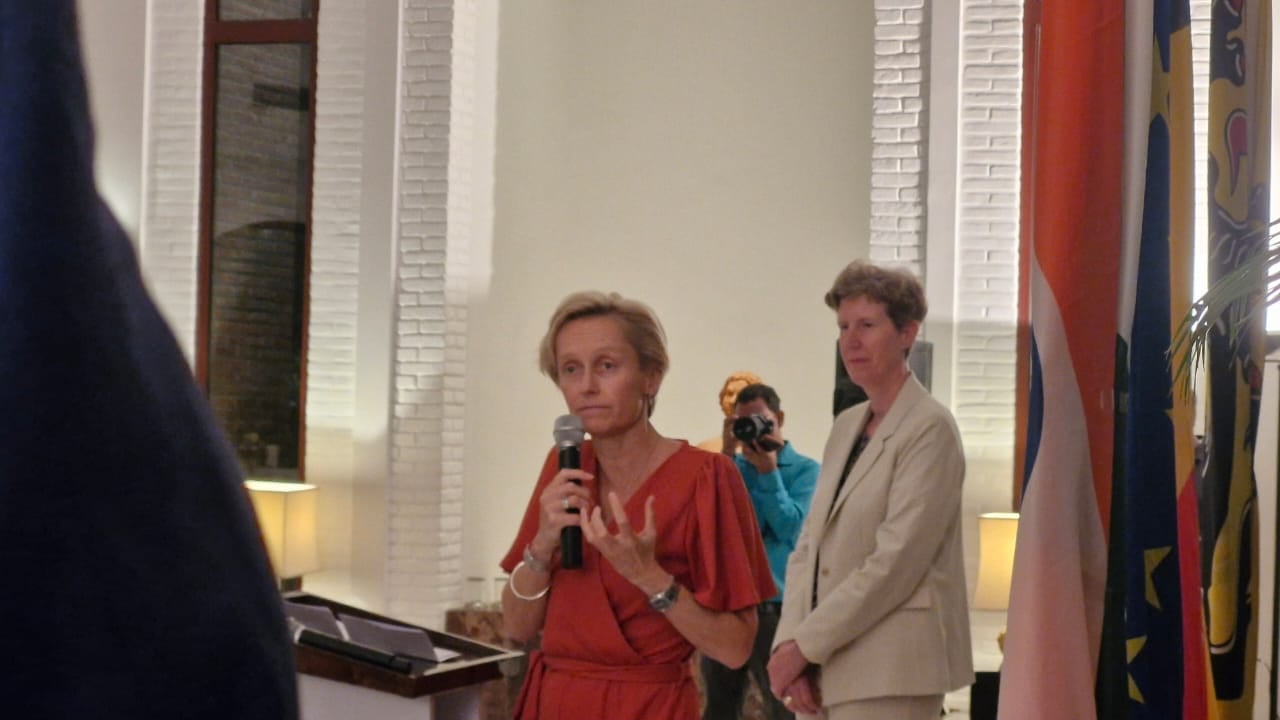
Belgian Ambassador to India Sophie Karlshausen used Solvyns’ return to Antwerp as a segue. She said Solvyns ended his career as captain of the port and then invited Minister De Ridder, “who was also almost captain of the port,” to the hall for speeches.
Also read: From Raja Bhoja to Mughals, how archaeologists traced Bhojshala’s changing past
India-Belgium bilateral potential
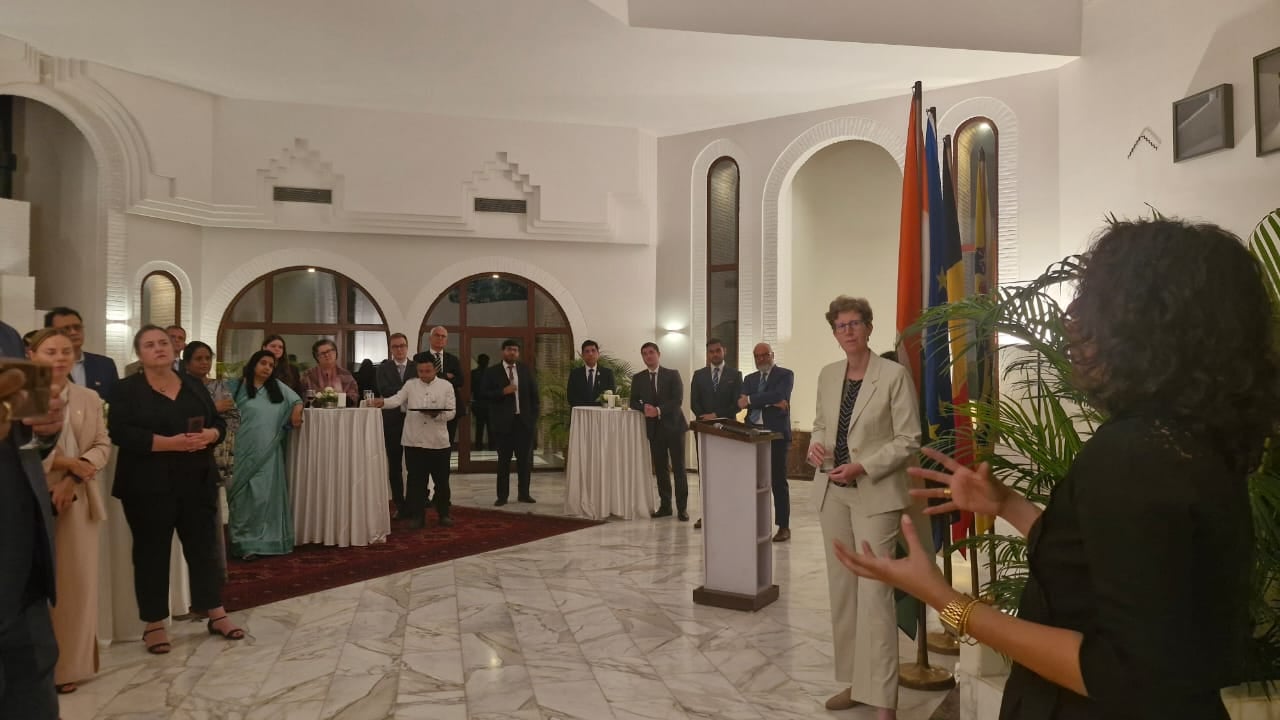
De Ridder began by pointing out how the world looked grim, with wars on Europe’s borders and in West Asia and tariffs being imposed. However, she called herself an optimist.
“In challenging geopolitical times, we should focus on opportunities and strengthen our relationships with reliable partners like India. We aim to deepen our ties with this growing market,” she said.
De Ridder pointed to India’s industrial scale and growing middle class, while highlighting Belgium’s Flanders region’s infrastructure, technology and port expertise.
She added that the port of Antwerp and Bruges could offer Indian businesses access to the wider European market.
“We see you. We see the potential,” she said.
Siegfried Verheijke, Trade and Investment Commissioner for Flanders Investment and Trade, spoke about plans for a roadshow in February focused on the emerging EU-India trade relationship.
“We believe that this will be a unique chance to enhance the business that we have on two continents,” he said.
Over drinks and snacks, the crowd dispersed slowly, while the etchings stayed on the walls. Solvyns’ Bengal looked out over a room that had come to talk about ports, routes, and partnerships in a very different India.
(Edited by Ratan Priya)