



New Delhi: For archaeologist and professor Alok Tripathi, the story of the disputed Bhojshala in Madhya Pradesh did not begin with a court order, an excavation trench or even the inscriptions that would later become central to the investigation.
It began with a question: What happens when a monument has lived several lives? At Bhojshala, the archaeologists were not merely digging up the ground. They were digging up the monument’s memory.
Walls are built, altered and reused. Stones from older structures become part of newer ones. Inscriptions are broken and embedded into floors. Pillars are cut, shifted and fitted into another building. Centuries later, the same monument can carry traces of several different periods — sometimes side by side.
That, Tripathi said, is where archaeology comes in.
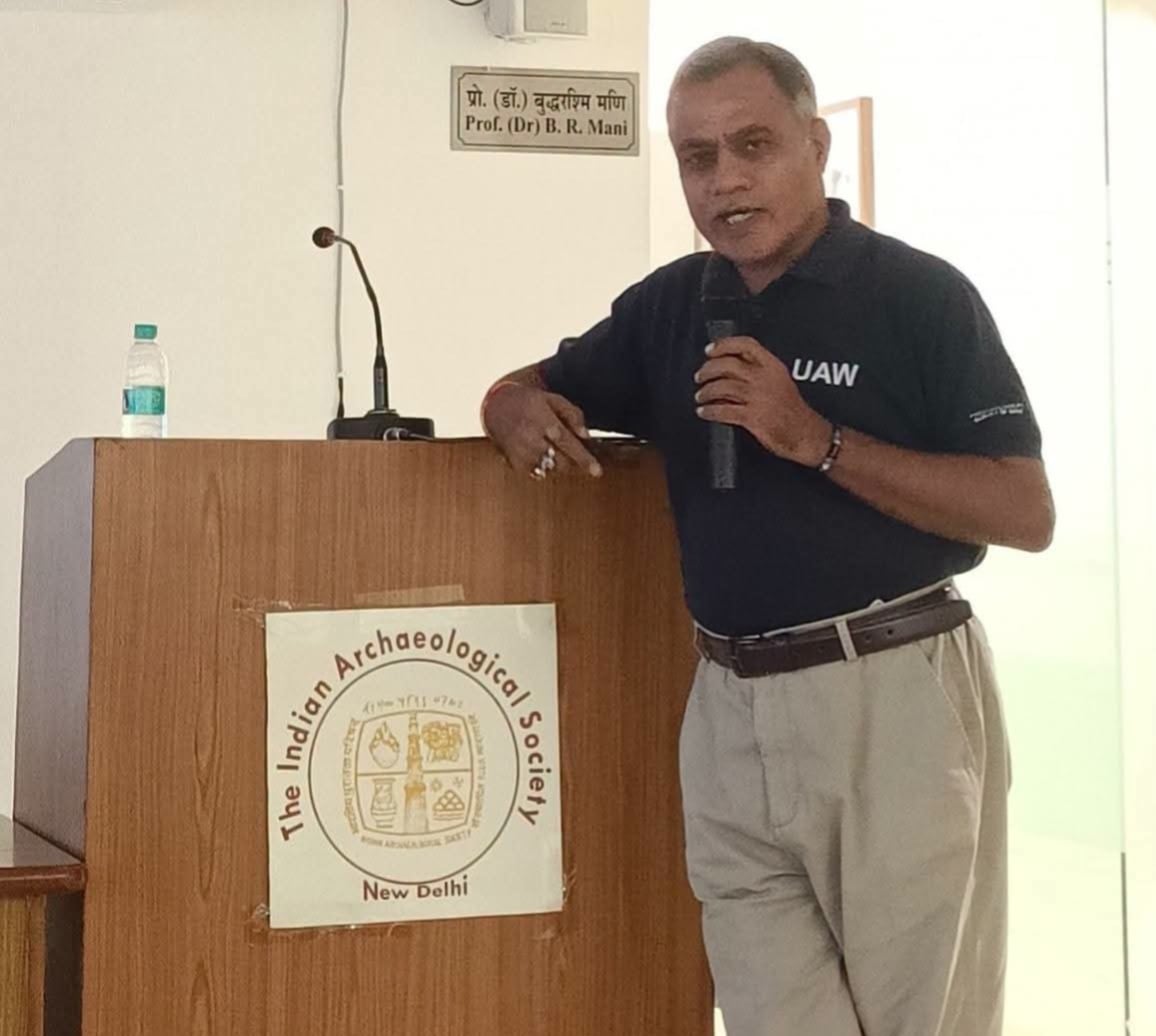
“Archaeology is essentially a source or a medium for reconstructing history. Through archaeology, we study remains buried in the ground and try to understand what happened in the past and reconstruct the history of past societies,” said Tripathi, the former Additional Director-General of the Archaeological Survey of India (ASI). He was delivering the D. Devahuti Memorial lecture titled Archaeology as a Scientific Tool to Find Truth: A Case Study From Madhya Pradesh at the Indian Archaeological Society on October 1.
Renowned archaeologists BR Mani and Amarendra Nath were among the audience, which largely comprised archaeology students.
For Tripathi, archaeology is not simply about digging up old remains. It is about putting together fragments of history — stone, pottery, coins, inscriptions and architecture — and trying to understand the people and societies that lived during different eras.
“Archaeology starts with the evidence and never really ends with a final answer. There is no absolute final piece of information. Facts and remains can be reinterpreted and analysed further. The more we know, the more we can potentially discover,” he said.
This approach guided the archaeological investigation at Bhojshala, a monument at the centre of a long-running religious dispute in Madhya Pradesh’s Dhar.
A multi-layered monument
Bhojshala is a protected monument. Its history has been contested for years. The dispute becomes particularly sensitive when Basant Panchami falls on a Friday — both Hindu and Muslim communities seek to carry out religious activities at the site.
In March 2024, the dispute eventually reached the Madhya Pradesh High Court, which ordered a detailed archaeological investigation to be undertaken at the monument. Tripathi and his team were tasked with probing not just what was visible above the ground, but also what lay beneath it.
The site offered plenty to examine.
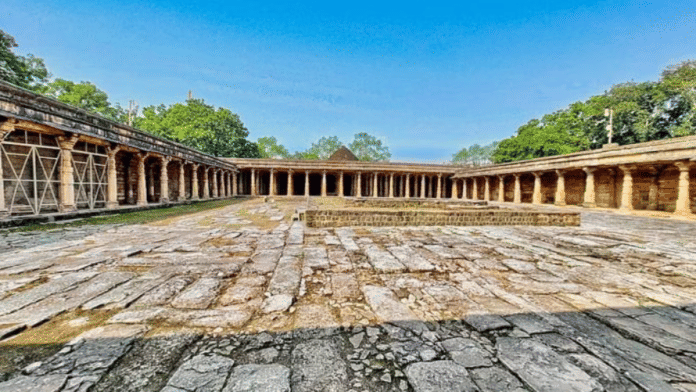
An entrance opens into a courtyard, with a tank at its centre. A pillared corridor runs along one side, while the main hall occupies another. A mehrab stands on the western wall. Nearby are structures associated with Kamaluddin and Mahmud Khilji.
The investigation extended to a 50-metre area around the monument. Modern additions were removed or cleaned wherever possible so that older features could be examined.
Then came the excavation.
The team worked inside the monument, in the courtyard and outside along its three sides. Every wall, stone, inscription and architectural feature had to be documented. But there was one problem: a protected monument cannot simply be dismantled to find out what lies underneath.
A ground-penetrating radar (GPR) survey was used to examine the subsurface. The survey indicated that there were several layers beneath the existing structure, and deposits that extended several metres below the surface.
A test pit was subsequently opened in selected areas. What emerged was a monument that, according to Tripathi, had not been built just once. It had been rebuilt. Again and again.
Three buildings, one monument
Once the layers were exposed and cleaned, three distinct architectural phases became visible. The oldest structure was substantial, with large offsets and strong foundations. Tripathi associated this earliest phase with the period of Raja Bhoja.
The second phase saw the structure expanded into a much larger complex. That structure was subsequently destroyed.
Then came the third phase — the structure that largely survives today. But even this building was not entirely new. Stones and architectural elements from earlier structures had been reused in its construction.
“In all three phases, different materials were used, and each phase belongs to a different period,” said Tripathi.
The evidence was not confined to foundations. The team documented 106 pillars and 82 pilasters. Their sizes, materials and decorative features varied. Some pillars appeared to have been assembled from different pieces, with different types of stone used within the same architectural element.
For Tripathi, these differences were clues. They suggested that architectural material from different structures had been brought together and reused.
Some elements bore decorative motifs. Others contained images. Some had clearly been cut down before being incorporated into walls, lintels or other parts of the building.
Centre of learning
Among the most significant finds were inscriptions. Hundreds of inscription fragments were documented, many were broken or reused as flooring material. A few survived as isolated lines or words.
Others were much larger. Tripathi said some texts had been inscribed directly on stone slabs and walls — effectively turning parts of the building into a public archive.
Among the inscriptions were references to Parijatamanjari, a Sanskrit play, and to a stage or performance space. For Tripathi, these were not merely pieces of text. They offered leads about how the space may have been used.
The inscriptions, he said, described the place as a centre of learning for cultural activities. Archaeological evidence, therefore, could be read with literary references to understand the site’s past.
The excavation also yielded coins, pottery and sculptures. Architectural remains corresponding to different parts of temples — from the jagati or platform to the shikhara and kalasha were found in the broader archaeological context, according to Tripathi.
But the site also contained evidence of later periods. Fifty-six Arabic and Persian inscriptions were documented. Tripathi said these were later than the Sanskrit and Prakrit inscriptions.
Taken together, he said, the archaeological evidence indicated a long sequence of occupation, construction and reuse — stretching across periods associated with the Delhi Sultanate, Malwa Sultanate, Mughal period, Dhar State and later periods.
That sequence, he argued, is precisely why archaeology cannot be reduced to a single object or inscription. The hardest part comes after the digging.
The Bhojshala investigation posed another challenge for Tripathi. But it had little to do with excavation. Archaeological teams, he said, often spend considerable time excavating but struggle to produce reports afterwards.
“Archaeologists are generally known to speak but not write,” he said. The problem, he argued, is not a lack of ability but a lack of planning.
Funds are often prioritised for fieldwork, while report writing gets pushed aside. Excavations finish, teams move on and reports remain pending.
At Bhojshala, however, the situation was different. The court required the findings to be documented, and the investigation had to be completed within a stipulated timeframe. “There has to be someone monitoring the process and ensuring that the deadline is met,” said Tripathi.
For him, that lesson is as important as what was found beneath the monument.
Archaeology begins with a shovel, a survey instrument or an inscription. But it does not end there.
The real work, Tripathi said, begins when those fragments are assembled into a timeline — carefully, scientifically and with the recognition that what appears to be one monument may actually be a record of centuries of construction, destruction, reuse and memory.
In the Bhojshala case, Tripathi said, the court relied on the archaeological investigation and its findings in reaching its conclusions. That, he said, is ultimately the larger significance of the exercise.
“Archaeology is a scientific discipline and a reliable source of evidence. It is useful not only for reconstructing history but also in disputes where facts are unavailable or contested,” he said.
(Edited by Aakriti Handa)