





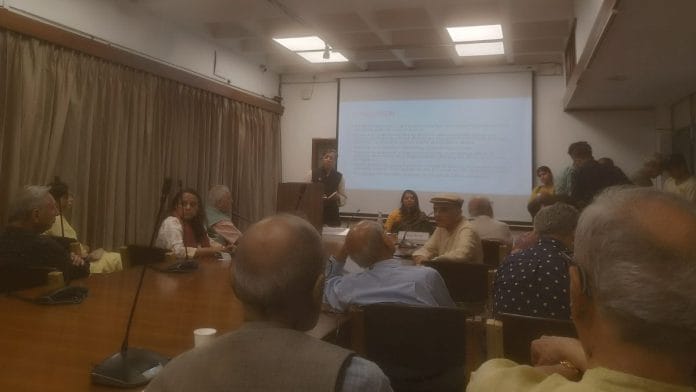


New Delhi: For political scientist Ashutosh Varshney, India’s democracy is a positive exception, but its health has seriously deteriorated.
India, he argued, despite its immense diversity, poverty and scale, has sustained electoral democracy for decades. But today, he warned, the country’s democratic foundations are under greater strain than at any point since Independence.
“The gap between the electoral and the liberal democracy became alarmingly wider. But now even electoral democracy faces serious threats. The new principles of voting amount to the most serious assault on electoral democracy since Independence,” said Varshney, professor of political science at Brown University during his lecture titled Still Exceptional: India’s Democracy in Comparative and Historical Perspective at Delhi’s India International Centre (IIC).
Over the next 45 minutes, Varshney traced India’s democratic journey—from its remarkable resilience to what he described as its current democratic decline. At the centre of his concerns was the government’s Special Intensive Revision (SIR) of electoral rolls.
The lecture hall at the IIC was packed with economists, political thinkers, academics and students. The lecture was moderated by Yamini Aiyar, senior visiting fellow at Brown University.
“It is deeply disturbing that the electoral process has reached a point where not only do I have to consistently prove to the very government that gave me all these documents and put me on the roll in the first place that I am indeed a citizen and then I’m also told that my passport may or may not be proof of citizenship,” said Aiyar.
Aiyar said that being taken off the electoral roll is no longer just a fight to protect our right to vote.
“This suspicion is used as a tool to deeply polarise society. We saw what happened in the West Bengal election and now as a means of exclusion from basic rights in terms of welfare rights, socio-economic rights of the most vulnerable of our citizens,” said Aiyar.
Also read: What SIR in Delhi’s Shaheen Bagh looks like. Hunting for documents, avoiding rumours
Electoral vs liberal democracy
Varshney said democracy theorists have long recognised that India’s democracy is historically exceptional. But he made a distinction—this label applies mostly to India as an electoral democracy. It has historically functioned less well as a liberal democracy.
Varshney said a liberal democracy always protects freedom of speech, freedom of association, and minority rights.
“Over the last decade or so, 2014 onwards, the electoral and the liberal aspects of democracy in India first developed a deep conflict. The liberalism of its polity went into a serious decline,” said Varshney.
Varshney said the liberal erosion was rooted in the ideology and the ideology was aligned with electoral democracy in principle.
“India’s emerging electoral architecture violates two foundational principles of modern democratic theory—electoral competitiveness and universal franchise,” he said.
Also read: Why Bengal’s election outcome matters. The world wants to know how SIR will play out
Democratic backsliding
In his presentation, Varshney pointed out that in a democracy the majority can protect themselves by their numerical weight but minorities don’t have numbers.
“Without minority protections, democracy can become a majoritarian force,” he said.
Varshney argued that while dealing with the recent democratic backsliding, the explanatory salience of elite values and ideologies is unmistakably clear.
“Hindu nationalism is the guiding ideology of those in power. That ideology says India is a Hindu nation, a truth that the Constitution and post-Independence politics wrongly and unjustly denied. And it’s time to get that back,” he said.
According to Varshney, Hindu nationalism’s communitarianism is aligned in principle with the electoral democracy, not a liberal one.
He said the rights and equality of citizens are not the starting point of Hindu nationalism as they are in liberalism. Its core instead is a discourse of national loyalty, on which rights are thought to depend.
“Loyalty is seen as a community-based phenomenon rather than something anchored in the individual proclivities of citizens,” said Varshney.
Varshney said the Constitution makers said those Muslims who remained in India deserve the same rights as other citizens. But for Hindu nationalists, this is tushtikaran (appeasement) and the Constitution must be revised to restore Hindu primacy as Hindus and Muslims cannot be equal given India’s history.
Also read: Nehru served longer than Modi. No point arguing with Hindu nationalists though
Erosion of electoral democracy
Varshney argued that India is now on a journey from electoral vibrancy to the erosion of electoral democracy.
He also delved into SIR and which communities in India will be disenfranchised more as a result of this exercise.
“The onus of registering voters is now being placed on citizens when it was always the responsibility of the government,” he said.
“The effect of the new voting architecture will be to tilt the playing field heavily in favour of the BJP for years to come. Everywhere except the South,” he said.
The current experiment brings a challenge to the Opposition.
“Victories, though possible, will be much harder. And the mountain to climb will be much higher. The BJP can still be defeated. But the enormity of the challenge has gone up by several notches,” said Varshney.
Economist Gurcharan Das, who was in the audience, pointed out that the reason behind the rise of Hindutva was not addressed. Das took it upon himself to do so.
Referencing his book, The Dilemma of an Indian Liberal, he said that it’s partly due to a defect of liberals—they are individualistic.
“We don’t make enough connections with the community. That alienation could have produced this whole social revolution that has occurred,” said Das.
(Edited by Theres Sudeep)