



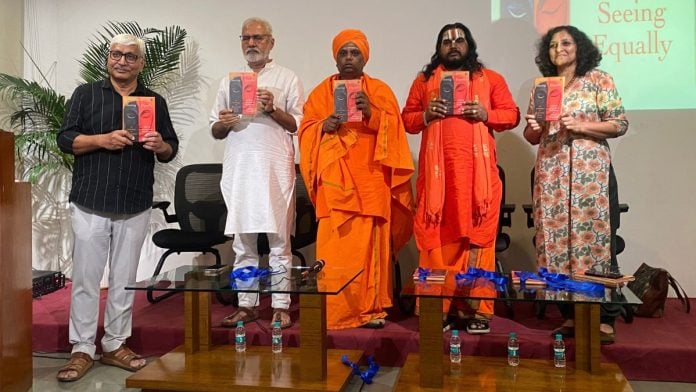
New Delhi: A growing crop of Hindu voices is grappling with the idea of a religion in crisis. Religious leaders from various Hindu schools of thought are asking a pressing question: what would Hindu life look like if we truly took equality seriously?
Mahant Ram Das, Swami Korneshwar, and Sadhvi Madhuri—who were part of a panel at Delhi’s Jawahar Bhawan—attempted to answer this question from within the folds of Hindu religion.
Their contributions are part of a series of 13 personal essays, comprising voices of Hindu religious leaders and practitioners, which come together in a book titled Seeing Equally: An Anthology of Progressive Hindu Voices. The book is edited by Sunita Viswanath and Anantanand Rambachan, and published by Westland Books.
Joining the authors were journalist Rahul Dev, Westland Books publisher Karthika VK, and political commentator and professor Apoorvanand, who moderated the conversation.
Apoorvanand contextualised the conversation.
“If on the one hand, we look at outward expressions of the religion in the last 70-100 years, the entire nation looks imbued by Hinduism. You will find such symbols and colours spread across the country, that will make you feel the country has become a Hindu nation,” he said.
He pushed the audience to consider: does this spread of the religion “reflect a feeling of self-confidence, or is it coming from a place of insecurity?”
Journalist Rahul Dev drew a sharp distinction between the religion, Hinduism, and the political project of Hindutva.
“When Savarkar coined the term Hindutva, he stated clearly that this term has nothing to do with religion, but has political use,” he said.
Korneshwar agreed.
“The Hinduism of our saints is different from the Sangh’s Hindutva, which is a destructive force,” he said, proposing a return to the teachings of Kabir, Ramdas, Tulsidas, and Guru Nanak. “The saints worked toward bringing society together, not dividing it.”
‘No place for caste, gender-based discrimination’
Korneshwar said he was from Karnataka, a state that had seen the orchestrated deaths of progressive thinkers: “I come from the land of Gauri Lankeshji and MM Kalburgiji.”
The state is also the birthplace of the Lingayat tradition, founded by Basavanna in the 12th century as a challenge to the caste hierarchies of Hinduism. Korneshwar follows this tradition and is a board member of the religious organisation Satya Dharam Samvad.
As “the tendency to kill anyone who talks about equality is still prevalent”, he said, there is a dire need for Lingayat saints to challenge the terrors of Hindutva. In his view, even as Lingayats seek an identity separate from Hinduism, they must challenge the ills ailing the religion and the country.
“For the sake of our country, we need to come together to end religious discrimination, to end caste-based discrimination. We need to work together,” he added.
Ram Das, manager of the Sidh Peeth Shri Kartilya Baba Ashram in Ayodhya, pointed to the casteist practices prevalent among religious leaders, even after a vow of sainthood is supposed to free a person from their ties to caste. Hindu saints are said to become part of the achyuta gotra, or a divine lineage tied to the god Krishna, when they renounce their material ties.
The ground reality, according to Ram Das, remains far from this ideal. When someone belonging to an oppressed caste visits the Hanuman Garhi temple in Ayodhya, they are allowed to carry out darshan, but not cross the pious threshold, Ram Das pointed out.
“The way we have to deal with discrimination and casteism among ourselves, even after we take up sainthood, is a sad reality of today”, he added.
Madhuri, a renunciant initiated into the Kabir sect, had joined the event through video conferencing, made a critical point about the contemporary reading of scriptures, and how this is misused to perpetuate existing social hierarchies.
“Even in the 21st century, some religious gatherings continue to talk about women in derisive ways, and present such interpretations of our scriptures that strengthen patriarchal thinking in society,” she said.
According to her, scriptures must be read in the context of the times and society they were written in.
“Scriptures are our guiding forces, but we cannot use them as weapons to show women down, or deny them rights,” Madhuri said. “In contemporary society, we have to understand the core values of our religion: compassion, justice, love, and respect for all.”
Also read: Lal Bahadur Shastri beyond Jai Jawan Jai Kisan—‘he had an English sense of humour’
‘The language to fight communalism’
Dev turned his attention to contemporary conversations bent on attributing atrocity and terror to the supposed 1,000-year-long Muslim rule in medieval India.
“All our saints—Tulsi, Kabir, Nanak, Tukaram, Namdev, Janabai, Basaveshwar—they were all practising during the Muslim-kaal, right? So why did the Muslims spare them even though they were rescuing and preaching Hinduism?” Dev asked.
Alluding to the persecution of several Sikh leaders during Mughal rule, Dev asked whether “any of the 10 Sikh gurus had said anything against Islam or Muslims in general in their gurbanis, or sacred compositions”.
Not a single word, he said, because for them, it was not a fight against Islam. “It was a political fight.”
Cautioning against the narratives increasingly taking hold of Hindu society, Dev proposed a return to the scriptures, to truly understand the teachings of religion.
“This force cannot be fought on purely secular grounds. The only way to fight communalism is by challenging religion on its own terms—using the language of religion… because the appeal of religion is not as much to the mind, as it is to the soul,” he said.
The audience, a diverse group comprising practising Hindus and Muslim compatriots, saw the event as the start to a larger conversation about finding a renewed identity for Hinduism.
Faisal Khan, the national convener of the recently revived Khudai Khidmatgar—the organisation founded in 1929 by Khan Abdul Gaffar Khan—was present in the audience along with six members.
“Today the conversation was about equality and love in religion. These qualities are the soul of religion… The soul of religion is compassion, love, equality… these saints here are working toward preserving that soul,” Khan said. “Some people, on the other hand, are distancing a religion from its soul.”
Madhulika Banerjee, a professor of political science in Delhi University, was also present in the audience. She said she was “deeply invested in exploring Hinduism as a practising Hindu”.
She added that there needs to be a better political articulation of the position of Hindus who stand against divisive forces in society.
Purvi Rajpuria is an alumna of ThePrint School of Journalism.
(Edited by Prasanna Bachchhav)
This is just the political opposition’s latest PR campaign packaged in a saffron robe.