



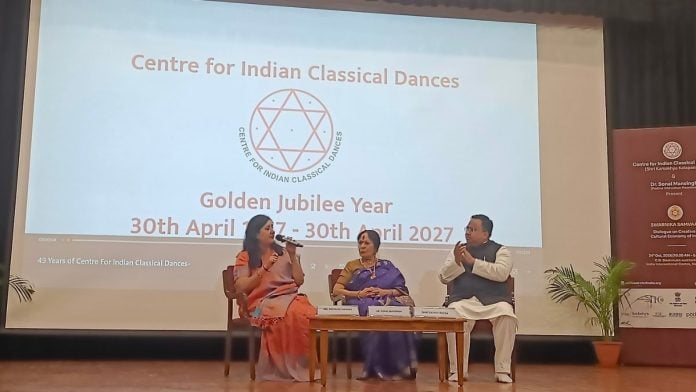
New Delhi: The struggling artist was once romanticised, but that should no longer be the case, said BJP MP Bansuri Swaraj. She argued that artists must be seen not merely as custodians of India’s cultural heritage but as contributors to its economic growth.
“Artists need to be the economic growth engines of India, and there is a need to do a lot of work for their welfare,” said Swaraj at ‘Swarnika Samvaad: Dialogue on Creative and Cultural Economy of India to Explore Culture’s Role in Viksit Bharat @ 2047’, held at Delhi’s India International Centre (IIC) on 24 October.
The remarks came amid a wider conversation on how India can turn its vast cultural inheritance into an engine of economic opportunity without reducing its traditions to relics of the past.
The dialogue was attended by Rajya Sabha MP Sasmit Patra, former diplomat Shyam Saran, history scholar Sachchidanand Joshi, and Lily Pandeya, joint secretary at the Ministry of Culture.
At the heart of the discussion was a question: how can India preserve its civilisational wealth while ensuring that the artists, artisans, and communities who keep it alive also benefit from the country’s economic growth?
Organised by the Centre for Indian Classical Dances (CICD), an initiative founded by Padma Vibhushan awardee Sonal Mansingh, Swarnika Samvaad brought together speakers from politics, diplomacy, and the cultural sphere. The panellists called for a shift in how India approaches its heritage—from treating culture as something to be protected to recognising it as a source of livelihoods, innovation, and global influence.
“India’s culture is not merely a legacy to be preserved; it is a living source of knowledge, creativity and possibility,” Swaraj said, arguing that cultural knowledge and artistic talent must find a more meaningful place in the country’s development priorities.
Building an economy around culture
The challenge, speakers argued, is not simply to celebrate India’s cultural diversity but to create the institutions and opportunities that allow it to flourish.
Pandeya highlighted the place of culture in supporting livelihoods, anchoring global tourism, inspiring contemporary design, and opening new avenues of economic enterprise.
“For a country like India, blessed with civilisational depth and unmatched cultural pluralism, culture can never be treated as a peripheral sector. It is a strategic resource for national development, a catalyst for social cohesion, and a primary currency in our engagement with the world,” she said.
The task, Pandeya added, is to move beyond celebrating culture’s intrinsic value and build a self-sustaining ecosystem that can monetise, protect and expand that value into meaningful opportunities.
India’s creative landscape, she said, is an interconnected network of master artisans, classical and folk performers, museums, architects, designers, filmmakers, authors, digital creators and other creative professionals.
Yet talent alone cannot sustain such an ecosystem. Creative professionals need access to quality training, robust infrastructure, patient capital, professional networks and international markets.
“Our approach must therefore strengthen the connections between heritage, creativity, technology, markets, and livelihoods by ensuring that cultural integrity and the interests of the communities that sustain our tradition remain central,” said Pandeya.
Also read: Delhi exhibition brings together embroidery traditions from Kashmir, Bengal, Palestine
A civilisation that has always absorbed change
Saran stressed that India’s cultural strength lies not only in the antiquity of its traditions but also in their ability to absorb difference. He cautioned against assuming that celebrating the past would, by itself, secure the country’s future.
“We should certainly take our past as an inspiration, but the brilliance of the past is no guarantee of luminescence in the future,” said Saran.
For him, one of the greatest strengths of Indian civilisation has been its plurality—its ability to embrace diverse influences without losing its identity.
“Indian culture is not an exclusive narrow kind of vessel. Indian culture is really vast. Its great quality is precisely its accommodativeness,” said Saran.
But he also pointed to a gap between the country’s stated commitment to culture and the place it occupies in everyday life. A commitment to culture, he said, must be reflected in people’s lives and behaviour—something that does not always happen.
Also read: After the crash, before the hospital: India’s missing minutes of emergency care
Tradition and modernity need not be rivals
Patra argued that the conversation around culture needed to move beyond the question of how to preserve it. Instead, he said, India should be asking how its cultural inheritance can shape the 21st century.
“While India has inherited one of the world’s richest civilisational traditions, the future of that inheritance will depend upon the institutions we build, the opportunities we create, and the imagination we bring to the challenges of our times,” said Patra.
He challenged the assumption that tradition and modernity must exist in opposition to each other, asking why the two could not become partners.
“Why can’t both exist together?” he asked.
Patra also called for a change in how cultural expenditure is viewed.
“Rather than treating support for culture as a means of keeping traditions alive. It should be seen as an investment in their growth,” said Patra.
(Edited by Prasanna Bachchhav)