



New Delhi: In July 2023, six members of a family, including two children, died when their SUV collided with a school bus on the Delhi-Meerut Expressway. An investigation found that it took over an hour just to pull the victims out of the vehicle. According to the National Crime Records Bureau, 1.75 lakh people died in road crashes in 2024, nearly 480 people per day.
This crash and several others expose a deeper problem. Even today, after an accident, victims often lie bleeding while people gather but hesitate to help; precious minutes pass as bystanders try to recall the right ambulance number. Even when an ambulance arrives, it is often ill-equipped, with empty or faulty oxygen cylinders. When the victim finally makes it to a hospital, they are often turned away; other times, they are pronounced dead on arrival.
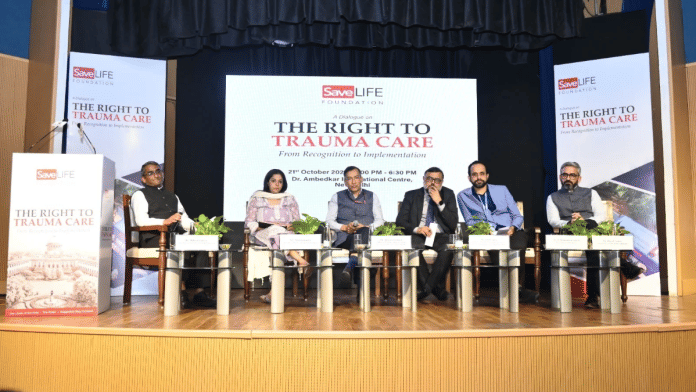
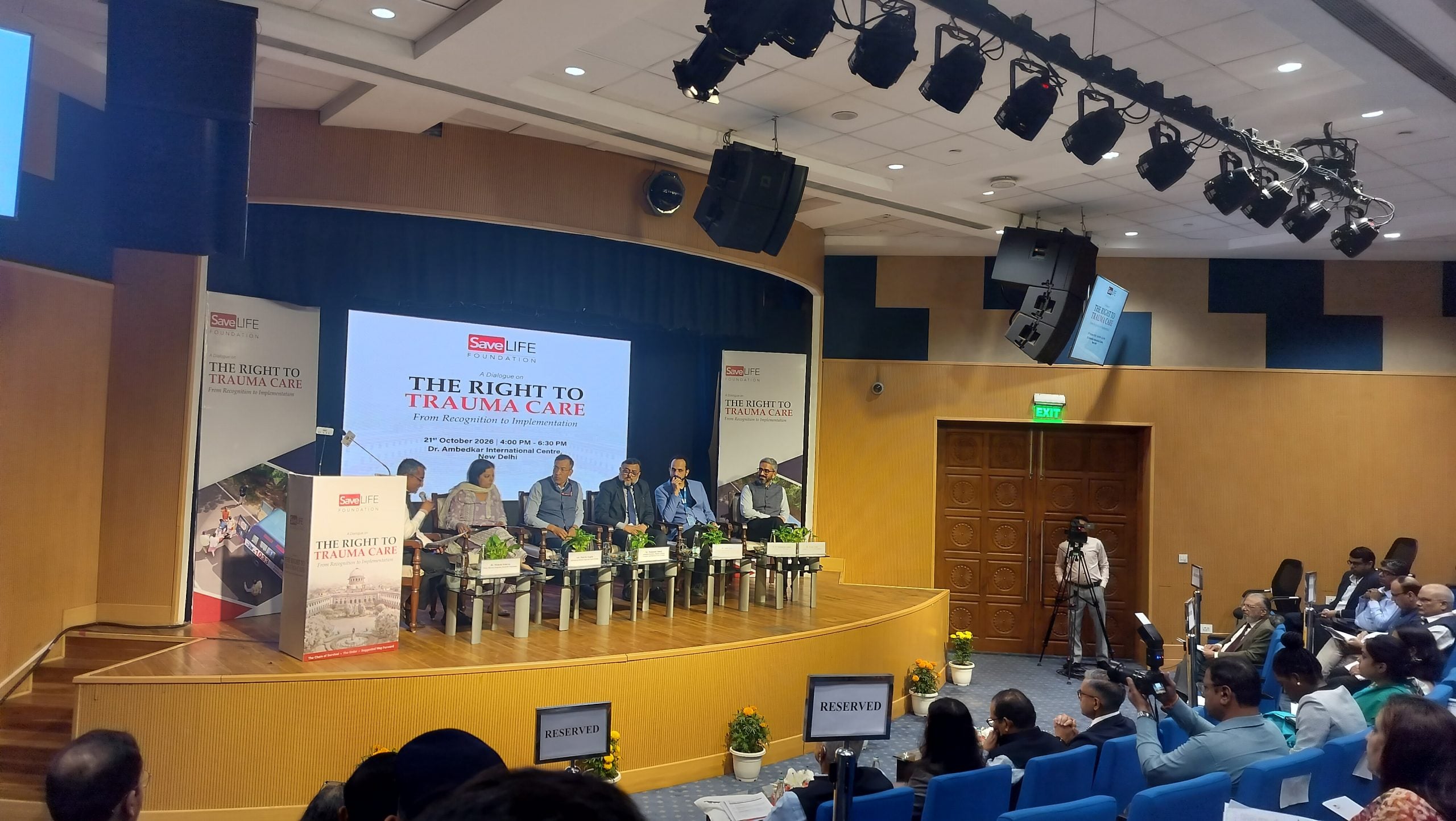
“An ambulance that arrives in time only to carry a body to the morgue no longer remains an emergency service,” said former Supreme Court judge Justice JK Maheshwari, addressing a crowd of about 100 people, doctors in scrubs, police officers, lawyers, judges, and government officials. They had gathered at the Ambekar International Centre on 21 October for the First National Dialogue on the Right to Trauma Care, organised by SaveLIFE Foundation.
The panel, including an advocate, an additional secretary of the Ministry of Road, Transport, and Highways, and a professor of trauma surgery at AIIMS, discussed a range of topics related to trauma care from personal losses to Indian roads. The panel remained focused on the gaps between the moment of a crash and the arrival of road-safety workers. The Supreme Court recognises trauma care as part of the fundamental right to life, but the system to deliver that right is still in the making.
The Good Samaritan Law
For Piyush Tewari, the founder of SaveLIFE Foundation, the journey began with a death in his family. When a young member of his family was hit by a car and died without timely assistance, it changed Tewari’s life. He founded SaveLIFE; before long, the organisation’s independent investigations revealed several problems with emergency care in the country. Ambulances arrived late, responders had a hard time locating victims, hospitals were not equipped to handle serious injuries, and lack of coordination between agencies led to deaths that might have been otherwise preventable. During a mock emergency drill on a highway in South India, it took 37 minutes for the 112 control room to just track the caller’s location.
“In fact, the person calling for help had become the coordinating point for the entire emergency response system,” said Tewari.
In 2016, SaveLIFE approached the Supreme Court to establish guidelines to protect “good samaritans”, which led to a judgement later incorporated into the Motor Vehicles Act in 2019. According to the judgment, good samaritans were shielded from civil or criminal liabilities for helping transport an injured person to a hospital. They are also allowed to leave the hospital or accident site without being forced to reveal their identity.
In October 2024, the foundation filed a fresh petition, asking the court to recognise trauma care as a right and to put a system in place to deliver it. On 26 May 2026, a Supreme Court bench of Justices JK Maheshwari and Atul S Chandurkar recognised this right.
The court also added directions to integrate emergency numbers into 112, improve protections for “good samaritans”, standardise medical rescue protocols across the country, and ensure that ambulances meet the prescribed standards and are also fitted with GPS tracking. Other directions included training emergency medical staff, grading hospitals according to their trauma care responsibilities, and implementing the PM RAHAT scheme, the government’s cashless treatment plan for road-crash victims.
Speaking to the audience, Justice Maheshwari recalled how when his sister-in-law suffered a spinal fracture in a car accident, he made several calls to get her quick and efficient treatment in a well-equipped hospital in Indore.
“But I was a man with contacts, connections, and power. What about the other citizens, what can they do? By the time this programme ends, close to 50 more families will have received the calls no family ever wants,” said Justice Maheshwari.
Also Read: Who is a homemaker? Karnataka HC sets down definition in deciding road accident claim
A national disaster
Although road accidents are hardly considered “national disasters”, B Mohammed Asheel, a project lead for the World Health Organisation, India, pointed out that if only they were treated so, the country would be far ahead in its fight against road crashes. He recalled the Covid-19 pandemic and how at the time, district collectors, state disaster management authorities, and various departments all came together.
Control rooms could even track hospital oxygen supplies, ICU beds, ambulances, even those run privately. Calling something an “emergency” or a “disaster” helped overcome the usually fragmented response.
Such a system already exists in South Korea, where their response to road accidents is managed by a separate authority, quite like a national disaster response force.
“The question is, when a thing kills two lakh people every year in India, can that be notified as a national disaster?” Asheel asked.
(Edited by Insha Jalil Waziri)