


New Delhi: Amiran may not ring a bell. But Umrao Jaan certainly does. The glittering Anarkali, the graceful dance, the iconic song of In Aankhon Ki Masti, and Rekha’s unforgettable portrayal have kept the story of the famous courtesan alive in our memory for generations.
On 13 November, Delhi revisited Umrao Jaan’s life and legacy on the first day as the Urdu Academy inaugurated its six-day 36th Urdu Drama Festival at Shri Ram Centre, Mandi House. As the familiar story unfolded on stage, a young Amiran was transformed into Umrao Jaan, a woman whose identity would come to define her life and whose story continues to find an audience.
“Aaj se aapka naam Amiran nahi, aap Umrao Jaan ke naam se jaani jayengi (From today, your name will no longer be Amiran; you will be known as Umrao Jaan)”, said the head of the Kotha, beginning the story of a young girl’s transformation into the celebrated tawaif, Umrao Jaan.
The festival, organised under the Delhi government’s Department of Art, Culture and Languages, runs until 18 November.
The opening day featured Umrao Jaan, presented by Theatre Leela Acting Studio and Performing Arts Society and directed by Varun Sharma. Based on Mirza Hadi Ruswa’s celebrated Urdu novel Umrao Jan Ada, the production traced the tragic journey of a young girl who was abducted from her home, separated from her original identity and eventually renamed the famous Tawaif Umrao Jaan.
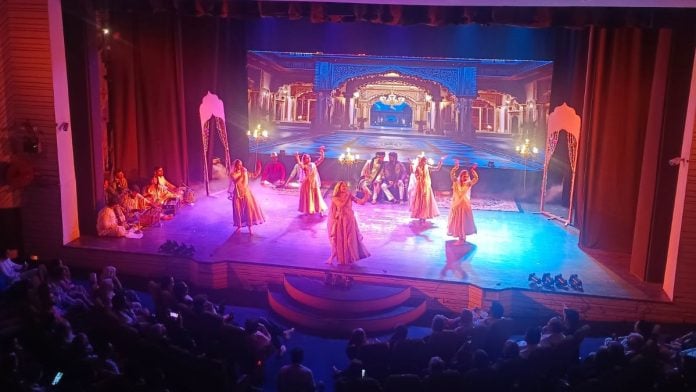
A full house, people even standing in the back and sitting on the ground of the balcony space, live music, standing lamps and the occasional haze of smoke drifting across the stage set the mood for the evening. Four women entered from opposite sides, dressed in golden Anarkalis. At the centre stood Umrao Jaan, adorned in a striking red, glittering Anarkali — standing out from the others.
Then came the familiar strains of In Aankhon Ki Masti, the iconic song associated with Umrao Jaan.
“Kotho par dil lagaye nahi behlaye jaate hai (In courtesan houses, hearts are not given in love; they are entertained)”, and soon after, the song ends with a dance performance; the story begins.
Also read: A DAG booth at Art Mumbai takes on the colonial gaze. Who gets to tell the story?
Amiran to Umrao Jaan
The lights went out briefly as the music faded. The story then moved on to narrate the ordeal of the young girl behind the celebrated name.
One character after another entered the stage, bringing fresh interpretations, subtle changes to the narrative and moments that kept the audience engaged. The interspersed shayaris, particularly those exchanged by Umrao Jaan and Nawab Sahab, added to the atmosphere.
“Yahan aankhon se pee jaati hai, yahan mai ka kya kaam, teri nazron se kaam chalta hai, yahan jaam ka kya kaam (Here, intoxication flows through the eyes; what need is there for wine? When your glances are enough to intoxicate, what purpose does a wine cup serve?)”, said the character Nawab Sahab, meeting Umrao Jaan for the first time.
The drama opens inside a kotha, with music and dance, before taking the audience back to the beginning of Amiran’s journey. A young girl, abducted by her family’s rivals and sold to a kotha owner, is separated from her home and trained to become a tawaif.
While the story carries its share of emotional moments, the production also brings in humour through several characters and their antics. From a character repeatedly falling on stage to a gay man playfully flirting with another man. Nawab Sahab’s childhood mischief and his music teacher chasing and beating him for one naughty incident after another add humour to the performance.
“I loved the movie by Rekha, but thought this experience would change my whole view of the story. It was presented so beautifully,” said 56-year-old Damini Kashyap, who was seated among the audience.
With around 30 characters, the play also further explored the social realities of a tawaif’s life — a woman pushed into a profession she never chose, yet rarely given the freedom to leave it. Confined to the walls of a kotha, these women were often denied acceptance by society and even their own families. Love and marriage remained distant possibilities, with their identities as tawaifs overshadowing their identities as women.
The story takes another emotional turn when Umrao Jaan escapes the kotha and decides to return to her hometown, Faizabad—the place she had never been able to forget. But even there, she finds no acceptance. Her own brother refuses to recognise her and asks her to leave.
Umrao Jaan returns to the kotha, realising she will never be accepted again as Amiran by her family and society.
The play ends by bringing the story back to where it began. A man arrives at the kotha with a young girl, whose original name is Maryam. Just as Amiran was once renamed Umrao Jaan, the girl is given a new identity.
“Aaj se tumhara naam Maryam nahi, aap Noor Jaan ke naam se jaani jayengi (From today, your name will no longer be Maryam. You will be known as Noor Jaan)”, and with that, the stage turns black and silent.
This was not the first time Umrao Jaan’s story had been brought to life. Her character has travelled across generations and artistic mediums, most famously through Rekha’s iconic portrayal in the 1981 film Umrao Jaan and Aishwarya Rai Bachchan’s performance in the 2006 adaptation of the same name.
(Edited by Saptak Datta)