


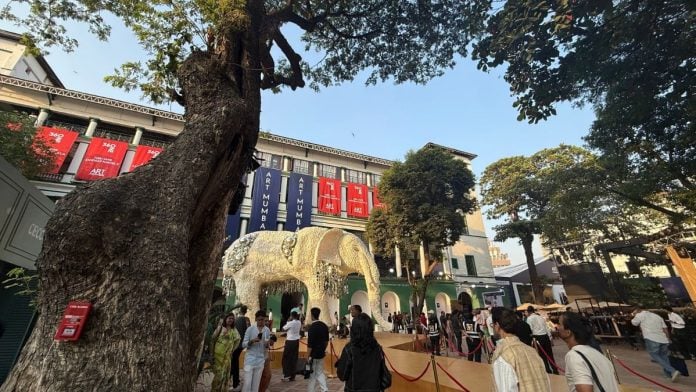
Mumbai: The fourth edition of Art Mumbai was packed on Thursday afternoon. Artists, collectors and interior designers moved between galleries, stopping every few minutes to greet someone they knew.
The art fair, running from 12 to 15 November, has turned the open grounds of Mahalaxmi Racecourse into a huge, covered, air-conditioned exhibition venue. Galleries from India and abroad filled the space with paintings, sculptures and installations.
Tucked away in Section A, beyond the stage being set up for the Abu Jani–Sandeep Khosla fashion show later that evening, was the DAG enclosure. The gallery, founded as Delhi Art Gallery in New Delhi in 1993, now has spaces in Mumbai and New York, too.
Inside, the brightly lit, high-ceilinged halls gave way to dark blue and plum walls, with spotlights picking out individual paintings. It was moodier and more intimate, but just as crowded.
DAG’s exhibition, Visions Across Time, brings together works from the 18th to the 21st century, tracing what the gallery describes as a history shaped “not by a single trajectory, but by encounters between artistic traditions”.
The show begins with European artists painting India’s landscapes and monuments, then follows Indian artists as they borrow European techniques to portray their own myths, people and everyday lives. In the later works, artists push colour, form and materials to find a style that is their own.
The colonial gaze, and who gets to tell the story
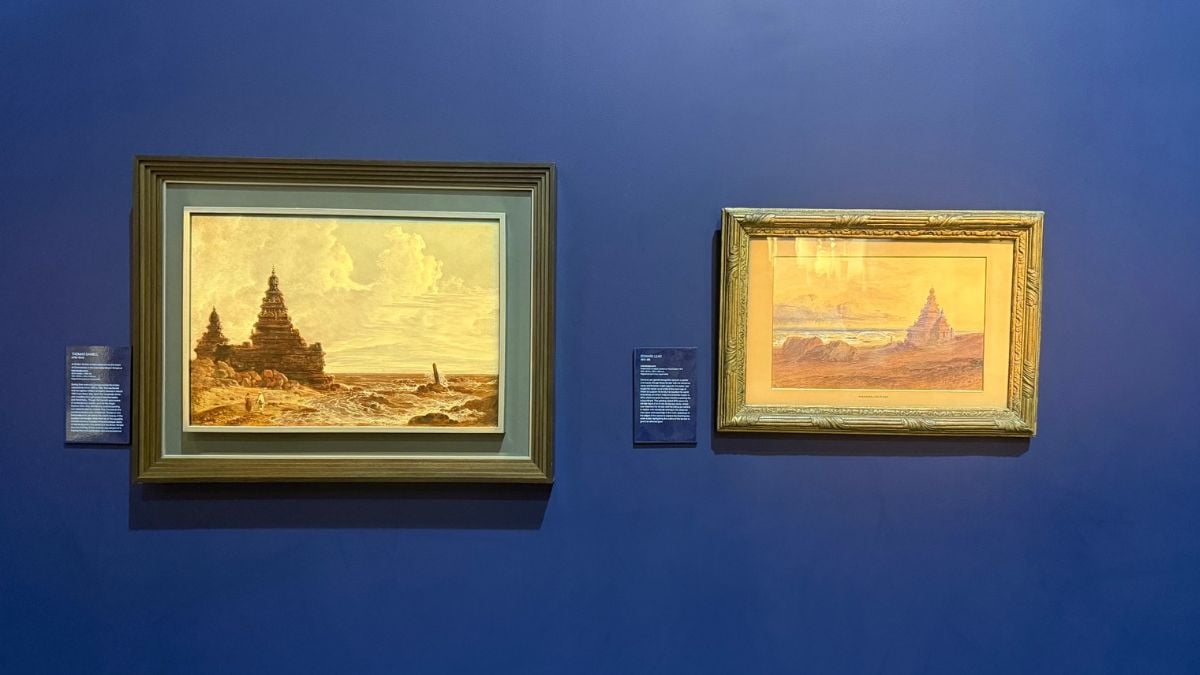
The older works are at the entrance. To the right hang two paintings of the Shore Temple at Mahabalipuram, made more than 80 years apart. As visitors stopped to look at them, the paintings visibly trembled in their frames to the bass of the music playing across the venue.
Thomas Daniell painted the temple around 1792–93, in oil on wood. It rises above a rocky coastline, with waves breaking against the shore and clouds filling the sky. Edward Lear’s 1875 watercolour shows the same monument from another angle. Here, the temple is smaller and less detailed, while white highlights pick out the waves in a stormy sea.
Both belong to the European Picturesque tradition, which involved “romanticizing a certain landscape and ruins,” explained Kanupriya Sharma from DAG. But there was more to these paintings than a European fascination with scenery. Sharma said such representations often fed into imperial ideas that Indians were unable to look after their own heritage.
On the adjoining wall, three small watercolours by an unidentified Murshidabad Company artist showed animal sacrifice as part of a Kali Puja, pilgrims at a riverbank, and Charak Puja, a Bengali festival involving rituals such as hook-swinging.
These paintings were made by Indian artists for European patrons, particularly British East India Company officials, who wanted pictures of Indian customs, festivals and everyday life to show people back home how the “natives” lived. Some even supplied reference images for the artists to work from.
Indian subjects, European techniques
Opposite them was another, rather different kind of exchange between Indian and European artistic traditions. Vanara Army with Garuda Regaining his Wings, painted by an unidentified early Bengal artist in the mid-to-late 19th century, shows an episode from the Ramayana. But behind the mythological figures are buildings that resemble the colonial architecture of the time.
The painting is in oil, a European medium then associated with “high art”. Wealthy Bengali patrons had begun commissioning oil paintings for their homes, but the subjects they chose were often drawn from Hindu mythology.
“More often than not, you’ll see a mythology episode being presented, but the setting is very contemporaneous,” Sharma said. “So artists are taking from their environment and incorporating those elements within.”
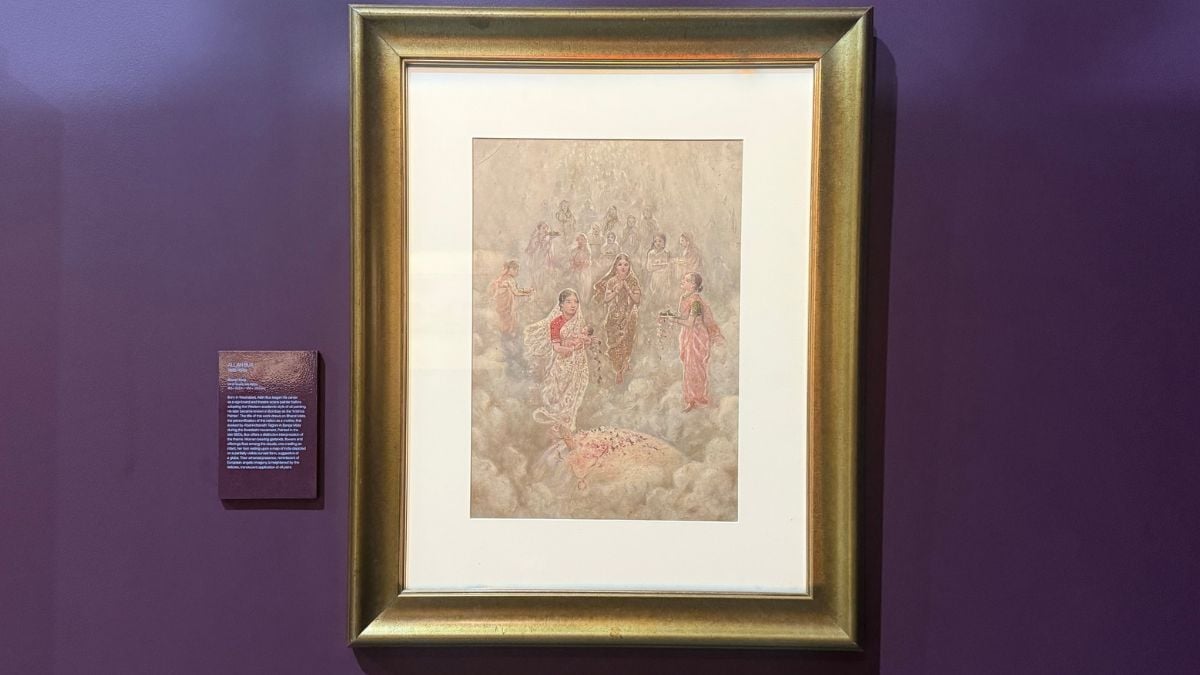
Allah Bux’s Bharat Mata, painted in the late 1920s, takes the dialogue further. Women float among clouds carrying garlands, flowers, and offerings. One cradles a child, with her foot resting on a map of India. The scene has an almost religious reverence to it, while the figures themselves are reminiscent of angels in European paintings. Bux, who began his career painting signboards and theatre sets, went on to adopt the Western academic style of oil painting.
Other Indian artists were being trained in European academic techniques, particularly at institutions such as Bombay’s Sir J. J. School of Art. Two charcoal portraits by M. V. Dhurandhar from 1895, made during his years at the school, were strikingly detailed. One captures the texture of a woman’s skin, the other the scars on a man’s forehead.
L. Haldankar, who studied in the same school, painted his Portrait of a Parsi Woman in 1945. The woman’s face is carefully rendered, with a sari draped over her head and a string of pearls around her neck.
From realism to abstraction
Jogen Chowdhury’s Tulip (1984) marks a sharp break from realism. Three dark, drooping blooms rise from a thick stem, their outlines drawn in orange against an ochre background. Chowdhury, who trained in Calcutta and later Paris, stretches and distorts the forms rather than rendering them realistically.
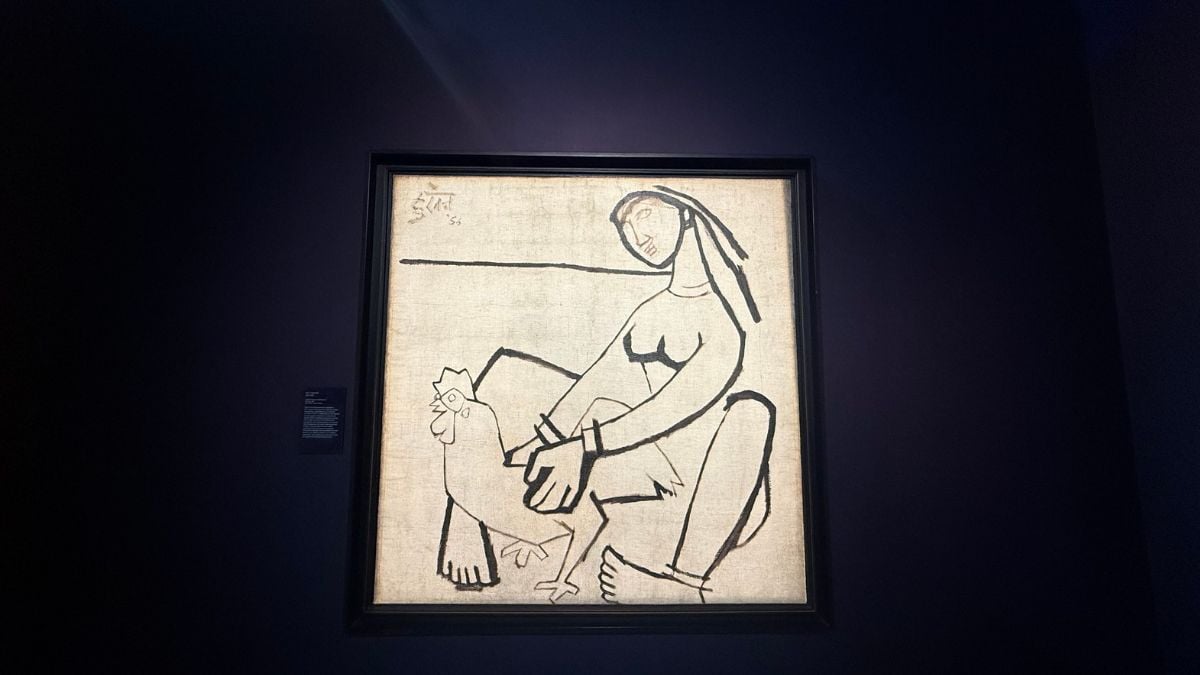
F. Husain’s Woman with Rooster (1956) uses bold black outlines to depict a woman and a bird, painted in oil on jute. It is a long way from the carefully shaded portraits of Dhurandhar. S. H. Raza’s Untitled from 1958 is an abstraction with deep blue above, yellow ochre below, and a cluster of shapes between them. To its right, Avinash Chandra’s City, also from 1958, is full of blues, yellows, and greens, broken up by black lines.
Shanti Dave takes the experiment from form to medium. His large Untitled canvas from 1970 uses encaustic, a technique that mixes pigment with hot beeswax to create a textured surface. Against a grey-green background are shapes that look like broken stone tablets, covered in markings resembling an ancient script. It is almost like looking at pieces of the Rosetta Stone, except there is nothing to decipher.
“He grew up in a village in Gujarat where he was surrounded by temple ruins and architectural ruins, and somehow that seeps into his mind,” Sharma said.
DAG is also showing Amit Ambalal at an art fair for the first time. His Untitled (1986) depicts two men in white, seemingly deep in conversation, against pink earth, green palms and a church-like building. The bright colours and exaggerated figures bring a sense of “gentle humour and absurdity” to an otherwise ordinary scene.
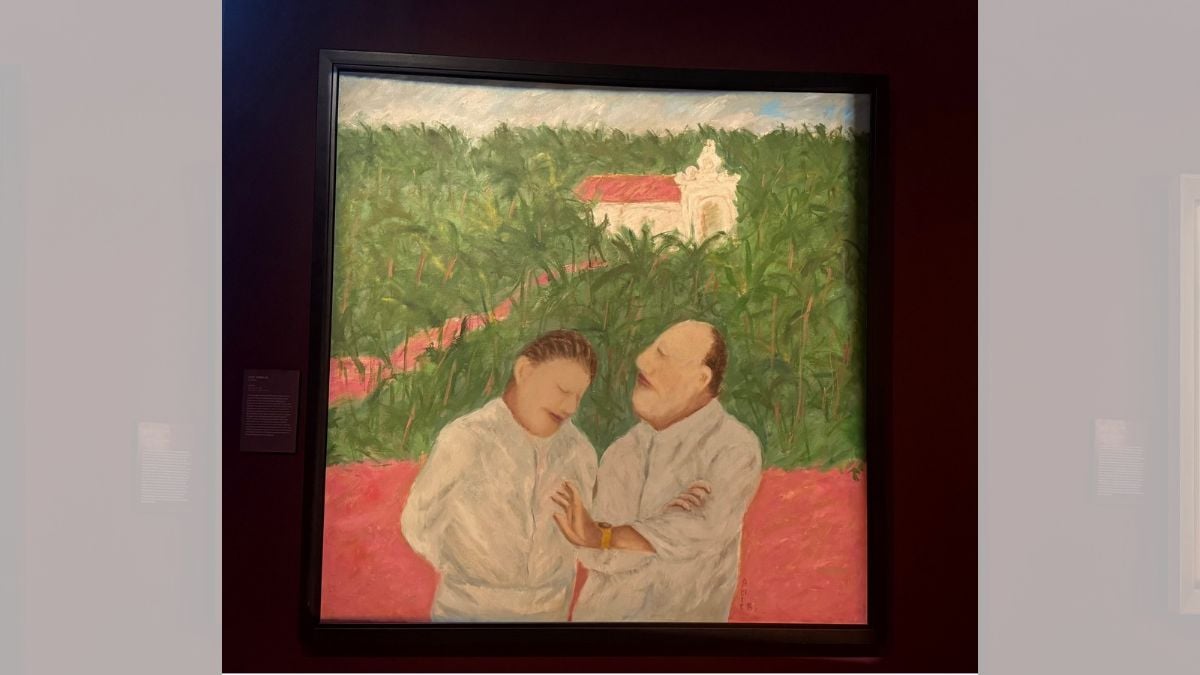
The paintings span three centuries, and the influences are as varied as the artists themselves.
“You have to have your big names, but it’s also introducing other artists who are perhaps lesser known, and trying to build a market for those also,” Sharma said.
(Edited by Maryam Hassan)