







New Delhi: Almost a month after its launch, bribes.fyi, a public library of corruption data, has gone offline “voluntarily”.
Over the past two days, the website’s “We will be back shortly” announcement has gone viral online.
Angel investor, Aniruddha Malpani, founder of Malpani Ventures, told ThePrint that he is not “sure” why it happened. Malpani, who supports citizen tech initiatives, also gave a grant of Rs 30,000 to the website’s founder Aryan Nishad, a B.Tech student at Maharaja Agrasen Institute of Technology.
“Nishad released the website in good faith, but they have to ensure they comply with the requirements of the Prevention of Corruption Act”, said Malpani.
“The young generation is fearless, who are tech-enabled, who are digital natives, who are fearless, who will say, how can I build on this? How can I make it?. They can bring change,” Malpani added. He has also given grants to Empowered Indian, Indian potholes, People v/s Corruption and Zen Citizen.
“The purpose of a grant is to catalyse activity. Take the money. It’s non-dilutive. You don’t have to give it back, anything else. We just want to kick-start the process. And that is exactly what happened with bribes.fyi”, he said.
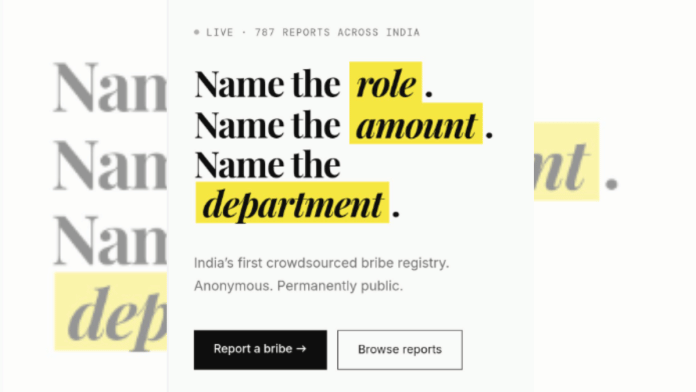
Created by engineering student Aryan Nishad, bribes.fyi allowed Indians to anonymously report instances where they were allegedly forced to pay money to a government officer to get work done.
Shortly after its launch on 2 July, Nishad posted on LinkedIn that visitors to the website have been steadily increasing.
“260 visitors so far, mostly from sharing it across a few developer communities. What’s meant more: real reports are coming in, and some sharp technical feedback (spam prevention, privacy edge cases) that’s already made the product better. Still figuring out where this actually goes long-term. But grateful for everyone who’s taken a minute to contribute, criticise, or ask a hard question”, he wrote.
“The point is that digital artefacts create a life of their own. And this is very different from what it was 10 years ago, is my point. People are seeing the impact, people are saying, hey, I can make a difference. I think that is empowering,” Malpani said reflecting on the website’s impact.
‘Need lawyer or CA’
However, on 18 August, Nishad and his colleague, Manish Sahani, announced in another LinkedIn post that they are working to create a “robust legal and financial infrastructure” for the website.
“Pausing new submissions and support for now. Back soon”, wrote Sahani.
Replying to the post, Nishad called for a lawyer or a chartered accountant with experience in Indian tech. He asked if someone was “willing” to help out.
Meanwhile, the website updated its status to: “This is a voluntary, precautionary step, not a response to any complaint.”
It further explained that the measure was being taken for a “steady and sustainable separation”. Bribes.fyi said that it did not want to become another viral moment.
The website has since received more than five million requests and over two lakh new users in the last 48 hours.”
How to report a bribe
To register a report on the platform, a user has to take out roughly a minute; bribes.fyi asks for basic information about the incident, the department involved, the city and the amount requested.
When the website was live, most of the reports received were from Karnataka, with 135 complaints, followed by Maharashtra and Uttar Pradesh.
Users can also indicate if the bribe was eventually paid or refused. Once all the details are submitted, the information will be made public.
The highest bribe recorded on the website was reported from Jammu and Kashmir, with most users paying more than Rs 19,000 and a zero per cent refusal rate.
Complaints related to the police were the highest, with 336 reports, followed by RTO (89), Revenue and Land Records (69), passport office (43), and municipal corporations (29).
(Edited by Insha Jalil Waziri)