







New Delhi: D-Propulse, an Indian deep-tech company has completed a test run of a rotating detonation engine at the Defence Research and Development Laboratory in Hyderabad last week. The firm joins a handful of global companies working on this niche technology.
Hailing it as a “revolutionary” next-generation propulsion system, D-Propulse said these engines would change both civil and military aviation systems, including rockets and crude missiles, in the coming years. It was the first time in India that an air-breathing rotating detonation engine (RDE) of this scale was tested.
“RDE is a general-purpose technology, no less important than artificial intelligence or electricity – it will be everywhere,” said Saurav Jha, co-founder and CEO of D-Propulse, in an exclusive interview to ThePrint. “It’s no longer as nascent as people think; most global power centres, now including India, are working on it.”
A rotating detonation engine (RDE) is a type of propulsion system that differs from conventional gas turbines and ramjets in the way it uses fuel. Usually, engines use deflagration, which is a subsonic, steady way of burning fuel through a flame. On the contrary, an RDE uses detonation, wherein the fuel burns faster as rapid supersonic explosions rotate through the chamber of the engine.
This rapid detonation produces more thrust for the same amount of fuel. Given the composition of the engine, it is also estimated by D-Propulse to be cheaper than ramjets and conventional jet engines.
A major step in cracking RDE tech
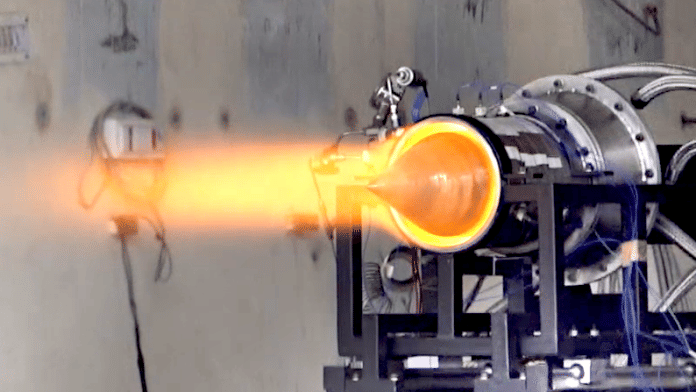
On July 22, Jha posted a 20-second video on X showcasing their latest test at the DRDL facility in Hyderabad. It was the company’s 5-kilonewton air-breathing RDE, integrated with an aerospike nozzle, which Jha said is the proof motor for a flight-capable design.
The grainy footage showed a stainless steel cylinder with a nozzle sticking out; in the last five seconds, it let out a loud noise and a bright, sharply defined plume of fire, proof of the test’s success.
Thought I'll give you guys a sneak peek. Here's a video of one of the short duration runs conducted by @dpropulse with its air-breathing rotating detonation prototype at a government facility during July 21-22, 2026. 5 kN burn with reduced air mass flow and reduced fuel flow as… pic.twitter.com/wx6da8LWZ5
— Saurav Jha (@SJha1618) July 23, 2026
These five seconds told D-Propulse’s team all they needed to know about their engine prototype. They had achieved Technology Readiness Level (TRL) 5.
“The test actually went better than we expected. The screech of the engine, the flame, it was all perfect. But, more importantly, we generated 5,000 kN of thrust with reduced air flow, which means it could go higher with normal air flow,” said Jha.
If RDEs are scaled up to commercial levels, they could generate more useful propulsive energy from the same amount of fuel. This translates to longer range, higher payloads and higher speeds in a package of the same size. For defence and aerospace applications, where every kilogram of weight and every unit of fuel matters, even incremental improvements in propulsion can have significant consequences.
“India needs supersonic munitions en masse, and legacy aero propulsion systems will not give you that. RDEs are going to solve that,” Jha told ThePrint.
Jha’s one-year-old company is running with the idea that RDEs, which are still in the laboratory and testing stage in most countries, are going to be the future of defence and even civilian propulsion.
The July 22 test was a major step towards building a stack of RDE applications, which can be used in cruise missiles, in rockets, and even as a replacement for commercial gas turbines.
How D-Propulse came to be
The origin story of D-Propulse lies in Operation Sindoor, when Jha noticed how significant India’s supersonic strike capabilities were during the brief conflict with Pakistan.
D-Propulse was launched in July 2025 as an IIT-Madras-incubated startup, headed by Jha, who is a former defence analyst. He is the founder of Delhi Defence Review, a think tank that focuses on defence and military policy.Dr V Ramanujachari, a retired scientist and scramjet engine expert from the Defence Research and Development Organisation (DRDO), co-founded D-Propulse with Jha and is now the firm’s Chief Technology Officer.
In June 2026, the company announced that Dr V K Saraswat, former chairman of DRDO and former member of NITI Aayog, has joined them as Chairman of the Board.
“D-Propulse is working on providing affordable RDE-powered mass munitions and drones, which will be indigenously made in India,” said Jha. “In 6-7 years, we plan to build supersonic drones using RDEs.”
RDEs will be more fuel efficient and provide the same speed as ramjets currently do in cruise missiles. As Jha explained, they would also be cheaper to construct at scale, because unlike deflagration engines that require complex turbine blades, shaft bearings, and other moving parts, RDEs are functionally just a static piece of metal.
According to D-Propulse’s latest calculations, their systems cost 60% less than ramjets currently. They are also be 96% indigenously made. However, these calculations are based on theoretical figures, as of now.
While the DRDL test was a good sign, D-Propulse is still at a nascent stage in terms of technological capabilities, and will take until 2029 to develop an actual RDE-powered munition for testing. The problem isn’t specific to D-Propulse or India. RDEs are notoriously difficult to crack, with efforts ongoing in the biggest aerospace companies in the world, including Raytheon, NASA, GE Aerospace and Lockheed Martin.
RDE research ecosystem
Experts consider D-Propulse’s recent test as a good step in India’s growth towards next-generation propulsion technologies.
“RDEs are novel; they are tomorrow’s technology, just like cryogenic engines, and D-Propulse’s work shows that India has the potential to develop it,” said Lt General PR Shanker, former DG Artillery, Indian Army, and currently professor at the Aerospace Department at IIT Madras. “To continue the momentum, we need a National Propulsion Centre developed by the government, so academics can come together, and startups can get support to continue this research and harness it.”
Some global organisations like the Łukasiewicz Institute of Aviation in Poland have been conducting RDE research for over a decade, and have conducted multiple test flights to demonstrate their propulsion capabilities for rockets and turbines. Others like Raytheon are working with the United States’ Air Force Research Laboratory to develop RDEs for military use.
In India, apart from D-Propulse, the RDE research ecosystem is nascent. IIT Kanpur, supported by DRDO and ISRO, launched a Detonation Tube Research Facility, which plans to focus on RDE technology. However, two years after their launch, they are yet to announce significant testing plans.
D-Propulse, on the other hand, has rapidly advanced its development and testing, reaching TRL-5 only a year after their launch. By December 2027, the company plans to reach TRL-7 by demonstrating an RDE-powered sustainer flight. By December 2029, they want to offer their RDE-powered munitions for user trials to the Indian military.
(Edited by Aakriti Handa)
You have indicated that this could be used to power a “Crude Missiile” and this is wrong. It should probably be “Cruise Missile”. Please correct it.