


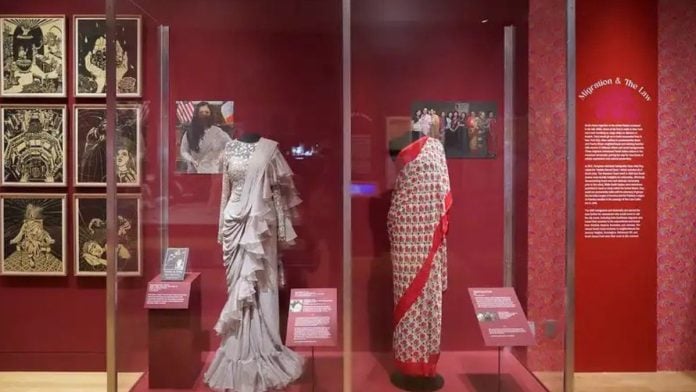
New Delhi: New York City Hall, a building that represents the political life of one of the world’s most diverse cities, is displaying the sari, a garment deeply rooted in South Asian culture and identity.
The exhibition, installed on 21 October, explores the sari’s place in New York’s cultural history through stories of migration, identity, and the achievements of women. Titled The New York Sari, it was brought to City Hall through a collaboration between Council Member Shekar Krishnan and Mayor Zohran Mamdani.
It will remain on display until 1 December. The display includes saris belonging to Mira Nair, Mamdani’s mother; Dr Lalitha Krishnan, Shekar Krishnan’s mother; and Council Member Shahana Hanif.
The idea for The New York Sari was first developed by Krishnan and S Mitra Kalita, co-founder of the community news organisation Epicentre NYC, in collaboration with The New York Historical. The exhibition was originally displayed at the museum from 12 September, 2025, to 26 April, 2026. It was curated by Salonee Bhaman and Anna Danziger Halperin, director of the Centre for Women’s History.
The exhibition also seeks to bring greater attention to the contributions of South Asian women to New York’s history.
“My mother often says, ‘If we don’t tell our own stories, no one else will’. Wherever we are telling the story of New York City, we must be telling the stories of the South Asian women who helped build it, and with this new exhibit, we are bringing those stories to City Hall,” said Mamdani.
The stories woven into each sari
For many Indian women, a sari is more than an item of clothing. It can hold memories of home, family occasions, migration and milestones that have shaped their lives. The exhibition brings these personal histories into focus through garments worn by their owners at significant moments in their lives.
One of the most significant pieces belongs to Dr Lalitha Krishnan. She wore the sari when she travelled from Kerala to New York in search of work after completing her PhD. Years later, she wore it again when she received an award in 1991 for her work in developing a drug used to combat multi-drug-resistant infections.
Her achievement came in a field where women, particularly women of colour, often struggled to receive the recognition given to their male colleagues. Her son, Shekar Krishnan, has said the sari helped her make a statement at an award ceremony where she stood out among people dressed in suits and evening gowns.
The council member said the exhibition was particularly meaningful because it gave his mother’s contribution a place in the city’s public history.
“I wanted to make sure those stories were told,” Krishnan said.
Mamdani’s mother, Mira Nair, is also represented through a sari in the exhibition. An internationally acclaimed filmmaker, Nair has explored migration, gender and diasporic identities in films such as Mississippi Masala (1991) and Monsoon Wedding (2001).
The exhibition also features a sari worn by Shahana Hanif, New York City’s first Bangladeshi and Muslim woman elected to the City Council, during her swearing-in ceremony in 2021.
Also read: New York mayor Zohran Mamdani hands out water, high-fives runners at city marathon
A longer history of the sari in New York
Rather than looking at the sari only as traditional clothing, the exhibition uses it to trace the history of South Asian communities in New York, from early migration and trade to the neighbourhoods and cultural movements that define the city today.
The display brings together historical photographs, textiles and artwork. It also looks at how the sari has come to represent cultural identity, creativity and resistance across generations and communities.
The sari’s history in New York stretches back further than the more recent waves of South Asian migration. The exhibition traces connections to the city’s past, including the appearance of South Asian performers at Coney Island in the late 19th and early 20th centuries. It also examines the role of women in the Indian independence movement and the garment’s changing place in the lives of immigrant communities.
“I hope that people come away from this exhibition with a curiosity to learn more about how and why the things they love in this city–be it a beautiful and colourful fabric or a funky groove, or a tasty and transcendent meal–got to where they are and then follow that curiosity to learn more about the people that brought that thing, or food, or colour palette into their lives,” said co-curator Salonee Bhaman.
For Kalita, bringing the exhibition to City Hall is especially significant because the saris connect the city’s political milestones with the women whose contributions helped make them possible.
“The sari connects diaspora communities around the world. Those threads are woven into New York and now into City Hall,” she said.
(Edited by Maryam Hassan)